Pre Revenue Founders: Match to Lenders With One Soft Credit Pull


Pre-revenue startups can get funded, and the paths that actually work are narrower than most founders assume: SBA microloans, CDFIs, equipment financing, non-dilutive grants like SBIR/STTR, and select crowdfunding or Kiva-style micro-loans. Merchant cash advances and unsecured lines of credit exist too, but they cost more and lean hardest on personal credit. The rest of this guide breaks down eligibility, the exact application checklist, alternatives to debt, and where a brokerage saves you weeks of dead-end applications.
TL;DR:
SBA microloans and CDFI funding prioritize character, community ties, and collateral over sales, making them accessible for pre-revenue startups.
Equipment financing relies on asset value rather than revenue, which is ideal for asset-heavy businesses without income history.
Non-debt options like SBIR/STTR grants and Kiva-style micro-loans offer non-repayable or low-interest capital suitable for tech and validation phases.
Founder experience, personal credit, demand validation, and collateral are critical signals that lenders assess when revenue is absent.
Applying through a brokerage reduces multiple credit pulls and narrows options to lenders that accept early-stage, pre-revenue applicants, saving time and hassle.
Table of Contents
Funding Options That Work for Startups With No Revenue
Every lender and program that will talk to a pre-revenue company is substituting something else for the sales history it doesn’t have: collateral, a co-signer, a federal research mandate, or the goodwill of a nonprofit mission lender. Knowing which substitute each program accepts tells you where to spend your time.
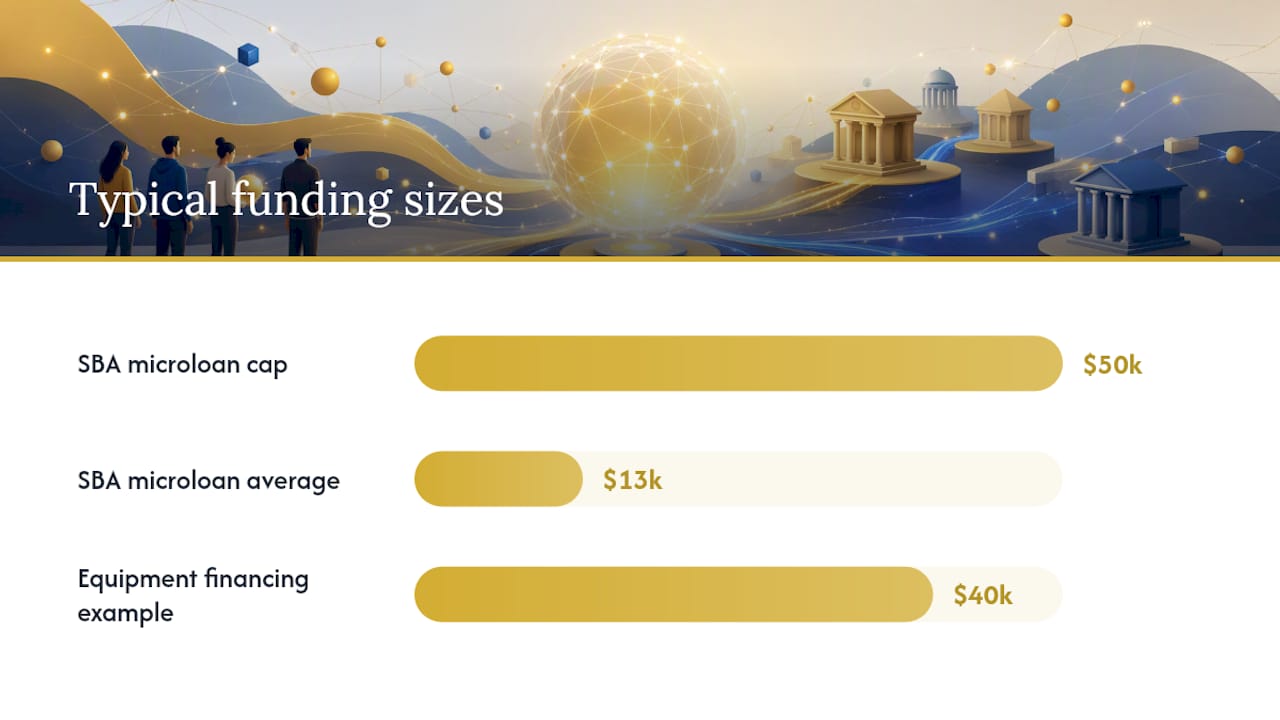
SBA microloans run through nonprofit intermediaries rather than banks, cap out at $50,000, and average close to $13,000 per loan. You can’t use the money to pay off existing debt or buy real estate, and the intermediary, not the SBA, sets the actual rate and term. The upside is that many intermediaries bundle the loan with business coaching, which sounds like a formality until you realize most microloan lenders build technical assistance into the approval process, improving your odds of both getting funded and surviving the first year.
CDFIs (community development financial institutions) underwrite on character as much as numbers. A CDFI loan officer wants to see your track record, your ties to the community you’re serving, and a plan that makes sense, not three years of tax returns you don’t have. This character-based approach is part of why CDFIs are considered more accessible to underrepresented founders who get filtered out by conventional bank scoring models.
Equipment financing sidesteps the revenue question almost entirely, because the equipment itself is the collateral. A lender financing a $40,000 espresso setup or a fleet of delivery vans cares more about the resale value of that asset than your bank statements, which is why equipment loans are approved primarily on collateral value rather than trailing revenue.
Business lines of credit and business credit cards are the wild card. Some lenders will extend a small line based almost entirely on your personal credit score and personal income, especially if you’re willing to guarantee it. Others won’t touch a business with zero operating history no matter how clean your personal file looks. Worth exploring, but don’t count on it as your primary route.
Invoice financing and factoring need actual invoices to advance against, so by definition they only help once you’ve made your first sale, even one. If you’re truly pre-revenue, cross this one-off until you land your first paying client.
Merchant cash advances and other alternative lenders move fast, sometimes funding within 48 hours, but they trade speed for cost. Daily or weekly debits against a bank account can crush a startup that hasn’t stabilized its cash flow yet.
SBIR/STTR grants (America’s Seed Fund) hand out non-dilutive federal money to tech-focused startups, no repayment, no equity given up, which makes them the best-kept secret in early-stage financing for the right kind of company.
Crowdfunding and Kiva-style micro-loans round out the list. Kiva-style platforms offer small, often zero-interest loans up to roughly $15,000, useful for validating an idea or covering a first inventory run without touching your personal credit at all.
SBA microloans: up to $50,000, average around $13,000, no real estate or debt refinancing
CDFIs: character-based underwriting, often paired with mentoring
Equipment financing: approval tied to asset value, not sales history
Lines of credit/business cards: personal credit dependent, inconsistent availability pre-revenue
Invoice factoring: requires existing invoices, not viable pre-revenue
MCA/alternative lenders: fast funding, high effective cost, daily/weekly payments
SBIR/STTR: non-dilutive, tech-focused, no repayment
Kiva-style crowdfunding: small amounts, often 0% interest, good for validation
If you’re staring down a 60 to 120 day SBA processing window and need to know which of these actually fits your timeline, matching funding type to startup stage is worth reading before you apply anywhere.
What Do Lenders Look for When You Have No Revenue?
Every lender still needs to answer one question: will this business pay me back? Without revenue to point to, lenders reconstruct that confidence from five other signals, and personal credit, founder experience, collateral, and demand validation carry the weight that a P&L statement normally would.
Personal credit score and financial documentation. Lenders will pull personal credit and often ask for personal bank statements, tax returns, and a completed SBA Form 413 personal financial statement if you’re pursuing an SBA-adjacent product. A strong personal score doesn’t guarantee approval, but a weak one closes doors fast.
Founder experience and character. CDFIs and microloan intermediaries weigh your background heavily, industry experience, prior small business ownership, even community involvement. This is subjective by design, and it’s why a well-written narrative in your application matters more here than almost anywhere else.
Collateral. Equipment, vehicles, real estate, and sometimes inventory can substitute directly for revenue history. The lender isn’t betting on your sales forecast; they’re betting they can recover the asset if things go wrong.
Demand validation. Letters of intent, signed pre-orders, pilot contracts, and waitlist numbers are the closest thing a pre-revenue company has to sales data. A single signed LOI from a credible buyer can move an application from “no” to “let’s talk.”
Projections and debt service coverage. Lenders want to see that your projected cash flow, not your current cash flow, can service the debt. A common target is a debt service coverage ratio (DSCR) of around 1.25x, meaning your projected income covers loan payments with 25% to spare.
Pro Tip: Build three cash flow scenarios, best case, expected case, and a deliberately conservative downside, and lead with the downside when you talk to a lender. It signals you’ve stress-tested the plan instead of just being optimistic about it.
Different lender types weight these signals differently. CDFIs lean on character and community fit. Equipment lenders lean almost entirely on collateral value. SBA microloan intermediaries blend personal credit with your business plan and, often, whether you’ve completed their required coaching hours.
How to Prepare and Apply for Startup Funding Without Revenue
Getting funded without a sales track record comes down to sequencing. Apply before your paperwork is ready and you’ll get a fast rejection that also burns a hard inquiry on your credit report. Get the sequence right and you’re applying only to lenders who are realistically going to say yes.
Lock down your legal structure. Get your EIN, form your LLC or corporation, and open a dedicated business bank account. No lender will take you seriously without separation between personal and business finances.
Write a concise business plan with 24-month projections. Build it month by month, not just annually, and include your DSCR calculation and a downside scenario. Lenders read projections for realism, not optimism.
Gather your documents before you apply. That means two to three years of personal tax returns, recent personal and business bank statements, a personal financial statement (SBA Form 413 for SBA products), and your formation documents.
Decide your collateral and guarantee position. Know in advance what you’re willing to pledge, equipment, a vehicle, savings, and whether you’ll need a co-signer with stronger credit than yours.
Match your strongest signal to the right lender type. Strong personal credit and clean liquidity points you toward SBA microloans or a business line of credit. A hard asset to finance points you toward equipment lenders. Strong technical differentiation points you toward SBIR/STTR.
Compare offers on total cost, not just the rate. Look at origination fees, prepayment penalties, and repayment cadence side by side. A 9% loan with monthly payments can be far cheaper in practice than an 18% advance with daily debits.
Expect four to twelve weeks from first outreach to funded, longer for SBA products, faster for equipment financing or a straightforward line of credit.
Documents worth having ready in a single folder before you start:
EIN confirmation letter and entity formation documents
Two to three years of personal tax returns
Personal and business bank statements (last three to six months)
Personal financial statement (SBA Form 413 where required)
24-month financial projections with DSCR calculation
Any signed LOIs, pre-orders, or pilot agreements
Documentation of collateral (titles, equipment invoices, appraisals)
Founders who keep getting turned down by traditional banks often don’t realize how much faster alternative same-day funding routes can move once the paperwork above is actually in order.
Alternatives to Debt: Grants, Equity, and Crowdfunding
Debt isn’t always the right first move, especially when you have a repayment obligation but no revenue stream to meet it. Three non-debt paths deserve a real look before you sign a loan agreement.
SBIR/STTR grants work in phases. Phase I is proof of concept, typically $50,000 to $275,000; Phase II funds technology development, up to roughly $1.8 million; Phase III is commercialization, expected to run without further SBIR/STTR money. If your startup is genuinely R&D heavy, this is the strongest non-dilutive option on the table, and some states run Phase 0 assistance programs that help first-time applicants write a more competitive proposal.
Angel investors and early-stage venture capital will look at pre-revenue companies, but their bar is different from a lender’s. They’re not asking whether you can service a loan; they’re asking whether the market is big enough and the team is strong enough to justify a 10x return down the road. Expect to give up equity, expect real diligence on your total addressable market, and expect them to care far more about traction signals (waitlist size, pilot results, founder background) than about a polished projection spreadsheet.
Crowdfunding splits into two flavors that solve different problems. Rewards-based crowdfunding validates demand and generates cash simultaneously, someone pre-buying your product tells you people want it. Equity crowdfunding raises capital from a large pool of small investors and works well when you have a compelling consumer story but not a huge network of angels.
SBIR/STTR: best for deep-tech or R&D-heavy startups, no equity given up
Angels/accelerators: fastest path to real capital, but dilutive and diligence-heavy
Rewards crowdfunding: validates demand while raising money
Equity crowdfunding: works when the story resonates broadly
Blended approach: pair a small microloan with a grant or a friends-and-family round to hit your next milestone without over-leveraging
A founder’s playbook on raising early-stage capital covers the validation tactics that make crowdfunding and angel conversations go smoother, worth a read if equity is even a maybe for you.
Risks, Costs, and When Not to Borrow Before Revenue
Payment cadence is where pre-revenue borrowers get hurt most. A monthly SBA microloan payment is manageable to plan around; a merchant cash advance debiting your account daily can drain working capital before you’ve even collected on your first invoice. Alternative lenders that require daily or weekly payments often carry effective APRs far above what the advertised factor rate suggests.
Calculate your real cost of capital by adding origination fees, any prepayment penalty, and the cost of rolling the advance over if you can’t pay it off on schedule, not just the headline rate. Borrowing makes sense when the capital funds something that generates revenue fast enough to cover the payment, buying inventory you have a pre-order for, financing equipment tied to a signed contract. It doesn’t make sense to borrow just to extend runway with no plan for what changes.
Pro Tip: Walk away from any offer that hides its fee structure, pushes automatic rollovers, or skips documentation entirely. A lender that doesn’t ask for basic paperwork usually isn’t pricing the risk fairly, they’re pricing it painfully.
How a Brokerage Approach Helps Pre-Revenue Founders
Applying to five lenders individually means five hard credit pulls, five sets of paperwork, and five different rejection letters if you guessed wrong on fit. A brokerage flips that math: one soft credit pull, one application, and a match against lenders who actually work with pre-revenue businesses.
Soft credit pull for pre-qualification, so shopping around doesn’t ding your score
One streamlined document set instead of rebuilding your file for every lender
Matching against multiple independent funding providers based on your specific signals (collateral, credit, projections)
Faster elimination of lenders who were never going to say yes to your stage
Cotifunding works across startup funding, equipment financing, and SBA loan introductions, connecting founders to lenders suited to where they actually are, not where a generic bank application assumes they should be.
To be direct about the model: Cotifunding is a brokerage. It connects businesses with independent funding providers, and does not itself underwrite, approve, or guarantee any loan, rate, or funding outcome. Every approval decision and every term is set by the lender you’re ultimately matched with.
Which Funding Route Should You Actually Pursue First?
If I had to give one piece of advice to a founder with zero revenue and a real business idea, it’s this: chase asset-backed or non-dilutive money before you chase debt with a fixed monthly payment. Equipment financing, SBA microloans, and SBIR grants all let you build toward revenue without betting your personal credit on a forecast that hasn’t been tested yet. Save short-term debt, lines of credit, MCAs, for capital that directly produces revenue fast, like inventory tied to a signed order.
Before you apply anywhere, run this checklist: do you actually need the capital now, do you have enough runway to survive a slow approval, and do you have a repayment plan that survives your downside scenario, not your best case? If you can’t answer all three cleanly, spend another month on projections and get one piece of demand proof, an LOI, a pre-order, a pilot agreement, before you fill out a single application.
— Eduardo
Compare Your Funding Options Before You Apply Anywhere
Cotifunding exists for exactly the moment you’re in right now: no revenue yet, a real plan, and no idea which lender is actually going to say yes. Instead of submitting five separate applications and taking five hard credit hits, you get pre-qualified with a soft pull and matched against independent funding providers who work with businesses at your stage.
The platform helps founders explore startup funding, equipment financing, and business line of credit options without wasting weeks guessing which lender fits. If you’re financing a vehicle, machinery, or a specialized setup, the equipment financing options for asset-heavy businesses walk through what approval actually looks like when the asset itself does most of the work. Start with a free pre-qualification, see what you actually match to, and decide from there. No obligation, no wasted applications on lenders who were never going to say yes.
Where to Verify the Details
SBA microloan program overview for current loan limits and intermediary lender listings
SBA Lender Match and loan programs for official eligibility rules
Sbir for current solicitation deadlines and award ranges by agency
NerdWallet’s guide to business loans with no money for a consumer-facing breakdown of collateral and guarantee requirements
This article is general information, not a substitute for advice from a qualified financial advisor. Consult a qualified financial professional about your own circumstances before acting on anything here.
Sources
FAQ
How Can I Get Startup Funding With No Money of My Own?
Focus on options that don’t require large personal capital upfront: SBA microloans, CDFI loans, equipment financing tied to the asset itself, and non-dilutive SBIR/STTR grants if your business is technology-focused. A brokerage pre-qualification can also show you which lenders are realistically open to your situation before you commit personal savings to fees or deposits.
Is It True That 90% of Startups Fail?
Failure statistics vary widely by industry, funding stage, and how “failure” is defined, so there isn’t one universally agreed figure. What matters more for funding purposes is that lenders and grant programs price that uncertainty into their underwriting, which is exactly why demand validation like signed LOIs and pilot contracts carries so much weight in a pre-revenue application.
What Would the Payment Be on a $1,000,000 Business Loan?
The payment depends entirely on the interest rate, term length, and repayment structure, so there’s no single answer that applies across lenders. A pre-revenue startup is also unlikely to qualify for a loan of that size without substantial collateral or a co-signer, since most pre-revenue-friendly programs like SBA microloans cap out at $50,000.
How Do You Value a Startup Company With No Revenue?
Without revenue, valuation typically relies on comparable early-stage deals, the strength of the team, market size, and traction signals like a working prototype, pilot users, or signed LOIs rather than financial multiples. This is more relevant to equity fundraising than to debt financing, since lenders care about repayment capacity, not valuation.
Can I Get an SBA Loan With No Business Revenue?
Yes, SBA microloans are one of the more accessible SBA products for pre-revenue businesses, since intermediary lenders weigh personal credit, your business plan, and sometimes collateral more heavily than sales history. Larger SBA 7(a) loans are harder to secure without revenue and usually require stronger collateral or a cosigner.
Recommended
Disclosure: Coti Funding is not a direct lender. We connect businesses with independent third-party lenders and financing providers. Financing products, rates, terms, funding amounts, approval requirements, and funding timelines vary by provider and applicant qualifications and are not guaranteed. Any rates, terms, examples, or scenarios presented in this article are for general informational and educational purposes only and may not reflect actual offers available to a particular business. Submission of information or an application does not guarantee approval or funding. This content does not constitute financial, legal, tax, or investment advice.
Comments