Business Loan Terms: What Small Business Owners Should Know


Business loan terms are the contractual conditions that govern how you borrow and repay money — covering repayment length, payment frequency, interest calculation method, fees, and collateral or guarantee requirements. For U.S. small businesses, those terms span a wide range depending on the product:
Invoice financing and short-term online loans: a few weeks to under one year
Lines of credit: revolving draw periods, commonly lasting a year or two per cycle
SBA microloans: generally up to seven years.
Term loans and equipment financing: varying repayment terms typically ranging from a year up to a decade
SBA 7(a) working capital and equipment: up to 10 years
SBA real estate loans: up to 25 years
Exact terms shift significantly based on loan product, your business profile, and the lender’s underwriting criteria. The sections below break each factor down so you can read any offer with confidence.
Table of Contents
How loan term length varies by product type
The table below maps each major loan type to its realistic repayment window, payment structure, and primary use case. Use it as a quick-reference before diving into any offer.
Loan Type | Typical Term | Repayment Structure | Best Use Case |
SBA 7(a) — working capital | Up to 10 years | Fixed monthly, amortized | Operations, hiring, inventory |
SBA 7(a) — real estate | Up to 25 years | Fixed monthly, amortized | Commercial property purchase |
SBA 504 | 10 or 20 years | Fixed monthly, amortized | Major fixed assets, real estate |
SBA microloan | Up to 7 years | Fixed monthly | Startups, very small businesses |
Bank/conventional term loan | 1–10 years | Fixed or variable monthly | Equipment, expansion |
Business line of credit | 1–2 years (revolving) | Revolving draws, variable | Working capital, cash flow gaps |
Equipment financing | 2–7 years | Fixed monthly | Machinery, vehicles, tech |
Invoice financing | Weeks | Lump sum on invoice payment | Bridging receivables gaps |
Merchant cash advance | 3–12 months | Daily or weekly from sales | Fast cash, high-revenue businesses |
Revenue-based financing | 6–12 months | Weekly, tied to revenue | Variable-revenue businesses |
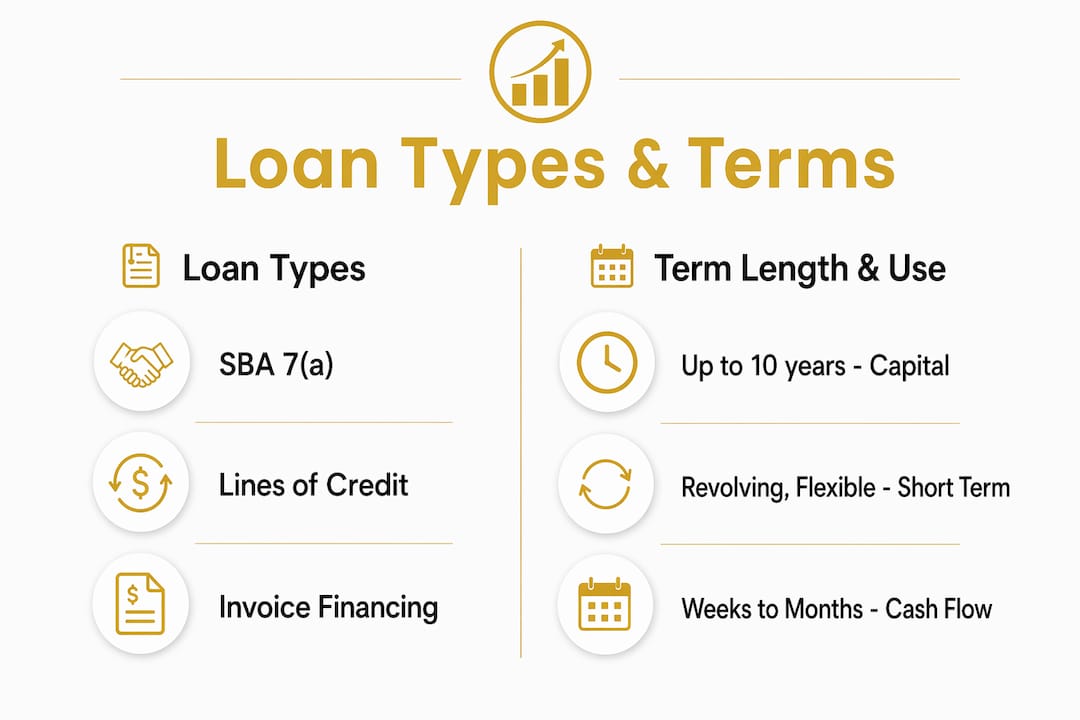
SBA term lengths are tied directly to asset useful life — you cannot get a 25-year term for working capital, and lenders enforce these program rules during underwriting.
A few exceptions worth noting:
Very small SBA microloans (under $5,000) may carry shorter terms than the seven-year maximum
Specialty USDA or state-backed programs sometimes offer terms outside these ranges
A lender’s internal credit policy can shorten any term even when the program allows more
Short-term products like invoice financing typically run a few weeks to a few months, while lines of credit operate on revolving draw periods that reset annually or biannually.
How term length changes your monthly payment and total interest
Longer terms lower your monthly payment but raise the total interest you pay over the life of the loan. Shorter terms do the opposite: higher monthly obligations, but you exit the debt faster and cheaper overall.

The tradeoff is straightforward in principle but easy to underestimate in practice. A shorter term on a loan produces a meaningfully higher monthly payment than a longer term at the same rate — but the longer version can cost significantly more in cumulative interest. Choosing the shortest feasible term generally reduces total interest cost, provided the monthly payment stays within what your cash flow can absorb.
The break-even question to ask yourself: can your business comfortably cover the higher payment of a shorter term without cutting into operating reserves? If the answer is yes, the shorter term almost always wins on total cost. If the answer is no, a longer term preserves liquidity — but you should model the full interest cost before accepting it. Businesses with seasonal revenue often prefer longer terms for the breathing room, then make extra principal payments during peak months when cash allows.
How interest accrual and repayment structure affect what you actually pay
The method used to calculate interest changes your total cost and your cash-flow timing, sometimes dramatically. Three structures dominate small business financing: amortized loans, simple-interest loans, and factor-rate products.

Amortized loans spread payments evenly across the term, but the interest/principal split shifts over time. Early payments are weighted heavily toward interest; later payments go mostly toward principal. Each payment reduces the outstanding balance, which in turn reduces the interest owed on the next cycle. This is the standard structure for SBA loans, conventional term loans, and most equipment financing.
Simple-interest loans calculate interest on the original principal and keep that interest amount constant across payments — unless you pay down principal early. Simple interest loans carry the same interest amount each period, which makes budgeting predictable but means early payoff saves less than borrowers often expect. They are common in short-term online lending.
Factor-rate products — used in merchant cash advances and some revenue-based financing — skip interest entirely and multiply the borrowed amount by a decimal factor. Factor rates commonly range between 1.1 and 1.5, meaning a $50,000 advance at a 1.3 factor costs $65,000 total regardless of how quickly you repay. There is no interest-rate reduction for early payoff in a standard factor-rate deal.
Payment frequency compounds these differences. Amortized term loans collect monthly. Revenue-based financing and merchant cash advances pull daily or weekly from your bank account or card processor, tied to a holdback percentage of sales — typically 10%–20%. Those frequent automated draws can strain daily cash flow in slow weeks, so model them into your projections before signing.
Pro Tip: Before signing any financing agreement, ask the lender for a full amortization schedule (for term loans) or the exact factor-rate math and repayment frequency (for MCAs and revenue-based products). If they hesitate to provide either, treat that as a red flag.
Hypothetical Example — amortization schedule snapshot (first vs. last payment): On a $100,000 loan at 7% APR over 5 years (60 monthly payments of approximately $1,980):
Payment 1: ~$583 to interest, ~$1,397 to principal
Payment 60: ~$14 to interest, ~$1,966 to principal
The total payment stays the same; what changes is how much of it retires the debt.
Contract clauses that change your real cost and risk
These contract terms determine your legal and financial exposure. Read every one before signing.
Loan maturity date: The legal deadline for full repayment. Lenders treat it as firm. Negotiating a maturity date that aligns with your projected cash flow reduces default risk — an aggressive maturity on a slow-growth business is a setup for trouble.
Prepayment penalty: A fee charged if you pay off the loan early. Some SBA loans penalize prepayments of 25% or more in the first three years. Always ask for the prepayment formula in writing — some use tiered thresholds that trigger only above a certain payoff percentage.
Balloon payment: A large lump-sum payment due at the end of a loan term, after smaller periodic payments. Common in commercial real estate and some bridge loans. If you cannot refinance or sell the asset before the balloon comes due, you face a cash crisis.
Origination and servicing fees: Charged upfront or rolled into the principal. A 3% origination fee on a $200,000 loan adds $6,000 to your cost before you make a single payment. Always ask whether fees are deducted from proceeds or added to the balance.
Collateral pledge: An asset (real estate, equipment, receivables) the lender can seize if you default. Collateral requirements directly affect which term lengths and rates are available to you — secured loans generally get longer terms and lower rates.
Personal guarantee: A clause making you personally liable for the debt if the business cannot pay. Most SBA loans and many conventional loans require one. Understand what assets are exposed before you sign.
Financial covenants: Ongoing performance requirements, such as maintaining a minimum debt-service coverage ratio (DSCR) or liquidity threshold. Breaching a covenant can trigger technical default even if you are current on payments.
Red flags to watch for: origination fees rolled silently into principal without disclosure, vague covenant triggers with no defined cure period, automatic renewal clauses that extend your term without explicit consent, and daily withdrawal amounts that exceed what your cash flow can sustain.
One practical note on refinancing: prepayment penalties and balloon payment timing directly affect whether you can exit a loan early or roll it into better terms. Map those clauses before you assume refinancing is an option.
What “good” loan terms actually look like for your business
Good loan terms match the purpose of the loan, preserve enough monthly cash flow to keep operations running, and leave room to refinance or grow without penalty. That sounds obvious, but most borrowers focus on the interest rate and miss the other three variables that drive real cost.
Here is a prioritized decision checklist:
Purpose alignment: Short-term working capital needs a short-term product. Buying equipment that lasts seven years warrants a term close to that useful life. Mismatching term to purpose is one of the most common and costly mistakes.
Monthly payment affordability: Run the payment against your average monthly net cash flow. A payment that consumes more than 20%–30% of net cash flow leaves little margin for slow months.
Total cost (APR + all fees): APR is the most useful single comparison number because it folds in fees. Always ask for APR, not just the stated interest rate.
Repayment frequency: Monthly payments are manageable for most businesses. Daily or weekly draws require a tighter cash-flow model.
Collateral and guarantee demands: More collateral usually means better terms, but it also means more personal or business-asset exposure.
Prepayment language: If you expect to pay off early or refinance, a loan with no prepayment penalty is worth a slightly higher rate.
Covenant requirements: Understand what triggers a covenant breach and what the cure period is.
Questions to bring to every lender:
What is the APR, and does it include all fees?
What fees are charged, and are they deducted from proceeds or added to the balance?
Is there a prepayment penalty? If so, what is the formula and threshold?
Can you provide a full amortization schedule?
What collateral is required, and how is it valued?
Is a personal guarantee required?
What financial covenants apply, and what triggers a default?
What is the cure period if I breach a covenant?
What is the funding timeline from application to disbursement?
Can the term be extended or the loan refinanced, and under what conditions?
On timing: shorter-term products are faster to approve but more expensive per dollar borrowed. An SBA loan can take weeks to months; a merchant cash advance can fund in 24–48 hours. Documentation quality — clean financials, tax returns, and a solid revenue history — speeds approval for longer-term, lower-rate products. If SBA timelines concern you, there are ways to accelerate the process worth knowing before you apply.
Worked examples: monthly payments on $50,000 and $1,000,000 loans
All figures below are Hypothetical Examples for illustration only. Actual rates and terms vary by lender, borrower profile, and product. These are not loan offers.
The fixed monthly payment on an amortized loan uses this formula:
PMT = P × [r(1+r)^n] / [(1+r)^n − 1]
Where P = principal, r = monthly interest rate (annual rate ÷ 12), and n = total number of monthly payments.
Hypothetical Example — $50,000 loan at 8% APR:
Hypothetical Example — $1,000,000 loan at 7% APR:
The pattern is consistent: doubling the term on the $1,000,000 example cuts the monthly payment by roughly $8,200 but adds over $205,000 in total interest. That tradeoff is worth quantifying for any loan you are evaluating, not just estimating.
For non-amortized products like merchant cash advances, the formula above does not apply. Refer to the earlier section on factor rates for how to calculate total cost on those structures.
Key Takeaways
Understanding business loan terms means knowing how repayment length, interest method, fees, and contract clauses combine to determine your true cost and risk — not just the monthly payment.
Point | Details |
Term length varies widely by product | SBA real estate loans run up to 25 years; invoice financing may last only weeks. Match the term to the asset or need. |
Longer terms cost more overall | A lower monthly payment on a longer term often means tens of thousands more in total interest paid. |
Interest method changes everything | Amortized, simple-interest, and factor-rate structures each produce different total costs and cash-flow timing. |
Contract clauses carry real risk | Prepayment penalties, balloon payments, personal guarantees, and covenants can change your exposure significantly. |
Cotifunding connects you to options | Through its network of financing partners, Cotifunding helps small businesses compare term structures, fees, and repayment schedules side by side. |
A brokerage perspective on matching terms to your business
Cotifunding connects businesses with financing partners to compare term structures — we do not lend directly. That position gives a clearer view of how different products actually perform for different business profiles, and the pattern that stands out most is this: borrowers who struggle most are almost never the ones who got a bad rate. They are the ones who accepted a term structure that did not fit their cash flow.
A restaurant with lumpy weekend revenue and a merchant cash advance pulling daily is a mismatch. A construction company financing a piece of equipment over two years when the asset will generate revenue for eight is leaving money on the table. The term length and repayment frequency matter as much as the rate.
From a brokerage standpoint, the documentation that most reliably unlocks longer, lower-rate terms is straightforward: two years of business tax returns, recent bank statements showing consistent revenue, and a current profit-and-loss statement. If you have collateral with a recent appraisal, bring that too. Lenders offering 7- to 10-year terms want to see that your business generates predictable cash flow — the paperwork is just evidence of that.
Offers vary by provider and applicant, and no brokerage can guarantee a specific rate or term. What a good brokerage can do is put multiple term structures in front of you at once so you can compare the real numbers, not just the headline rate.
Cotifunding helps you compare loan terms across financing partners
Sorting through repayment structures, fee disclosures, and covenant language across multiple lenders is genuinely time-consuming, and most small business owners are doing it while running a business. Cotifunding’s role is to cut that process down by connecting you with a network of third-party financing partners and helping you see multiple term structures side by side.

Through our network of financing partners, we can help you collect amortization schedules and fee breakdowns, identify which products fit your repayment timeline, and prepare the documentation that tends to qualify businesses for longer, lower-rate terms. We do not set rates, approve loans, or guarantee any specific outcome — all offers come from independent financing providers and vary by applicant. Some partners in our network may use a soft credit pull for pre-qualification, depending on the product.
If you want to see what term structures are realistically available for your business, start a comparison at Cotifunding — the process is straightforward, and you will have real numbers to work with instead of estimates.
Authoritative U.S. sources for further reading
Rate-sensitive figures and SBA program rules change periodically. Re-check APR benchmarks and SBA loan limits at least annually.
SBA.gov — 7(a) Loan Program: Official program rules, term limits, eligible uses, and guarantee fee schedules.
SBA.gov — Main Site: Broader resource for all SBA loan programs, including 504, microloans, and disaster loans.
CFPB: Plain-language explanations of loan agreements, APR calculations, and borrower rights.
Investopedia — Average Business Loan Term: Market-rate commentary and term-length benchmarks by loan category.
Bankrate — How to Calculate Loan Interest: Clear explanations of interest calculation methods and amortization mechanics.
NerdWallet — Small Business Loan Terms: Practical breakdowns of contract terms, prepayment penalties, and what to watch for in agreements.
Shopify — Small Business Loan Terms: Product-by-product term comparisons with use-case guidance for small business owners.
This article is general educational information, not legal or financial advice. Confirm current program rules, rates, and eligibility requirements with the SBA, CFPB, or a qualified financial professional for your specific situation.
Recommended
Disclosure: Coti Funding is not a direct lender. We connect businesses with independent third-party lenders and financing providers. Financing products, rates, terms, funding amounts, approval requirements, and funding timelines vary by provider and applicant qualifications and are not guaranteed. Any rates, terms, examples, or scenarios presented in this article are for general informational and educational purposes only and may not reflect actual offers available to a particular business. Submission of information or an application does not guarantee approval or funding. This content does not constitute financial, legal, tax, or investment advice.
Comments