Expanding a Business With Financing: A Practical Loan Guide


The fastest, most reliable way to fund growth is matching the financing type to the specific use: bank term loans or SBA loans for large, long-lived assets like real estate or major equipment; a business line of credit or invoice factoring for working capital gaps; equipment financing for machinery purchases; and online or alternative lenders when speed matters more than rate. Expanding a business with financing works best when you treat the loan search itself as a comparison exercise, not a scramble.
Here’s the quick mapping:
Real estate or a second location: SBA 504 or bank term loan
Equipment or machinery: Equipment financing, secured by the asset itself
Payroll gaps or seasonal cash flow: Business line of credit or invoice factoring
Fast, short-term needs: Online lenders or merchant cash advances (used sparingly)
Recurring revenue businesses: Revenue-based financing
Pro Tip: Don’t apply to five lenders separately and compare rate sheets by hand. Working with a broker lets you see multiple offers side by side in a fraction of the time, which matters when a good opportunity has a closing date attached to it.
Key Takeaways
Expanding a business with financing works best when the loan type is matched to the specific use, then compared across multiple lenders through a single process rather than one application at a time.
Point | Details |
Match loan to use case | Use SBA or bank loans for real estate and equipment, lines of credit for working capital. |
Check DSCR before applying | Aim for a debt service coverage ratio above 1.2 to meet common lender thresholds. |
Prepare documents early | Gather P&L statements, tax returns, bank statements, and a use-of-funds plan before applying. |
Compare total cost, not just rate | Factor in APR, fees, and prepayment penalties across every offer. |
Use Cotifunding to compare offers | Pre-qualify with a soft credit pull to see multiple lender options within 24 to 72 hours for fast-track products. |
This article is general information, not a substitute for advice from a qualified financial advisor. Consult a qualified financial professional about your own circumstances before acting on anything here.
Table of Contents
Why Expanding a Business With Financing Makes Sense (and When It Doesn’t)
Expansion financing typically covers six uses: a new location, equipment purchases, new hires, inventory buildup, an acquisition, or a marketing push tied to a growth plan. Not every one of those deserves debt, though. The test is straightforward.
Estimate the ROI. If a $50,000 equipment purchase adds $15,000 a year in net profit, you’re looking at a payback period around 3.3 years, which is reasonable against a 5 to 7 year loan term.
Check the payback period against the loan term. Borrowing for an asset that pays back in year six, on a loan due in year three, creates a cash crunch no matter how good the underlying idea is.
Watch for red flags. Weak or untested demand, thin margins that leave no cushion for a slow month, and already-high existing debt loads are the three reasons expansion loans go bad. If any of those apply, fix them before you borrow, not after.
The Main Loan Types for Business Growth Capital
Every financing option trades speed, cost, and flexibility differently, and picking the wrong one for the job is the single most common mistake owners make when expanding a business with financing.
Bank term loans remain the benchmark for cost. Rates are lower than almost anywhere else, but approval usually takes weeks, and banks want to see at least two years of consistent revenue and solid credit. These fit established businesses buying an asset with a long useful life.
SBA loans, specifically the 7(a) and 504 programs, are built for exactly this kind of large purchase. A 504 loan is often the right call for commercial real estate or heavy equipment, since it pairs a bank loan with a below-market government-backed portion and stretches terms out to 20 or 25 years. The tradeoff is paperwork. SBA loans require more documentation and can take longer to close than a conventional loan, which is why timing a real estate purchase around SBA approval takes planning.
Business lines of credit work like a financial safety net rather than a lump sum. You draw what you need, pay interest only on the amount outstanding, and repay it to free up the line again. That structure is ideal for the “expansion” uses that don’t have a single price tag attached, like ramping up payroll before a busy season or covering a gap between a big order and the client’s payment.
Equipment financing uses the equipment itself as collateral, which often makes approval faster than an unsecured loan. Some lenders will finance up to the full purchase price of the equipment, since the asset backing the loan reduces their risk if something goes wrong.
Invoice factoring turns unpaid invoices into immediate cash by selling them to a factoring company at a discount. It’s a strong fit for B2B businesses with long payment cycles, like a commercial contractor waiting 60 or 90 days on a client invoice, and it’s underused by service businesses that could smooth out seasonal cash gaps without adding traditional debt to the balance sheet.
Merchant cash advances and short-term online loans get money into your account fastest, sometimes within a day or two, but the cost reflects that speed. These products work best as a bridge for a true short-term need, not as a standing source of growth capital.
Revenue-based financing repays as a fixed percentage of monthly sales rather than a set payment, which makes it a natural fit for subscription businesses or companies with predictable recurring revenue. Repayment flexes with your actual sales, so a slow month doesn’t create the same stress a fixed loan payment would.
Here’s how the main options stack up at a glance:
How Lenders Decide: The 5 C’s, DSCR, and What to Have Ready
Lenders don’t evaluate every application the same way, but nearly all of them run your file through some version of the five C’s of credit: character, capacity, capital, collateral, and conditions.
Character covers your credit history and track record, including how you’ve handled past debt.
Capacity is your ability to repay, measured largely through cash flow. Lenders often use the Debt Service Coverage Ratio (DSCR), and many look for a DSCR exceeding a certain threshold considered safe for term loans for term loans, meaning your business generates at least 20% more cash than it needs to cover debt payments. A restaurant with annual cash flow comfortably above its annual debt service meets the typical DSCR threshold lenders look for.
Capital is what you’ve personally invested in the business, a signal that you have skin in the game.
Collateral is the asset backing the loan, whether that’s equipment, real estate, or a blanket lien on business assets.
Conditions covers the loan’s purpose and the broader economic environment your industry operates in.
Before you apply anywhere, assemble this documentation:
Profit and loss statements for the past two to three years
Cash flow statements and current bank statements
Business and personal tax returns
A business plan or clear use-of-funds statement
Debt schedule showing existing obligations
Having these ready before a lender or broker asks for them can shave weeks off the process, particularly for working capital loans where documentation gaps are the most common cause of delay.
Choosing the Right Loan: A Decision Checklist
Run every offer through the same five filters before you sign anything.
Match the term to the asset’s life. A five-year loan for equipment that will be obsolete in three years is a bad match, and so is a one-year loan for a building renovation that will pay off over a decade.
Calculate total cost, not just the headline rate. APR plus origination fees, plus any junk fees, tells you the real cost. Two loans quoted at similar rates can differ by thousands once fees are added in.
Read the covenants and prepayment terms. Some loans penalize you for paying early, which matters if you expect a strong year and want to clear the debt faster.
Model the monthly payment against your current cash flow, not your projected post-expansion cash flow.
Understand what’s securing the loan, including whether a personal guarantee is required.
Ask any lender or broker these six questions directly: How fast can funds actually arrive? What’s the full APR including fees? Is there a prepayment penalty? What covenants apply? Is a personal guarantee required? What documentation do you need from me today?
A quick example: an inventory purchase of $40,000 ahead of a busy season fits a line of credit better than a term loan, since you’ll draw it down, sell through the inventory, and repay before needing it again. A term loan for the same purchase locks you into fixed payments regardless of how fast the inventory actually sells.
Where to Get Financing and How Long It Actually Takes
Your timeline and budget should drive where you look first.
Banks and credit unions: Best rates for secured, established borrowers, but expect weeks to months for approval and funding.
SBA lenders: Favorable long-term rates for real estate and equipment, though the process commonly runs one to three months given the documentation involved.
Online and alternative lenders: Funding in days to a couple of weeks, with rates that run higher in exchange for that speed. Online lenders often accept thinner credit files and lean more heavily on cash flow data pulled directly from your business bank account.
Brokers: Rather than contacting each lender type separately, a broker surfaces offers across banks, SBA lenders, and online sources at once, which shortens the comparison process considerably. For readers evaluating business finance options more broadly, the tradeoffs between speed and cost hold regardless of where you’re located.
How a Financing Broker Fits Into Your Expansion Plan
Cotifunding operates as a brokerage, connecting businesses with independent funding providers rather than acting as the lender itself. That distinction matters because it means the comparison work, checking rates, terms, and eligibility across multiple sources, happens for you instead of falling on your desk one application at a time.
The pre-qualification process uses a soft credit pull, so checking your options doesn’t ding your credit score before you’ve even chosen a direction. For fast-turnaround products, outcomes often land in the 24 to 72 hour range once documentation is submitted.
A broker earns its place when the comparison itself is the bottleneck, not the money. If you have time and a strong file, going straight to a bank or an SBA lender can still make sense.
Use a broker when you’re comparing several financing types at once or working against a deadline.
Go directly to a bank or SBA lender when you already have a strong relationship and no urgency.
Alternative Funding: Equity, Crowdfunding, and Grants
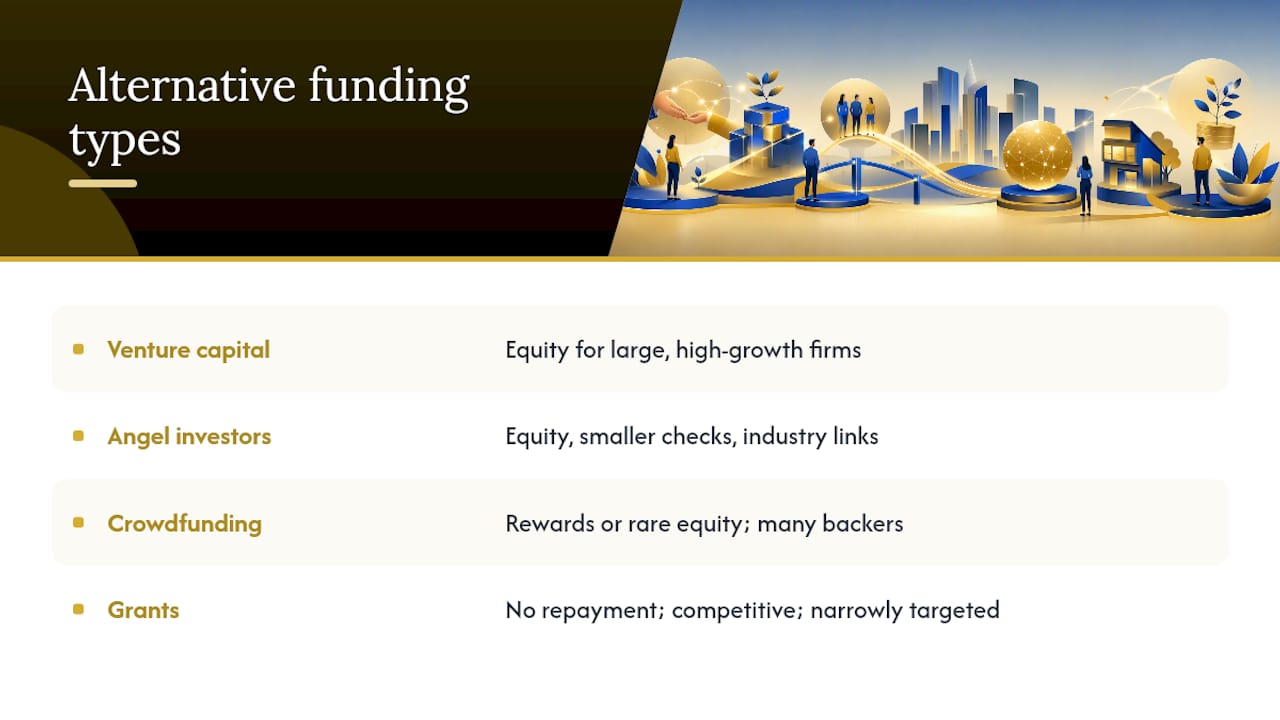
Debt isn’t the only route to expansion capital, and for some businesses it isn’t the right one. Venture capital trades a stake in your company for a large capital infusion, but it’s built for high-growth, scalable businesses expecting rapid returns, not the local service business adding a second van. Angel investors operate similarly on a smaller scale, often bringing industry connections along with the check, though they still take equity in exchange.
Crowdfunding platforms let you raise smaller amounts from many backers, either in exchange for early product access (rewards-based) or, less commonly for small businesses, equity. It works best for consumer-facing products with a story that resonates, not for funding a warehouse expansion.
Grants are the rare source of capital that requires no repayment and no equity given up, but they’re competitive, often narrowly targeted at specific industries, demographics, or regions, and rarely large enough to fund a full expansion on their own.
The common thread: every one of these alternatives either costs you equity, requires a public campaign, or comes with strict eligibility rules. Debt financing, by comparison, lets you keep full ownership and move on your own timeline, which is why it remains the default choice for most owners financing a concrete expansion project rather than a speculative new venture.
What Can Go Wrong When You Finance Growth
Borrowing to expand carries real risk, and the businesses that get hurt are usually the ones that treated the loan as a formality rather than a commitment. Overestimating demand is the most common trap. A new location or product line that takes twice as long to ramp up as projected still comes with a fixed monthly payment due on day one.

Stacking debt is another quiet danger. Taking a merchant cash advance on top of an existing term loan, then adding a line of credit on top of that, can push your total debt service past what your cash flow can support even if each individual loan looked manageable in isolation.
Interest rate exposure matters too, particularly with variable-rate products tied to a benchmark rate. A line of credit that looked affordable when rates were low can get considerably more expensive if rates rise during your repayment period.
Finally, a personal guarantee, common on loans to smaller or newer businesses, means the lender can pursue your personal assets if the business can’t repay. That’s a real exposure worth weighing against the loan amount, not a boilerplate clause to skim past.
Debt vs. Equity: What Financing Does to Ownership
Every dollar you borrow through a term loan, line of credit, or equipment loan leaves your ownership stake exactly where it was. You repay principal and interest, and once the loan is satisfied, the lender has no further claim on your business. That’s the core appeal of debt financing for an owner who wants to keep full control over decisions.
Equity financing works differently. Selling a stake to a venture investor or angel means giving up a percentage of future profits and, often, some say in how the business is run, through board seats, veto rights over major decisions, or reporting requirements. A 20% equity stake sold today is 20% of every dollar of value the business creates from that point forward, not just 20% of the cash raised.
For a business expanding through a defined, revenue-generating project like a new location or equipment purchase, debt is usually the more capital-efficient choice, since the expansion itself is expected to generate the cash to repay the loan. Equity makes more sense when the expansion is speculative or when the amount needed is too large for the business’s current cash flow to service as debt.
Tax Treatment of Business Financing
Interest paid on most business loans, including term loans, lines of credit, and SBA loans, is generally deductible as a business expense, which lowers the effective cost of borrowing compared to the stated rate. Principal repayments are not deductible, since that’s simply repaying borrowed capital rather than an expense.
Equipment financed through a loan or a qualifying lease may also qualify for accelerated depreciation deductions, which can meaningfully reduce taxable income in the year the equipment goes into service. Invoice factoring works differently: the discount fee charged by the factoring company is generally deductible as a business expense, but the transaction itself isn’t a loan, so there’s no interest deduction in the traditional sense.
Revenue-based financing sits in something of a gray area depending on how the arrangement is structured, since payments tied to revenue rather than a fixed interest rate don’t always fit neatly into standard interest deduction rules. A tax professional familiar with your specific financing structure should confirm treatment before you file, since misclassifying a financing arrangement can create problems well beyond the size of the loan itself.
The Overlooked Part of Financing Expansion
Most advice on expanding a business with financing focuses on which loan type to pick, but the bigger mistake I see is owners applying to lenders before they’ve stress-tested the expansion itself.
The conventional wisdom also oversells speed as an unambiguous good. Fast funding through a merchant cash advance or short-term online loan solves a cash problem today and often creates a bigger one in six months, once the repayment structure starts eating into daily margin. Speed should be a tool for genuine time-sensitive opportunities, like a favorable lease coming available, not a default preference.
What actually matters is sequencing: pin down the ROI and payback period first, match the term to the asset’s useful life second, and only then start comparing lenders on rate and fees. Comparing several financing types side by side, rather than committing to the first offer that arrives, is where a broker earns its value. It’s not about finding the cheapest rate in isolation. It’s about finding the structure that fits how the expansion will actually generate cash.
— Eduardo
Get Expansion Capital Matched to Your Business, Not a Generic Product
Cotifunding gives you one application and multiple lender options instead of the usual cycle of calling banks, filling out separate forms, and waiting on each one to respond. The pre-qualification step uses a soft credit pull, so you can see what you likely qualify for, across SBA-backed options, equipment financing, lines of credit, and more, without a hard inquiry hitting your credit file first.
If your expansion involves specialized equipment, an auto repair shop financing package built around equipment loans and working capital shows how the matching process works in practice for a specific vertical. For owners weighing a line of credit against a term loan for an upcoming inventory push or hiring round, Cotifunding surfaces the options side by side so you’re comparing real terms, not guessing which lender to call first. Start a pre-qualification today and see which financing types you actually qualify for before committing to one path.
Sources
Recommended
Disclosure: Coti Funding is not a direct lender. We connect businesses with independent third-party lenders and financing providers. Financing products, rates, terms, funding amounts, approval requirements, and funding timelines vary by provider and applicant qualifications and are not guaranteed. Any rates, terms, examples, or scenarios presented in this article are for general informational and educational purposes only and may not reflect actual offers available to a particular business. Submission of information or an application does not guarantee approval or funding. This content does not constitute financial, legal, tax, or investment advice.
Comments