Fixed vs Variable Rates for Small Business Loans: How to Choose


For most small-business borrowers taking on a term loan or equipment financing with a horizon of five years or more, a fixed rate is the safer default. The predictability protects cash flow, and the slightly higher starting rate is usually worth the certainty. That said, two situations flip the math: if you need a short-term line of credit (under 24 months) or you have high confidence that benchmark rates will fall before your next refinancing window, a variable rate often costs less.
Choose fixed when: your loan term is long, your margins are tight, or you cannot absorb a payment spike mid-cycle.
Choose variable when: you are drawing on a revolving line of credit, your term is short, or you plan to refinance or pay off the balance within 12–24 months.
One more constraint worth naming upfront: the loan product itself sometimes decides for you. SBA 7(a) loans offer both fixed and variable options, but most business lines of credit are variable by default, and many long-term commercial real estate loans are priced off Treasury yields and come fixed.
Table of Contents
What a fixed interest rate actually means for your business loan
How U.S. benchmarks are set and which one applies to your loan
Worked examples: when fixed costs less and when variable wins
Decision checklist: the questions that point you to fixed or variable
How the fixed vs. variable choice plays out across loan types
What the 2026 SBA base-rate change means for your loan comparison
How Cotifunding helps you compare fixed and variable offers side by side
What a fixed interest rate actually means for your business loan
A fixed rate locks in a single interest rate from the first payment to the last. Your monthly payment does not change when the Federal Reserve moves rates, when Prime climbs, or when SOFR spikes. That stability makes cash-flow forecasting straightforward: you know the exact debt-service cost for the full term.
For business lending, fixed rates on longer-term products are typically priced off Treasury yields. A lender funding a 10-year term loan will often use the 10-year Treasury note as the base and add a spread that reflects your credit profile, collateral, and loan size. That is different from how short-term variable products are priced, and it explains why fixed rates tend to start slightly higher: the lender is pricing in rate-risk protection for the full term.
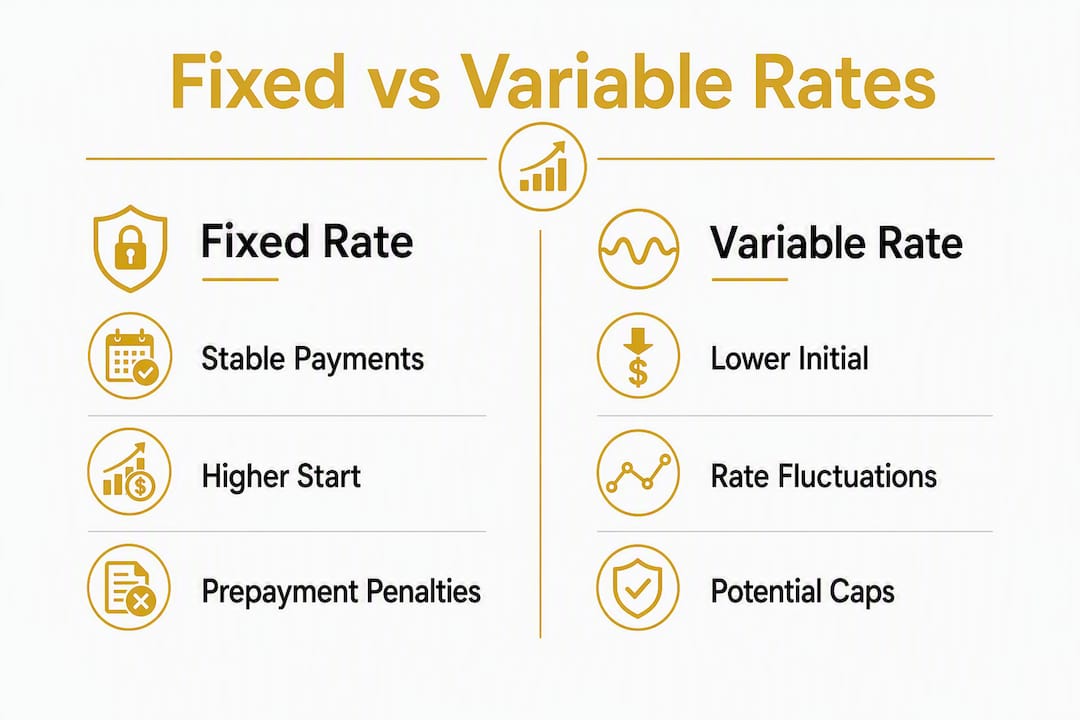
Pros: No payment variance, simpler budgeting, protection against rising rates. Cons: Higher starting rate than variable alternatives, no benefit if market rates fall, and prepayment can be expensive.

That last point catches borrowers off guard. Fixed-rate commercial loans often carry prepayment penalties, sometimes structured as yield maintenance (compensating the lender for lost interest income) or defeasance (replacing the loan’s cash flows with Treasury securities). Both can make early payoff costly. Always ask whether the rate quote is the all-in APR or just the headline note rate; fees and origination costs can add meaningful basis points to the true cost.
Pro Tip: Ask your lender for the APR, not just the interest rate. The APR folds in origination fees, points, and other charges, giving you the true annual cost of the loan. A loan quoted at 7.5% with 2% in fees has a higher APR than one quoted at 7.75% with no fees.
How variable rates work and what makes them move
A variable rate is built from two parts: a published benchmark index plus a fixed margin (also called a spread) that the lender sets based on your credit profile. The benchmark moves with market conditions; the margin stays constant. So if your loan is priced at Prime + 2.5%, and Prime moves from 7.5% to 8.25%, your effective rate moves from 10% to 10.75%.
Resets happen on a schedule, typically monthly or quarterly, and each reset recalculates your payment at the new benchmark level. Variable-rate loans reflect current interest rates throughout the life of the loan rather than locking in a single rate at closing, which is the core trade-off: you get market exposure in both directions.
Key terms you will see in variable-rate loan documents:
Index/base: The published benchmark (Prime, SOFR, Treasury) that moves with market conditions.
Spread/margin: The fixed markup your lender adds to the index, set at origination.
Floor: The minimum rate the loan can reach, even if the benchmark falls below it.
Cap: The maximum rate the loan can reach per reset or over the loan’s life.
Lookback: The number of days prior to a reset date used to calculate the new benchmark value.
Tenor: The length of the loan term, which affects how many resets you will experience.
SOFR-based products commonly use a 30-day average or a term SOFR plus margin, and many include caps that limit how much a single reset can move your payment. Without a cap, a sharp rate spike can push payments well above what you budgeted.
Variable rates typically start lower than fixed alternatives. That lower entry cost is real, but it comes with exposure to rising rates and genuine budgeting uncertainty over a multi-year term.

How U.S. benchmarks are set and which one applies to your loan
Three benchmarks dominate U.S. business lending, and they are not interchangeable. SOFR, Prime, and Treasury yields each serve different loan markets: SOFR for floating institutional and most post-LIBOR floating loans, Prime for small-bank loans and lines of credit, and Treasury yields for long-term fixed-rate products.
Prime is set by major U.S. banks and tracks the federal funds rate closely. It is the most common base for small-business lines of credit and many SBA 7(a) variable-rate loans. When the Fed raises rates, Prime typically follows within days.
SOFR (Secured Overnight Financing Rate) replaced LIBOR as the standard for floating institutional debt; you can learn more about the differences in this SOFR vs LIBOR mortgage rates explained guide. Bridge loans, construction loans, and many private credit facilities now use Term SOFR or a 30-day average SOFR as the base. SOFR tends to run slightly below Prime, so the same spread produces a lower all-in rate.
Treasury yields anchor long-term fixed pricing. A lender offering a 10-year fixed term loan will often price it at the 10-year Treasury note yield plus a spread. Because Treasury yields reflect long-term market expectations rather than overnight rates, they move differently from Prime or SOFR.
That difference matters more than most borrowers realize. Two loan quotes with the same spread can produce very different all-in rates depending on which base is used. Prime + 150 bps vs. SOFR + 300 bps can be several tenths to several full percentage points apart depending on where the bases sit on a given day.
Pro Tip: When comparing quotes from multiple lenders, ask each one to calculate the all-in APR using today’s published benchmark value. That converts every quote to the same basis and makes the comparison honest.
Worked examples: when fixed costs less and when variable wins
The scenario that determines the winner is almost always term length combined with the rate path.
Scenario A: $250,000, 5-year term loan
Fixed | Variable (SOFR-based) | |
Starting rate | — | variable (SOFR + margin) |
Reset cadence | None | Quarterly |
If rates rise 150 bps by year 2 | No change | — |
If rates fall 100 bps by year 2 | No change | — |
Over five years with rates flat, the variable loan saves roughly $1,080 per year. If rates rise 150 basis points by year two, the variable loan becomes more expensive than the fixed loan for the remaining term. The breakeven point is roughly a 100–125 bps increase sustained over the back half of the term.
Scenario B: $1,000,000, 10-year term loan
A 10-year fixed loan priced at the 10-year Treasury yield plus a spread locks in certainty for a decade. A floating alternative priced at SOFR + margin resets quarterly for 40 periods. Over a 10-year horizon, even a modest 200 bps average increase in SOFR adds roughly $100,000–$200,000 in additional interest, depending on the loan balance at each reset. The fixed loan wins on total cost in any rising-rate scenario and loses only if rates fall and stay low for most of the term.
The practical lesson: the longer the term, the more the fixed rate earns its premium. Short-term borrowers and line-of-credit users are the natural candidates for variable pricing.
Decision checklist: the questions that point you to fixed or variable
Run through these before your next lender conversation:
How long will you hold the loan? Under 24 months: variable is usually cheaper. Over 5 years: fixed is usually safer.
How stable is your monthly cash flow? Tight margins or seasonal revenue: fixed removes one variable from the equation.
Can you refinance if rates move against you? If yes, variable is more viable. If prepayment penalties or deal structure make refinancing expensive, fixed protects you.
What is your view on the rate path? If you expect rates to fall, variable captures that upside. If you expect rates to hold or rise, fixed locks in today’s cost.
Does the loan have a cap? A variable loan without a rate cap is a different risk profile than one with a 2% lifetime cap. Always confirm cap terms before signing.
What is the all-in APR, not just the spread? Ask every lender for the APR at today’s benchmark level, not just the note rate.
Red flags to watch for: A lender who quotes only the spread without naming the benchmark is hiding the base. Missing cap or floor language in a variable-rate term sheet is a negotiating gap you need to close. Prepayment terms described vaguely as “standard” without a formula are worth pressing on before you sign.
Pro Tip: If you have a business milestone coming up (planned sale, lease renewal, equipment replacement), map it against the loan’s reset schedule and prepayment window. A variable loan that resets right before a planned payoff can work in your favor; one that resets right before a cash-flow crunch does not.
How the fixed vs. variable choice plays out across loan types
SBA 7(a) loans offer both options. Variable-rate 7(a) loans are typically priced at Prime plus a lender spread, with SBA-mandated caps on that spread based on loan size. Fixed-rate 7(a) loans are available but less common; lenders offering them often price off Treasury yields. The SBA loan program structure means borrowers get some rate protection even on variable products, but the caps are on the spread, not the total rate, so Prime movements still flow through.
Business lines of credit are almost always variable. The revolving nature of the product makes fixed pricing impractical for most lenders. A business line of credit priced at Prime + 1.5% will reset monthly or quarterly. The short draw periods and revolving structure mean rate exposure is real but manageable, especially for businesses that pay down the balance regularly.
Equipment financing typically comes fixed. Lenders match the funding source to the asset life, and a 5-year equipment loan priced at a fixed rate gives both the lender and borrower predictability. Equipment loans with fixed terms make budgeting straightforward when the asset generates consistent revenue.
Commercial real estate loans for longer terms (10+ years) are usually priced off Treasury yields and come fixed, often with yield maintenance or defeasance prepayment structures. Shorter bridge or construction loans are typically floating, priced at SOFR or Prime plus a spread.
Credit profile matters throughout. Borrowers with stronger credit scores and established revenue history are more likely to be offered fixed-rate options, especially on larger loans. Variable pricing is more common when the lender needs flexibility to price risk that is harder to quantify at origination.
What the 2026 SBA base-rate change means for your loan comparison
Effective March 1, 2026, SBA 7(a) lenders may use 5-year and 10-year Treasury Note Rates as alternative base rates for pricing, in addition to Prime and SOFR-based options. That is a meaningful shift. Before this change, most SBA variable-rate loans defaulted to Prime. Now a lender can offer a Treasury-based fixed structure within the SBA program, which changes the fixed vs. variable comparison for SBA borrowers.
The practical implication: ask your SBA lender for both illustrations. A Prime-based variable quote and a Treasury-based fixed quote on the same loan amount and term will give you a real apples-to-apples comparison of what each structure costs at today’s rates and what each costs if rates move 100–200 basis points in either direction.
Pro Tip: Pull the current 5-year and 10-year Treasury yields from the U.S. Treasury website and the current Prime rate before your lender meeting. Ask each lender to build their quote off those published numbers so you can compare across lenders on the same day’s basis.
Tax implications of fixed vs. variable rate business loans
The interest you pay on a business loan is generally deductible as a business expense, regardless of whether the rate is fixed or variable. The IRS treats both structures the same for deductibility purposes: the interest expense flows through your Schedule C, Form 1120, or partnership return depending on your entity type.
Where the rate type creates a practical tax difference is in planning. A fixed-rate loan produces a predictable interest deduction every year, which makes tax planning straightforward. A variable-rate loan produces a deduction that fluctuates with the benchmark, so your deductible interest expense can be higher or lower than projected depending on where rates land.
If rates rise significantly on a variable loan, your interest expense and your deduction both increase, which partially offsets the higher payment cost. That is a real, if partial, cushion. It does not make rising rates good news, but it does mean the after-tax cost of a variable loan in a rising-rate environment is somewhat lower than the gross payment increase suggests.
One nuance worth confirming with your tax advisor: if you use loan proceeds for mixed purposes (partly business, partly personal), the deductibility rules become more complex. For pure business loans, the deduction is generally straightforward.
This is general information, not tax advice. Confirm the treatment for your specific entity structure and loan purpose with a qualified tax professional or CPA.
Key Takeaways
Fixed rates are the safer default for most small-business term loans over five years; variable rates make sense for short-term lines of credit, revolving facilities, or borrowers confident rates will fall before their payoff window.
Point | Details |
Fixed is the default for long terms | Loans over five years benefit most from fixed rates; payment certainty protects cash flow across the full term. |
Variable suits short-term borrowing | Lines of credit and loans under 24 months often cost less with variable pricing, especially if rates hold or fall. |
The benchmark changes the math | Prime, SOFR, and Treasury yields produce different all-in rates even at the same spread; always ask for the APR. |
2026 SBA change expands your options | SBA 7(a) lenders can now use Treasury-note rates as a base, so ask for both Treasury-based and Prime-based illustrations. |
Cotifunding compares offers for you | Cotifunding connects small businesses with multiple funding providers, surfacing side-by-side APR comparisons without contacting each lender individually. |
The rate choice most business owners get wrong
The conventional advice is to pick fixed for safety and variable for savings. That framing is not wrong, but it misses the more important question: what is the base rate, and how does it interact with the spread?
Most business owners compare loan offers by looking at the spread alone. “Lender A quoted Prime + 1.5%, Lender B quoted SOFR + 2.75%” — and they assume Lender A is cheaper because the spread is lower. But if Prime is running 75–100 basis points above SOFR on the day of the quote, Lender B’s all-in rate may actually be lower. That gap is invisible unless you ask for the all-in APR at today’s published benchmark values.
The 2026 SBA base-rate expansion makes this even more important. A Treasury-based fixed quote and a Prime-based variable quote on the same SBA loan can look similar on paper and diverge significantly over a 7-year term depending on the rate path. The borrowers who get the best outcomes are the ones who ask for both illustrations and run the numbers at two or three rate scenarios before signing.
My consistent recommendation for small-business borrowers: if your term is five years or longer and your cash flow is not highly predictable, start with fixed. Then ask for the variable alternative and stress-test it at +150 bps and +200 bps. If the variable loan still looks better under those scenarios, it probably is. If it does not, the fixed rate is earning its premium.
How Cotifunding helps you compare fixed and variable offers side by side
Getting the right rate structure is harder when you are contacting lenders one at a time. Each lender quotes on their own benchmark, their own spread, and their own APR methodology, and comparing those quotes without a common basis is genuinely difficult.

Cotifunding connects small businesses with independent funding providers across SBA loans, equipment financing, business lines of credit, and term loans. As a brokerage, Cotifunding does not directly lend, underwrite, or guarantee rates or approvals. What it does is surface multiple offers on a comparable basis, so you can see fixed and variable options side by side with all-in APRs calculated at the same benchmark levels. Pre-qualification uses a soft credit pull, so your credit score is not affected by the comparison process. Many businesses receive funding options within 24 hours of completing the application.
If you are weighing a fixed vs. variable structure for your next loan, start your pre-qualification at Cotifunding and ask for both rate-type illustrations when your funding options come back.
Where to verify current rates before your lender meeting
Pull these numbers the morning of any lender conversation so you can hold every quote to the same benchmark:
Current Prime Rate: Published daily by the Wall Street Journal; tracks the federal funds rate plus 3%.
30-day average SOFR and Term SOFR: Available at the New York Fed’s SOFR page and the CME Group’s Term SOFR dashboard.
5-year and 10-year Treasury yields: Published daily at TreasuryDirect and the U.S. Treasury’s yield curve page.
SBA base-rate guidance: The SBA 7(a) loan program page and the Federal Register for the 2026 base-rate rule change.
CFPB fixed vs. variable explainer: The Consumer Financial Protection Bureau publishes a plain-language breakdown of fixed vs. variable APR mechanics useful for confirming definitions.
Once you have those numbers, ask each lender: “What is your all-in APR at today’s [Prime/SOFR/Treasury] value, and can you show me a sample amortization schedule?” Any lender who cannot or will not answer that question is not giving you a comparable quote.
Recommended
Disclosure: Coti Funding is not a direct lender. We connect businesses with independent third-party lenders and financing providers. Financing products, rates, terms, funding amounts, approval requirements, and funding timelines vary by provider and applicant qualifications and are not guaranteed. Any rates, terms, examples, or scenarios presented in this article are for general informational and educational purposes only and may not reflect actual offers available to a particular business. Submission of information or an application does not guarantee approval or funding. This content does not constitute financial, legal, tax, or investment advice.
Comments