How to Get Business Funding Fast: 24–72 Hour Options


The fastest ways to get business funding are online short-term loans, business lines of credit, merchant cash advances, and invoice factoring — most of which can put capital in your account within a few days. Alternative lenders use automated underwriting to deliver funds far faster than traditional banks, though that speed comes at a higher cost. SBA loans offer the best long-term rates and can reach $500 to $5.5 million, but they typically take 30–90 days to close — not useful when you need cash this week.
Here is what to do in the next 24 hours:
Start a soft pre-qualification through a broker like Cotifunding. One application, one soft credit pull, multiple lenders reviewed simultaneously.
Pull your last three months of bank statements and save them as clearly named PDFs. Missing documents are the single most common cause of funding delays.
Check both your personal and business credit scores. Errors on your report can kill an approval that should have sailed through.
Table of Contents
How to secure funding in 24–72 hours: a step-by-step checklist
Why do lenders delay funding, and how do fast lenders avoid it?
What does fast funding actually cost? A hypothetical $50,000 example
SBA loans vs. fast alternatives: which one fits your situation?
Cotifunding connects you to fast funding without the guesswork
What are the fastest business funding options right now?
Not every fast funding product works for every business. The right choice depends on how quickly you need the money, how much you need, and what your revenue looks like.
Funding Type | Typical Time to Fund | Typical Amounts | Credit Requirements | Docs Needed | Typical Cost (APR/Fees) | Best Use Case |
Online short-term loan | typically a few days | varying amounts | personal credit considered | Bank statements, tax returns | Variable APRs | Working capital, payroll, inventory |
Business line of credit | typically a few days | varying amounts | personal credit considered | Bank statements, revenue proof | Variable APRs | Ongoing cash flow gaps |
Merchant cash advance | often same day to a few days | varying amounts | revenue-based approval | Card processing statements | Factor rates vary | High card-volume businesses |
Invoice factoring | generally a few days | based on invoice value | Based on your customers’ credit | Invoices, AR aging report | Discount rates vary | B2B businesses with slow-paying clients |
Business credit card | Instant if pre-approved | varying credit limits | credit score considered | Personal/business tax returns | Variable APRs | Small, recurring purchases |
SBA loan | typically a month or more | loans start from $500 up to several million dollars | personal credit score considered | Full financial package | Competitive APRs | Long-term, low-cost capital |
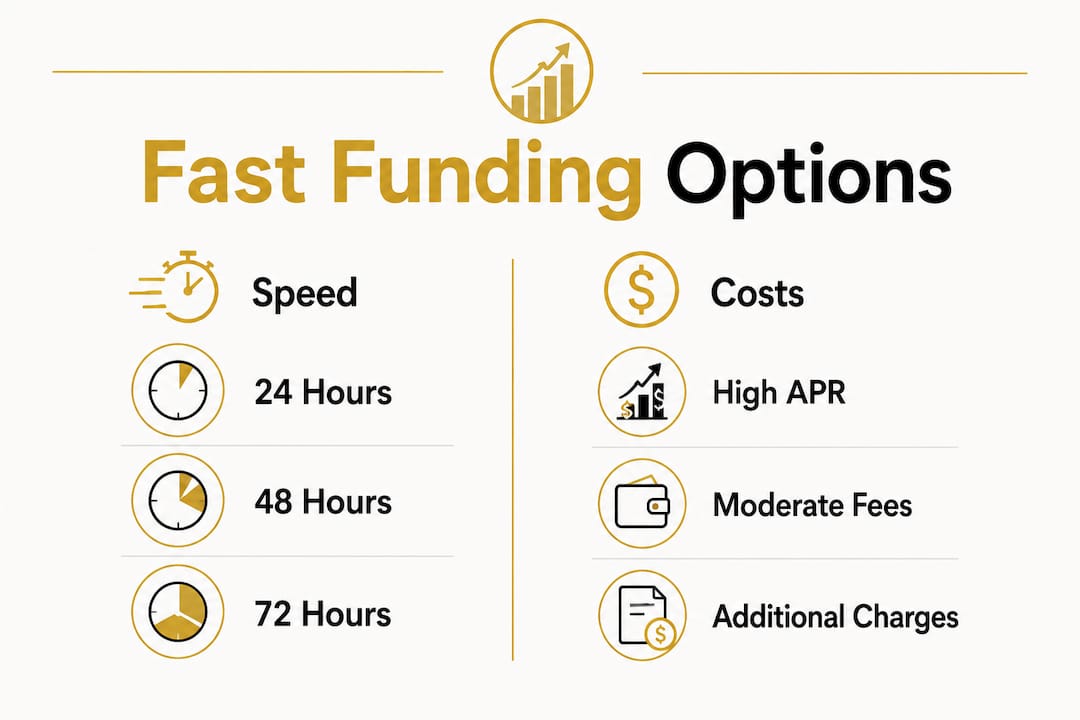
The core trade-off is simple: the faster the funding, the higher the cost. A merchant cash advance can hit your account the same day, but the equivalent APR often runs well above what a short-term loan charges. A business line of credit sits in the middle — reasonably fast, reusable, and less expensive than an advance.
SBA loans deserve a separate note. They are not a fast funding option for urgent needs. Their strength is long-term, low-cost capital for planned investments. If you need money quickly, SBA is not the answer today — but it may be appropriate as a refinance target later.
A few product-specific points worth knowing:
Invoice factoring does not require strong business credit because approval is based primarily on your customers’ creditworthiness, not yours. That makes it one of the most accessible fast options for B2B businesses.
Merchant cash advances repay via a daily or weekly percentage of sales, so payments flex with revenue. That flexibility has a price — factor rates of 1.15–1.50 mean you repay $1.15–$1.50 for every dollar borrowed.
Business credit cards work well for small, recurring expenses but carry high APRs and are a poor choice for large lump-sum needs.
What do lenders actually require to approve you quickly?
Speed at the lender’s end depends almost entirely on what you hand them at the start. A complete, organized application package can cut underwriting time from days to hours.

Common eligibility thresholds by product
Most fast alternative lenders evaluate factors like time in business, monthly revenue, and personal credit score, with varying minimum thresholds depending on the product.
Product | Min. Time in Business | Min. Monthly Revenue | Min. Personal Credit Score |
Short-term loan | 6 months | — | — |
Line of credit | 6–12 months | — | — |
Merchant cash advance | 3–6 months | — | 500 |
Invoice factoring | 3 months | Varies (invoice-based) | 500 (customer credit matters more) |
SBA 7(a) loan | 2 years | Varies | — |
Startups under six months old have fewer options, but 0% startup funding programs exist specifically for early-stage businesses.
The document checklist that speeds approval
Lenders want a complete loan package — and the businesses that get funded fastest are the ones that show up with everything ready. Prepare these before you apply:
Several months of recent business bank statements (all pages, PDF format)
Recent business and personal tax returns covering multiple years
A current profit and loss statement
Business license and articles of incorporation
Government-issued photo ID (driver’s license)
Voided business check
Merchant processing statements (for MCA applicants)
Accounts receivable aging report (for invoice factoring applicants)
Pro Tip: Name every file clearly before uploading: “BusinessName_BankStatements_Jan–Mar2026.pdf” takes seconds to label and prevents the back-and-forth that delays approvals by days. Save everything in a single zipped folder so you can submit to multiple lenders without hunting for files.
One caution: when pre-qualifying through a broker, you do not need to submit full tax returns upfront. A broker typically starts with bank statements and a soft credit pull. Hold back sensitive documents like Social Security numbers and full tax returns until you are in active underwriting with a specific lender.
How to secure funding in 24–72 hours: a step-by-step checklist
Follow this sequence and you give yourself the best realistic shot at same-day or next-day funding.
Triage your need. Decide exactly how much you need and when. Borrowing more than necessary increases cost; borrowing too little means a second application later.
Check your credit. Pull your personal credit report at AnnualCreditReport.com and dispute any errors before applying. A 20-point error on your report can drop you below a lender’s threshold.
Organize your documents. Use the checklist above. A complete package submitted at 9 AM can result in same-day approval; an incomplete one submitted at 9 AM results in a 3-day email chain.
Start with a soft pre-qualification through a broker. A single soft credit pull preserves your score while allowing multiple lenders to review your profile, which can lead to more competitive offers than applying directly.
Respond to follow-up requests within the hour. Lenders working on fast timelines move on when applicants go quiet. Treat every request for additional information as urgent.
Review terms before signing. Check the total payback amount, the daily or weekly payment, and — critically — the prepayment policy. Some alternative lenders include prepayment penalties or full-term interest clauses that make early payoff expensive.
Plan your bridge exit. If you are taking fast capital at a high rate, start your SBA application in parallel. Refinancing into a long-term SBA loan after 6–12 months of strong repayment history is a proven way to cut your lifetime interest cost.
Pro Tip: Ask any broker upfront: “Do you work with SBA Preferred Lenders?” Preferred Lenders have delegated approval authority, meaning they can approve SBA loans internally without waiting for SBA review. That alone can shorten an SBA timeline from months to weeks when you are planning a refinance.
The bridge strategy deserves emphasis. Securing fast short-term capital now while applying for an SBA loan in parallel is not a workaround — it is a deliberate financial move that many experienced business owners use to capture urgent opportunities without locking in high rates permanently.

Why do lenders delay funding, and how do fast lenders avoid it?
Most funding delays come down to four causes: manual underwriting, missing documents, third-party verification requests, and seasonality checks. Understanding where the bottleneck is helps you remove it.
Manual underwriting is the biggest culprit at traditional banks. A human analyst reviews every line of your financials, which takes days. Online alternative lenders replace most of that with automated decisioning — algorithms that read bank statement data in real time and return a decision in minutes.
Missing documents are the most preventable delay. A lender who has to email you for a missing bank statement page loses a day, minimum. Submit complete packages.
Third-party verifications — tax transcript requests from the IRS, payroll verification, or landlord confirmations — are common in SBA and traditional bank underwriting. Alternative lenders skip most of these by using API-based bank data connections (Plaid, Finicity) that verify deposits and cash flow directly.
Seasonality checks apply to businesses with irregular revenue. A lender seeing a slow month in your statements may pause to verify whether it is a trend or a pattern. Proactively explain seasonal dips in a brief cover note with your application.
Fast lenders typically follow this checkpoint sequence for 24–48 hour funding: application submitted → automated bank data pull (real time) → automated credit check → risk scoring (minutes) → conditional approval → document verification → final approval → same-day ACH transfer. The entire sequence can complete in under 24 hours when the application is complete and the business profile is clean.
To pre-authorize faster data pulls, connect your business bank account through the lender’s bank verification portal when prompted. Businesses that do this get decisions faster than those who upload static PDF statements, because the lender can see live transaction data rather than waiting for document review.
What does fast funding actually cost? A hypothetical $50,000 example
Fast capital is not cheap. Here is what the cost picture looks like across product types, followed by two labeled hypothetical examples.
Typical cost ranges by product
Product | Typical APR or Cost | Key Fees to Watch |
Short-term online loan | 40% APR | Origination fee (1%–5%), prepayment penalty |
Business line of credit | — | Draw fee, maintenance fee, renewal fee |
Merchant cash advance | Equivalent to 40%–150% APR | Factor rate (1.15–1.50), no fixed term |
Invoice factoring | 1%–5% per 30 days | Discount rate, wire fee, reserve holdback |
SBA 7(a) loan | — | Guarantee fee (0.5%–3.75% of guaranteed portion) |
Hypothetical Example A — Short-term term loan, $50,000: Assumptions: $50,000 borrowed, 12-month term, 40% APR, 3% origination fee. Origination fee = $1,500 (deducted upfront). Monthly payment ≈ $4,—. Total repaid over 12 months ≈ $55,200 (plus the $1,500 origination fee = $56,700 total cost). This is a hypothetical illustration only. Actual rates and fees vary by lender and borrower profile.
Hypothetical Example B — Merchant cash advance, $50,000: Assumptions: $50,000 advance, factor rate of 1.35, daily repayment at 12% of daily card sales, estimated average daily sales of $3,000. Total repayment = $67,500. At that repayment pace, the advance pays off in roughly 25 business days. Equivalent APR on a 25-day payoff is extremely high — this product is cost-effective only when you need capital for a very short window and card volume is strong. This is a hypothetical illustration only.
Converting factor rates to APR
Factor rates are not APRs and the difference matters. To get a rough APR equivalent: subtract 1 from the factor rate, divide by the loan term in years, and multiply by 100. A 1.35 factor rate on a 90-day advance works out to roughly 140% APR. That number is not a reason to avoid the product automatically — it is a reason to use it only when the return on the capital exceeds the cost.
Pro Tip: Before signing any fast-funding agreement, ask the lender to confirm in writing whether a prepayment discount applies. Some lenders charge the full factor rate regardless of when you pay off. Others discount it. That single question can save thousands of dollars.
SBA loans vs. fast alternatives: which one fits your situation?
The answer depends on three variables: how urgently you need the money, how much you need, and whether you can qualify.
SBA loans — particularly the 7(a) program — offer some of the best terms available to small businesses: competitive rates, amounts up to $5.5 million, longer repayment terms, and lower down payments. The catch is time. SBA processing typically takes 30–90 days, and that timeline assumes a complete application with no back-and-forth. For urgent needs, that is simply not viable.
Situation | Recommended Route |
Need capital within 72 hours | Online short-term loan, MCA, or line of credit |
Need capital within 2–4 weeks | Line of credit, invoice factoring, or SBA Express |
Need $500K+ at low cost, can wait 30–90 days | SBA 7(a) via Preferred Lender |
B2B business with slow-paying invoices | Invoice factoring |
High card-volume retail or restaurant | Merchant cash advance |
Planning equipment purchase, no urgency | SBA equipment financing |
The SBA Preferred Lender Program is worth knowing about even when speed is the priority. Preferred Lenders have delegated authority to approve SBA loans without waiting for SBA review, which can shorten the timeline meaningfully. Use SBA Lender Match to find approved lenders in your area and filter for Preferred Lenders when you are planning a refinance.
A practical decision rule: if you need money in under two weeks, start with a fast alternative product. If the amount you need exceeds $250,000 or the use case is long-term (real estate, major equipment), pursue SBA in parallel and use fast capital as a bridge. The commercial loan vs. SBA comparison is worth reviewing before you commit to either path.
What should you apply for first? A quick action plan
Prioritize in this order: urgency, then cost sensitivity, then eligibility fit. Here is how that plays out in practice.
Match your profile to the right product:
High card-volume business (retail, restaurant, e-commerce): Start with a merchant cash advance. Approval is revenue-based, not credit-based, and funding can arrive the same day. Read more about how MCAs work before committing.
B2B business with outstanding invoices: Invoice factoring converts receivables to cash in 24–48 hours without adding debt to your balance sheet.
Service business with steady monthly deposits: A fast business line of credit gives you reusable capital at lower cost than an advance.
Business that has been denied by a bank: Read about same-day funding alternatives before reapplying anywhere.
If you are denied, do not reapply immediately. Multiple hard credit pulls in a short window lower your score and signal desperation to lenders. Instead:
Ask the lender for the specific denial reason in writing.
Address the issue (low credit, missing docs, insufficient revenue history).
Use a broker for your next attempt — a single soft pull lets multiple lenders evaluate you without the score impact.
Using a broker in practice: Submit one application, provide one document package, and receive responses from multiple funding partners within hours. A good broker will tell you upfront which lenders are most likely to approve your profile and at what cost range — before you commit to anything.
One decision rule to close on: if you need capital in under 72 hours, the fastest path is a broker-assisted soft pre-qualification followed by a same-day submission to two or three matched lenders.
Key Takeaways
The single most important step to get business funding fast is to organize your documents and submit a soft pre-qualification through a broker before approaching any individual lender.
Point | Details |
Speed vs. cost trade-off | Faster funding (MCAs, short-term loans) carries higher APRs; SBA loans are cheaper but take 30–90 days. |
Docs determine speed | A complete bank statement and tax return package submitted upfront cuts approval time from days to hours. |
Broker advantage | One soft credit pull and one document set submitted to multiple lenders simultaneously speeds decisions and preserves your credit score. |
Bridge strategy | Take fast capital now for urgent needs, then refinance into an SBA loan within 6–12 months to lower lifetime cost. |
Cotifunding’s role | Cotifunding is a brokerage that connects businesses with independent funding partners — pre-qualification starts with a soft credit pull and no commitment. |
Why brokerage-first usually beats going lender-by-lender
The conventional advice is to shop around. What that advice leaves out is the cost of shopping around the wrong way.
Every time you submit a direct application to a lender, most of them run a hard credit pull. Do that three times in a week and your score drops, your risk profile worsens, and the next lender sees a borrower who has been turned down twice. The math works against you fast.
A broker changes that dynamic entirely. One soft pull, one document package, and your profile goes to multiple lenders at once. Those lenders know they are competing, which tends to produce better offers than you would get walking in alone. More importantly, a broker who works with the right network knows which lenders have delegated authority, which ones move fastest for your industry, and which ones are likely to approve your specific profile. That institutional knowledge is not something you can replicate by Googling “fast business loans.”
The question to ask any broker before you start: “What is your average time from application to funded for a business like mine?” A broker who cannot answer that specifically is not the right one. Also ask whether their lender network includes SBA Preferred Lenders — that matters the moment you are ready to refinance out of a high-rate product.
The businesses that get funded fastest are not the ones with the best credit scores. They are the ones with complete documents, a clear funding purpose, and a broker who knows which door to knock on first.
Cotifunding connects you to fast funding without the guesswork
When you need capital quickly, the last thing you want is to spend three days filling out separate applications for lenders who may not even be the right fit for your business.
Cotifunding is a business financing brokerage. That means we connect small businesses with independent funding partners — we do not lend directly, underwrite loans, or guarantee approvals or rates. What we do is submit your profile to multiple vetted funding partners through a single, streamlined process that starts with a soft credit pull.
The products Cotifunding can help you explore include business lines of credit, invoice factoring, merchant cash advances, equipment financing, working capital loans, term loans, and SBA refinance assistance. Whether you need capital in 24 hours or are planning a longer-term move, the process starts the same way: one application, one soft pull, no commitment until you review your options.
Cotifunding does not guarantee approvals, specific rates, or funding outcomes. All financing is subject to partner lender approval and eligibility requirements.
Start your soft pre-qualification at Cotifunding and see which funding options you qualify for — without touching your credit score.
Useful sources and further reading
The sources below are the most authoritative references for fast business funding in the U.S., along with Cotifunding resources that go deeper on each product.
Official sources:
Loans | U.S. Small Business Administration — The primary reference for SBA loan programs, amounts, and how to use Lender Match to find approved lenders.
Fund your business | U.S. Small Business Administration — SBA’s overview of all funding routes, including the Preferred Lender Program and how delegated authority speeds approvals.
How to Apply for a Small Business Loan Successfully | U.S. Chamber of Commerce — Practical guidance on documentation, banking relationships, and the bridge refinance strategy.
Cotifunding resources:
Invoice Factoring — Mechanics, eligibility, and speed-to-funding for B2B businesses with outstanding receivables.
Merchant Cash Advance — How factor rates work, who MCAs fit, and what to watch for in the contract.
Business Line of Credit — When a line of credit beats a term loan and how to qualify quickly.
The SBA Speed Secret: How to Skip the 6-Month Wait — Cotifunding’s guide to accelerating SBA timelines and planning a bridge-to-SBA refinance.
Why Banks Keep Saying “No” and How to Get Same Day Business Funding Instead — Step-by-step alternatives for businesses that have been denied by traditional lenders.
Small Business Funding Blog — The full Cotifunding resource hub covering every product and use case in this guide.
This article is general information, not financial or legal advice. Confirm current program terms, rates, and eligibility requirements with the SBA, a qualified lender, or a licensed financial advisor before making funding decisions.
Recommended
Disclosure: Coti Funding is not a direct lender. We connect businesses with independent third-party lenders and financing providers. Financing products, rates, terms, funding amounts, approval requirements, and funding timelines vary by provider and applicant qualifications and are not guaranteed. Any rates, terms, examples, or scenarios presented in this article are for general informational and educational purposes only and may not reflect actual offers available to a particular business. Submission of information or an application does not guarantee approval or funding. This content does not constitute financial, legal, tax, or investment advice.
Comments