Non-Notification Factoring: A Guide for Business Owners


Non-notification factoring (also called confidential or blind factoring) lets an eligible business convert outstanding invoices to cash while keeping the factoring relationship completely hidden from customers. Invoices stay on your letterhead, customers pay your account, and the funder never appears in any customer-facing communication.
Who it fits:
Established businesses with sufficient annual turnover, some years of trading history, and a disciplined internal collections function.
The core trade-off:
You keep the relationship private, but you pay a premium for that privacy (typically 1%–2.5% of invoice value versus 0.5%–1.5% for disclosed arrangements) and you retain full responsibility for chasing payments.
If you need costs, eligibility specifics, or a step-by-step application checklist, the sections below cover all of it.
Table of Contents
How non-notification factoring works in practice
The seller retains every customer-facing touchpoint. Your invoices go out under your name, your payment instructions stay on the document, and your customer never receives a Notice of Assignment. Behind the scenes, you have assigned those receivables to a funder who advances cash against them.
Here is the operational sequence:
Issue the invoice. You bill your customer normally, with your own bank details.
Assign it confidentially. You notify the funder of the invoice (usually via a sales ledger upload or portal), and the funder advances 80%–90% of the invoice value within 24–48 hours.
Customer pays you. The customer sends payment to your account, unaware of the funder’s involvement.
You hold funds in trust. Those customer payments are contractually held for the funder. Mismanaging these funds is the single most common reason facilities are terminated or converted to disclosed status.
Daily sweep to the funder. You remit collected funds to the funder, who deducts fees and releases the remaining reserve (the 10%–20% held back).
Reconciliation. The funder reconciles the ledger, credits your reserve, and the cycle repeats.
Scenario example: You issue a $50,000 invoice on 45-day terms. The funder advances $42,500 (85%) the next business day. Your customer pays on day 40. You sweep the full invoice amount to the funder, who deducts a fee and releases a reserve balance back to you. Net proceeds: you receive the majority of your invoice value, minus the agreed fee and reserve holdback, once your customer pays and the funder deducts all charges.
Because the funder cannot contact your customer directly, they depend entirely on your reporting. Expect to submit aging reports, remittance logs, and collection notes on a regular cadence. Failing periodic ledger audits is a frequent trigger for facility withdrawal.

Pro Tip: Open a segregated trust account for customer remittances from day one. Funds that hit your operating account and get commingled with payroll or vendor payments are the fastest path to a default notice. A dedicated account with a daily automated sweep removes the temptation and the risk.

Confidential vs. disclosed factoring: what actually changes
The core difference is simple: disclosed factoring sends customers a Notice of Assignment and routes payments directly to the funder; non-notification keeps the funder invisible and leaves collections with you.
Feature | Non-notification (confidential) | Disclosed (notified) |
Customer awareness | None | Notified via assignment notice |
Who collects | Seller | Factor |
Advance rate | 80%–90% | 80%–90% |
Service fee range | 1%–2.5% of turnover | 0.5%–1.5% of turnover |
Audit frequency | High (monthly or more) | Lower |
Eligibility threshold | Higher (turnover, history, credit-control) | Lower |
Three decision triggers that point toward confidential factoring for construction:
Your customer contracts include assignment-restriction clauses that disclosed factoring would trigger.
Your business operates in an industry where third-party collection damages relationships or reputation (professional services, staffing, construction).
You have a mature internal credit-control function and prefer to keep it.
One thing worth knowing: funders commonly convert a confidential facility to disclosed status when collections slow, audit reports arrive late, or debtor concentration spikes. That conversion is not a negotiation; it is a contractual right the funder holds.
Pros and cons worth mapping to your situation
Non-notification trades privacy for operational responsibility and a fee premium. That trade is worth it for some businesses and clearly wrong for others.
Benefits:
Relationship preservation. Customers never learn a third party is involved, which matters in sectors where assignment signals financial distress.
Brand control. All communications stay on your letterhead, preserving your professional image.
Contractual safety. You avoid triggering anti-assignment clauses buried in customer master service agreements.
Collections autonomy. You keep the customer relationship and can apply judgment on payment timing that a factor’s call center cannot.
Drawbacks:
Higher cost. The 1%–2.5% fee range reflects the funder’s increased risk from not controlling collections.
Recourse exposure. If a customer does not pay, you typically remain liable. Strong internal accounting is not optional; it is a prerequisite.
Audit burden. Monthly ledger audits, aging submissions, and remittance logs add administrative overhead that disclosed facilities do not require at the same frequency.
Commingling risk. Mixing customer remittances with operating funds is a contractual breach that can terminate the facility immediately.
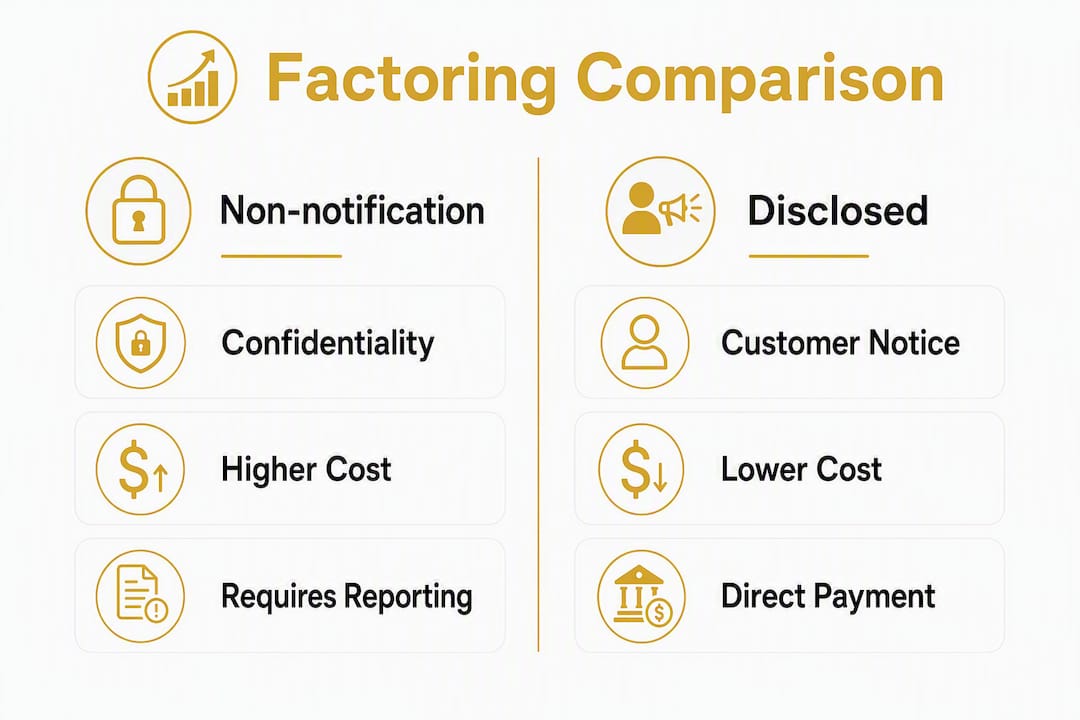
Dimension | Non-notification | Disclosed |
Confidentiality | Full | None |
Cost | Higher (1%–2.5%) | Lower (0.5%–1.5%) |
Credit-control burden | Seller | Factor |
Audit frequency | High | Moderate |
Who qualifies and what it typically costs
Confidential factoring is not a startup product. Funders generally want to see an established business with documented turnover and a collections function that can run independently.
Typical underwriting requirements:
Minimum annual turnover above a defined threshold.
At least one to two years of trading history with filed or audited accounts.
A clean, diversified accounts receivable ledger (no single customer representing more than 25%–30% of receivables).
Documented internal credit-control processes (written policies, aging reports, collection logs).
No material adverse liens or unresolved tax issues.
Cost snapshot: Non-notification service fees run a higher percentage fee of invoice turnover compared to disclosed arrangements. Add arrangement fees, audit fees, and any minimum volume charges when calculating total cost of the facility.
Document checklist:
Three to six months of sales ledger aging reports.
Sample invoices and customer contracts (to check assignment clauses).
Last two years of filed business accounts or tax returns.
Bank statements showing customer payment patterns.
Written credit-control policy or collections procedure.
Timeline: Pre-qualification typically takes a few business days for pre-qualification once documents are submitted. Full facility setup, including ledger audit and trust account opening, usually runs a few weeks.
How to apply for a confidential factoring facility
Do these steps before you contact any funder or broker.
Run an internal ledger audit. Pull your aging report and flag any invoices over 60 days, disputed balances, or customers with anti-assignment clauses in their contracts.
Review your customer contracts. Identify any clause that restricts or prohibits assignment of receivables. These must be resolved before pledging those invoices.
Open a segregated trust account. Have the account ready before funding starts so remittances never touch your operating funds.
Gather your documents. Sales ledger, sample invoices, two years of accounts, bank statements, and your written collections policy.
Submit to a broker or funder. A broker can run a soft pre-qualification and match you to providers whose eligibility criteria fit your ledger profile.
Negotiate terms. Confirm advance rate, reserve percentage, fee structure, audit cadence, and the conditions that would trigger conversion to disclosed status.
Complete the ledger audit. The funder will audit your receivables before drawing down the first advance.
Questions to ask any provider:
What is the advance rate and reserve percentage?
What triggers a conversion from confidential to disclosed?
How often are ledger audits conducted, and what happens if I miss one?
What are the recourse terms if a customer defaults?
Are there minimum volume requirements or early termination fees?
Red flags that should stop you from proceeding:
No audit rights or vague remittance rules in the contract.
Overly broad recourse windows (more than 90 days past invoice due date).
No clear process for handling disputed invoices.
A funder unwilling to confirm confidentiality obligations in writing.
Risks that can end a confidential facility fast
The single biggest operational risk is misdirected or commingled payments. When customer remittances land in your operating account and stay there, even briefly, you are in breach of the trust arrangement. Funders treat that as a default event, and the response is usually immediate: facility suspension, conversion to disclosed status, or termination.
Beyond commingling, watch for these:
Audit failures. Missing or incomplete aging reports are a primary cause of sudden facility withdrawal.
Slow collections. If your days sales outstanding creeps up, the funder’s exposure rises and the facility may be converted.
Concentrated debtor risk. One customer representing a large share of your ledger makes the funder nervous and may trigger a review.
Bankruptcy tracing. If your business enters insolvency, a trustee can trace commingled funds and challenge the funder’s security interest.
Legal considerations for U.S. businesses: Funders typically file a UCC-1 financing statement against your receivables. That filing is public record, even when the factoring arrangement itself is confidential. A customer who searches UCC filings could discover the assignment. Review your customer contracts for anti-assignment language before pledging any invoice, and get a contract attorney to confirm your exposure.
Pro Tip: Set a hard remittance SLA: all customer payments swept to the trust account within 24 hours of receipt. Build that rule into your accounting software as an automated transfer, not a manual task. Manual processes fail under pressure; automated sweeps do not.
How Cotifunding helps you compare confidential invoice financing
Cotifunding is a business financing brokerage, not a direct lender. That distinction matters here: Cotifunding does not underwrite your facility or guarantee rates. What it does is connect you with independent funding providers who offer confidential invoice financing, screen those providers for confidentiality standards, and help you compare offers without you having to approach each funder separately.
What the brokerage process covers for non-notification arrangements:
Pre-qualification. A soft credit pull and ledger review to identify which providers’ eligibility criteria you meet before any formal application.
Provider matchmaking. Cotifunding maintains relationships with funders across the U.S. who offer confidential facilities, including those with lower minimum turnover thresholds than the market average.
Confidentiality handling. Intake is conducted under NDA, and provider introductions are structured to protect your business identity until you choose to proceed.
Documentation support. Help preparing the sales ledger package, contract review checklist, and trust account setup guidance.
Offer comparison. Side-by-side review of advance rates, fee structures, audit requirements, and recourse terms so you can make an informed decision.
A staffing company in the Southeast approached Cotifunding after a direct funder rejected their application due to one large customer representing 35% of their ledger. Cotifunding identified a provider with a higher concentration tolerance, structured the facility around the diversified portion of the ledger, and the business drew its first advance within three weeks of initial contact.
Pro Tip: Before your broker intake call, pull a current aging report and flag your top five customers by balance. That single document cuts the pre-qualification conversation in half and signals to any funder that your credit-control function is already running.
Key Takeaways
Non-notification factoring suits established businesses with strong internal collections, a clean ledger, and customers sensitive to third-party involvement, but it costs more and demands tighter operational discipline than disclosed factoring.
Point | Details |
Who qualifies | Businesses with $500,000+ turnover, 1–2 years trading, and documented credit-control processes. |
Cost premium | Fees run higher for confidential factoring than for disclosed arrangements. |
Biggest operational risk | Commingled customer payments trigger default; a segregated trust account is non-negotiable. |
Legal exposure | UCC-1 filings are public; review customer contracts for anti-assignment clauses before pledging invoices. |
Next step with Cotifunding | Compare confidential facility offers through Cotifunding’s brokerage without approaching multiple funders individually. |
When confidential factoring is the right call, and when it is not
My honest view, after working through dozens of small business financing situations: non-notification factoring is genuinely useful for a narrow band of businesses, and oversold to everyone else.
The businesses where it makes clear sense are those with annual turnover above $500,000, a collections team (even a one-person function) that runs aging reports weekly, and customers who would react badly to a Notice of Assignment. Professional services firms, staffing agencies, and specialty contractors often fit that description. For them, the fee premium is a real cost of doing business, not a red flag.
Where I see it go wrong is when a business owner chooses confidential factoring primarily to avoid the awkward conversation with customers, without having the internal infrastructure to support it. Collections slip, the aging report gets submitted late, and within six months the funder converts the facility to disclosed anyway. At that point, you have paid the higher fee and still ended up where you started.
If your turnover is under $500,000 or your collections process is informal, a business line of credit or an SBA loan will almost always be a cleaner fit. The cost is lower, the operational burden is lighter, and you are not betting your funder relationship on the consistency of your AR team. For businesses that need short-term working capital without pledging receivables at all, a merchant cash advance is worth comparing.
The rule of thumb Cotifunding uses: if you have $500,000+ in annual turnover, a clean and diversified ledger, and customers who are relationship-sensitive, confidential factoring deserves a serious look. If any of those three conditions is missing, start with a different product.
Compare confidential invoice financing options through Cotifunding
Businesses with strong receivables and relationship-sensitive customers get the most from confidential invoice financing, but the right facility depends on your ledger, your customers, and your internal collections capacity. Cotifunding is a brokerage that connects you with independent funders who offer non-notification arrangements across the U.S., so you compare multiple offers in one intake process rather than approaching each provider separately.

To get started, have three things ready: a current sales ledger aging report, two or three sample invoices, and excerpts from your major customer contracts (specifically any assignment or change-of-control clauses). Your intake is handled confidentially, and no funder is introduced until you choose to move forward.
If confidential factoring turns out not to be the right fit, Cotifunding can match you with alternatives including business lines of credit or a merchant cash advance depending on your situation. Start your comparison at cotifunding.com.
Useful sources for further research
The sources below were selected for their practical coverage of non-notification mechanics, eligibility standards, and U.S.-relevant legal considerations.
Non-Notification Factoring: Requirements, Fees, and Risks (LegalClarity) — supports trust-account rules, breach consequences, and the how-it-works section.
Notification vs Non-Notification Factoring (InvoiceFactoringGuide) — covers audit frequency and reporting requirements.
Notification vs Non-Notification Factoring (ResolvePay) — concise comparison of disclosed vs. confidential structures.
What Is Confidential Factoring? (Zenith Group Advisors) — advance and reserve rate mechanics.
Notification vs Non-Notification Factoring (FactorAtlas) — UCC filing visibility and payment instruction clarity.
Confidential/Notified Facility Q&A (MarketInvoice) — fee range benchmarks (UK market; operational lessons apply to U.S. context).
This article is general information, not legal or financial advice. Confirm current eligibility requirements, fee structures, and UCC filing rules with a qualified professional or the relevant primary source before entering any financing arrangement.
Recommended
Disclosure: Coti Funding is not a direct lender. We connect businesses with independent third-party lenders and financing providers. Financing products, rates, terms, funding amounts, approval requirements, and funding timelines vary by provider and applicant qualifications and are not guaranteed. Any rates, terms, examples, or scenarios presented in this article are for general informational and educational purposes only and may not reflect actual offers available to a particular business. Submission of information or an application does not guarantee approval or funding. This content does not constitute financial, legal, tax, or investment advice.
Comments