How to Refinance Business Debt and Lower Your Payments

Updated: Jul 26

Refinancing business debt is worth doing when you can cut your APR, eliminate a balloon payment, or consolidate multiple high-interest accounts into one manageable payment. The short answer: yes, refinance if your current rate is materially higher than what you’d qualify for today, you have no prepayment penalty that erases the savings, and your cash flow can handle the closing costs. If any of those three conditions fail, the math usually doesn’t work.
Two programs worth knowing upfront: the SBA 7(a) loan can refinance most types of business debt, and the SBA 504 can refinance eligible commercial real estate projects. Both carry lower rates than most online lenders, but they take longer to close. Before you do anything else, pull your current loan documents and find the prepayment penalty clause and balloon payment schedule. Those two numbers will tell you more about whether refinancing makes sense than any rate quote will.
Quick next steps:
Run a savings calculation: compare total interest paid under your current loan vs. the new offer (including upfront fees)
Check your prepayment penalty language and get an exact payoff quote from your current lender
Request quotes from at least three lenders before committing
Pro Tip: The single check most owners skip is the balloon payment combined with a prepayment penalty. If your current loan has both, the penalty may apply to the full remaining balance including the balloon — not just the principal you’ve paid down. That can turn a $15,000 projected savings into a net loss.
Table of Contents
Is refinancing the right move for your business right now?
Your business is a good candidate for refinancing when your financial profile has improved since you took the original loan. Improved credit or revenue since the original loan often opens the door to lower APRs or more favorable terms. The flip side is also true: if your cash flow is already stressed, a new loan with closing costs and a hard credit pull can make things worse before they get better.
Signs refinancing likely fits your situation:
Your current APR is significantly higher than current market rates for your credit profile
You’re juggling multiple loans and missing payment windows is a real risk
A balloon payment is coming due within 12 months and you need to extend the term
Your revenue or credit score has improved since the original loan closed
You want to lower monthly payments to free up operating cash
Signs to hold off:
Your business is running negative cash flow month over month
Extending the term would cost more in total interest than you’d save on monthly payments
Prepayment penalties on your current loan would wipe out the rate savings
You’re less than six months into the original loan
Quick self-check (yes/no):
Is your current APR at least 2–3 percentage points above what you’d qualify for today?
Do you have a balloon payment due within 12 months?
Has your credit score or annual revenue improved since the original loan?
Are you paying three or more separate loan payments each month?
Can your business absorb closing costs of 1%–5% of the loan balance?
If you answered yes to two or more of these, refinancing is worth modeling. SBA 7(a) and SBA 504 are worth investigating first if your business has been operating for a significant time and you have solid revenue documentation.
What does refinancing actually cost you?
Refinancing involves fees covering origination charges, closing costs, and prepayment penalties on the old loan. Those costs are real money out of pocket before you see a single dollar of savings.
Full cost checklist before you sign anything:
Origination fee on the new loan (flat fee or percentage)
Closing costs (title, legal, appraisal if commercial property is involved)
Prepayment penalty on the current loan
SBA guarantee fee if using an SBA program
Underwriting or processing fees
The term extension trade-off catches a lot of owners off guard. Dropping your monthly payment can sound great until you realize you’ve extended the loan term and paid more in total interest. Lower monthly payment does not automatically mean lower total cost.
Refinancing also creates a short-term dip in your business credit score from the hard inquiry and the new account opening. That dip typically recovers within 6–12 months if you make payments on time, and the long-term effect of lower utilization and consistent payments is positive. But if you’re planning to apply for another loan within 90 days, the timing matters.
Sample before/after snapshot
Metric | Current loan | Refinanced loan |
APR | — | 10% |
Term remaining | 36 months | 48 months |
In this example, the lower rate saves enough to cover fees and still deliver real savings — but only because the APR gap is wide. Narrow that gap to 3 percentage points and the math gets much tighter.
What refinancing options are available to U.S. small businesses?
Refinancing and consolidation serve different goals: refinancing typically replaces a single loan with better terms, while business debt consolidation merges multiple debts into one new loan. Both can lower your rate, but consolidation also simplifies payment management.

Bank term loans work best for businesses with strong credit (FICO 680+), at least two years of operating history, and documented revenue. Rates are competitive, but underwriting is thorough and funding takes 2–6 weeks.
SBA 7(a) loans can refinance most types of business debt, including term loans, lines of credit, and equipment loans. The SBA loan category covers programs up to $5 million with government-backed guarantees that let lenders offer lower rates. Approval takes 30–90 days.
SBA 504 loans are specifically designed for commercial real estate and major equipment. They can refinance eligible commercial mortgage debt, but cannot be used to refinance an expansion project. Your business must be at least two years old to qualify for a 504 refinance.
Online lenders and alternative term loans accept shorter operating history and lower credit scores, but the trade-off is a higher APR. Community Development Financial Institutions (CDFIs) sometimes offer microloans under $50,000 for small consolidation needs at rates below typical online lenders.
Commercial mortgage cash-out refinance lets you borrow against property equity to pay down high-cost debt. The risk: it increases your total principal and secured exposure, so model the new debt load carefully before proceeding.
Equipment refinancing uses the equipment itself as collateral. If you have equity in machinery or vehicles, this can unlock a lower rate without requiring additional collateral.
Business line of credit refinancing replaces a high-rate revolving line with a lower-rate one. A line of credit for seasonal needs can also serve as a cash-flow buffer while you complete a longer refinance process.
Option | Best for | Typical APR | Speed |
Bank term loan | Strong credit, multiple years in business | competitive rates | 2–6 weeks |
SBA 7(a) | Most business debt types, established businesses | competitive rates | up to several months |
SBA 504 | Commercial real estate, major equipment | competitive rates | up to several months |
Online lender | Limited history, faster need | generally higher rates | days to weeks |
CDFI microloan | Small balances, underserved markets | competitive rates | weeks |
Equipment refinance | Equipment with equity | varies | 1–3 weeks |
What does the refinancing process look like from start to close?
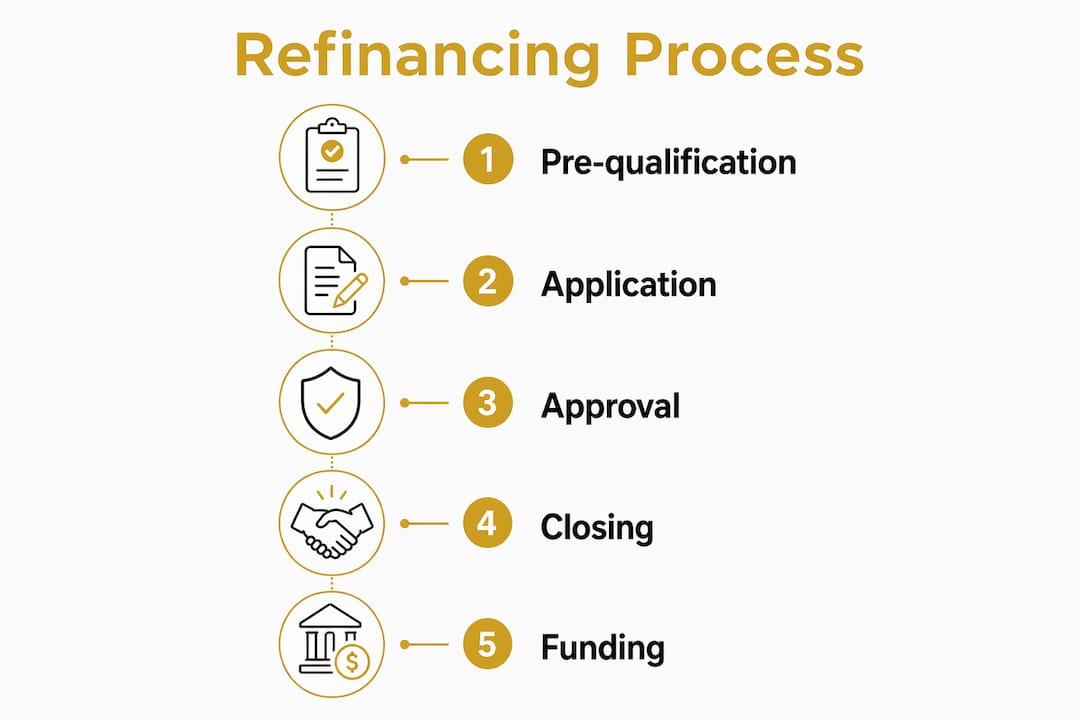
A step-by-step refinance process moves through six stages, and the timeline varies significantly by lender type.
Set your goal — lower monthly payment, lower total interest, or consolidation. This determines which loan type to target. (1–2 days)
Audit your current debt — list every balance, APR, payment schedule, and prepayment penalty clause. Get an exact payoff quote from your current lender. (2–5 days)
Gather documents — tax returns, bank statements, P&L, balance sheet, and loan payoff statements. (3–7 days)
Pre-qualify with multiple lenders — use soft-pull pre-qualification where available to protect your credit score while shopping. (1–3 days per lender)
Submit full applications — once you’ve narrowed to 2–3 offers, submit complete applications. Underwriting may request appraisals, environmental reports, or personal guarantees. (1–4 weeks)
Close and fund — sign documents, pay closing costs, and confirm the new lender pays off the old balance directly. (1–5 days after approval)
Stage | Online lender | Bank | SBA |
Pre-qualification | Same day | 2–5 days | 3–7 days |
Full underwriting | 1–5 days | 1–3 weeks | 3–6 weeks |
Approval to funding | 1–3 days | 3–7 days | 5–10 days |
Total timeline | 3–14 days | 3–6 weeks | 30–90 days |
Pro Tip: Have your last two years of business and personal tax returns, three months of bank statements, and your current loan payoff statement ready before you contact any lender. Owners who walk in with a complete document package cut underwriting time by weeks.

What lenders will check and the documents to prepare
Lenders evaluate several dimensions before approving a refinance. Knowing what they look for lets you address weak spots before applying.
What lenders assess:
Personal credit score (most lenders want 650+; banks and SBA typically prefer 680+)
Business credit score and payment history
Time in business (many programs require 1–2 years minimum)
Annual revenue (requirements vary widely by lender and loan size)
Debt service coverage ratio (DSCR): most lenders want 1.25 or higher, meaning your net operating income covers debt payments with 25% to spare
Collateral value (real estate, equipment, accounts receivable)
Cash flow statements showing consistent income
Document checklist:
Last 2 years of personal and business tax returns
Last 3–6 months of business bank statements
Current profit and loss statement
Balance sheet (current)
Business license and formation documents
Existing loan payoff statements with prepayment penalty disclosure
Proof of collateral ownership (deed, title, or equipment documentation)
If your business is held in an LLC, note that refinancing property inside an LLC can be more complex. Many banks won’t refinance commercial property owned by an LLC without structuring it as a commercial loan, and some require the owner to qualify personally or transfer title. Clarify this with your lender before spending time on an application.
Pro Tip: Pull your business credit report from Dun & Bradstreet or Experian Business before applying. Errors on business credit reports are common and can cost you a full percentage point on your rate.
How to compare refinance offers objectively
Total cost is the only number that matters, and it’s not the monthly payment. Use this formula: Total cost = (monthly payment × number of months) + upfront fees. Then compare that figure across every offer you receive.
Comparison checklist for each offer:
APR (not just the nominal rate)
Term length and total months
Monthly payment amount
Total interest cost over the full term
Upfront fees and closing costs
Prepayment penalty or balloon payment exposure
Payment frequency (monthly vs. weekly vs. daily)
Collateral requirements
Eligibility conditions and personal guarantee requirements
APR matters more than the nominal rate because it folds in fees. A loan advertised at 9% with a 3% origination fee has a higher effective cost than one at 10% with no origination fee, depending on the term.
Before/after comparison: current loan vs. Offer A
Dimension | Current loan | Offer A |
Term | 24 months remaining | 36 months |
Prepayment penalty | — | None |
In this scenario, the savings are real but modest. If Offer A’s term were 48 months instead of 36, total interest would likely exceed the current loan’s cost despite the lower rate. That’s the term extension trap: always run the full-term math, not just the monthly payment comparison.
When is a lower monthly payment worth higher total interest? When your business is cash-flow constrained right now and the freed-up cash will generate more than the extra interest cost. A restaurant buying inventory for a peak season or a contractor funding payroll between projects may rationally accept higher total interest to survive the short term.
When refinancing loses money: a worked example
Here’s a scenario that plays out more often than owners expect.
A business carries a loan at a high APR with some months remaining. A lender offers a significantly lower APR over a longer term, reducing monthly payments. The refinancing includes prepayment penalties and origination fees that add to upfront costs, with monthly savings calculated and a break-even point estimated. Total interest for current and new loans and net savings after fees depend on these variables.
In this case, refinancing wins clearly. But change one variable: make the prepayment penalty 5% instead of 1%, and the penalty alone jumps to $10,000. Add the $4,000 origination fee and you’re paying $14,000 upfront to save $20,740 in interest. The break-even stretches to over six months, and if the business sells or the owner wants to pay off the loan early again, those savings evaporate.
Pro Tip: Ask your current lender for the exact prepayment penalty language in writing, not a verbal estimate. Some penalty clauses are calculated on the original loan amount rather than the remaining balance, which can make the penalty far larger than you’d expect.
The break-even formula is simple: Break-even months = total upfront costs ÷ monthly savings. If the break-even point is longer than you plan to hold the loan, walk away. If you’re refinancing a merchant cash advance, be especially careful: the effective APR on MCA products is often embedded in a factor rate, and you may end up paying interest on interest when you refinance the outstanding balance.
Key Takeaways
Refinancing business debt saves money only when the APR gap is wide enough to cover all fees and penalties within your planned loan horizon.
Point | Details |
Run the total-cost math | Compare (monthly payment × months) + upfront fees across all offers before deciding. |
Check penalties first | Prepayment penalties of 1%–5% can eliminate projected savings; get the exact language in writing. |
SBA programs offer the lowest rates | SBA 7(a) covers most debt types; SBA 504 covers commercial real estate and major equipment refinancing. |
Term extension is a hidden cost | A lower monthly payment with a longer term often costs more in total interest over the life of the loan. |
Cotifunding pre-qualifies with a soft pull | You can check your options through Cotifunding without a hard credit inquiry affecting your score. |
What actually wins refinancing approvals (and where owners lose savings)
Most owners approach refinancing backwards. They find a rate they like and then scramble to assemble documents, which signals to underwriters that the business isn’t organized. The owners who get the best terms walk in with a complete package, a clear payoff figure from their current lender, and a specific ask.
On the negotiation side, a few moves consistently work. First, ask for an origination fee waiver or reduction if you’re bringing a strong credit profile. Lenders have flexibility they don’t advertise. Second, if your current loan has a prepayment penalty, ask the new lender to structure a slightly higher loan amount to cover that cost. It increases principal slightly but eliminates the out-of-pocket hit. Third, offering additional collateral or a personal guarantee can move you from a borderline approval to a full approval with a lower rate.
The businesses that lose savings almost always do so in one of two ways: they don’t get the exact prepayment penalty figure before shopping, or they extend the term so far that the total interest cost exceeds what they would have paid on the original loan. Both are avoidable with 30 minutes of math before the first lender call.
Cotifunding’s soft-pull pre-qualification is genuinely useful here because it lets you see what you’d likely qualify for without triggering a hard inquiry. That means you can shop realistically before committing to a full application. For SBA-eligible businesses, Cotifunding can also guide you through the documentation requirements specific to SBA 7(a) and 504 programs.
Fast pre-qualification for business refinancing through Cotifunding
If you’ve run the math and refinancing makes sense, the next question is speed. Traditional banks take weeks; SBA programs can take months. Cotifunding pre-qualifies small businesses using a soft credit pull, so you can see real options without a hard inquiry hitting your score.

Cotifunding offers term loans, business lines of credit, equipment financing, SBA loan guidance, and invoice factoring. For businesses that need to refinance quickly or consolidate multiple payments into one, the application takes minutes and funding can arrive in as little as 24 hours for qualifying products. For SBA-eligible businesses, Cotifunding’s team walks you through the documentation and program requirements so you’re not navigating that process alone.
The starting point is a pre-qualification at Cotifunding. No commitment, no hard pull, and you’ll know within hours whether a refinance offer is worth pursuing.
Authoritative sources and further reading
Refinance Business Debt — AOF: Practical overview of refinancing options for small businesses; good starting point for understanding the basics.
How to Refinance a Business Loan — NerdWallet: Step-by-step process guide with eligibility criteria and cost considerations; useful for building your comparison checklist.
Business Debt Consolidation — Nav: Covers consolidation vs. refinancing distinctions, cash-out trade-offs, and MCA refinancing nuances.
Business Debt Consolidation FAQs — Business.com: Practical FAQ format covering when consolidation makes sense and common pitfalls.
Refinancing Business Loans — LendingTree: Covers SBA 7(a) and 504 refinance eligibility rules and loan type comparisons.
Business Debt Consolidation Loans — SoFi: Explains the mechanics of consolidation loans and APR trade-offs.
Refinance a Business Loan — SoFi: Covers fee ranges (1%–5%) and the step-by-step refinance process.
Refinancing an LLC-Held Property — Bradley Legal Corp: Explains the specific challenges of refinancing commercial property held inside an LLC.
Small Business Borrowers’ Bill of Rights — Aspen Institute: Outlines fair lending standards and disclosure rights; useful when evaluating lender transparency.
Request a current payoff quote from your existing lender before running any refinance calculation. That single number, combined with the exact prepayment penalty language, is the foundation of every comparison that follows.
This article is general information, not financial or legal advice. Confirm current program requirements and your specific eligibility with a qualified lender or financial professional before making any refinancing decision.
Recommended
Disclosure: Coti Funding is not a direct lender. We connect businesses with independent third-party lenders and financing providers. Financing products, rates, terms, funding amounts, approval requirements, and funding timelines vary by provider and applicant qualifications and are not guaranteed. Any rates, terms, examples, or scenarios presented in this article are for general informational and educational purposes only and may not reflect actual offers available to a particular business. Submission of information or an application does not guarantee approval or funding. This content does not constitute financial, legal, tax, or investment advice.
Comments