SBA Express Loan: What Small Business Owners Need to Know


An SBA Express loan is a faster, delegated-authority option within the U.S. Small Business Administration’s 7(a) program that delivers capital for eligible small businesses, with a maximum loan amount capped at $500,000 [SBA]. Cotifunding works as a brokerage to help you find the right lender for it. The core trade-off is straightforward: you get speed and a streamlined underwriting process, but the SBA’s guarantee drops to 50% (versus up to 85% on standard 7(a) loans), which means lenders carry more risk and apply their own credit policies on top of SBA rules.
When SBA Express is the right fit:
You need working capital fast and your funding need is $500,000 or less
You’re making a time-sensitive equipment purchase and can’t wait months for a standard approval
When it probably isn’t:
Your project requires more than $500,000 — a standard 7(a) loan covers up to $5 million with a higher SBA guarantee, which gives lenders more room to work with
Table of Contents
What is an SBA Express loan and how does delegated authority work?
The SBA Express program is a delivery method inside the broader 7(a) loan program, not a separate product. What makes it distinct is delegated authority: approved lenders can process, close, service, and liquidate these loans without SBA review at each stage. The SBA issues a loan number quickly once the lender submits, but the credit decision itself belongs entirely to the lender.
That shift has real consequences. Because the lender absorbs more of the risk — the SBA guaranty is 50% compared to up to 85% on standard 7(a) loans — each lender’s internal underwriting policies carry significant weight. One lender might require two years of tax returns and a minimum FICO of 680; another might accept 650 with strong cash flow. The SBA sets the floor; the lender builds the house.
Practical consequences for borrowers:
Faster SBA decision (often days, not weeks), but actual funding still depends on lender closing speed
Lender documentation requirements vary more than in standard 7(a) processing
Lender risk appetite for your industry, collateral position, and credit profile determines approval odds as much as SBA eligibility does
Pro Tip: Matching your business profile to a lender whose internal risk appetite fits your situation is the single biggest factor in getting approved quickly. A brokerage like Cotifunding can identify which lenders are most likely to approve your specific profile before you submit a single application.
What are the actual loan amounts, terms, rates, and collateral rules?
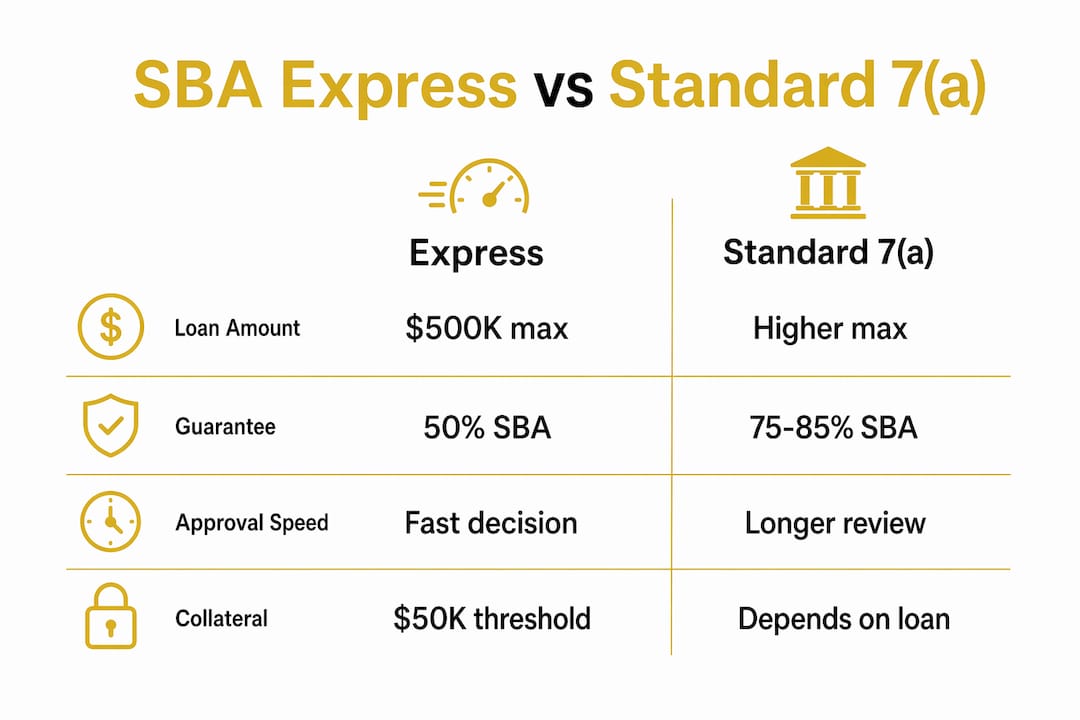
The SBA Express program caps at $500,000 — and individual lenders may set their own lower internal limits based on their portfolio strategy.
The SBA guarantee on Express loans sits at 50%, compared to 75–85% on standard 7(a) loans. That gap matters because it directly affects how much risk a lender absorbs, which is why Express lenders tend to be more selective about credit quality and collateral.
Repayment terms vary by how you use the funds. Working capital and equipment loans carry terms up to 10 years; real estate, when permitted under Express, can extend to 25 years. Lines of credit under Express have a revolving period of up to 10 years.
Interest rates on SBA Express loans are tied to a base rate (typically the prime rate or SOFR) plus a lender spread, with the SBA setting maximum allowable markups. Rates vary by lender and loan size, so the number you see in one place may not reflect what you’ll actually be quoted.

Collateral: The SBA does not require collateral for loans of $50,000 or less. Above that threshold, lenders routinely apply their own collateral policies — business assets, equipment liens, or real property. Don’t assume “no SBA collateral requirement” means no collateral at all; ask the lender directly.
Feature | SBA Express | Standard 7(a) |
Maximum loan amount | $500,000 maximum | higher standard 7(a) maximum |
SBA guaranty | 50% | up to 75–85%, depending on loan size |
Max term (working capital) | up to 10 years | similar term length |
Max term (real estate) | up to 25 years when permitted | similar extension |
Collateral (SBA rule) | no collateral required for loans of $50,000 or less | no collateral required for loans of $50,000 or less |
Underwriting authority | Lender (delegated) | SBA review required |
What can you actually use SBA Express loan funds for?
The permitted uses are broad, which is part of the program’s appeal for small business owners who need flexible capital.
Allowed uses:
Working capital (day-to-day operations, payroll, seasonal cash flow gaps)
Equipment purchases and machinery
Inventory acquisition
Refinancing existing business debt, subject to SBA conditions (the debt must be on reasonable terms and the refinance must benefit the business)
Business acquisition, with lender approval
Leasehold improvements and tenant build-outs
Limited commercial real estate purchases (note: for large real estate projects, an SBA 504 loan is usually a better fit given its longer terms and lower down payment requirements)
What’s excluded or restricted:
Personal expenses of any kind
Passive real estate investment (rental properties held purely for income)
Businesses in certain ineligible industries (gambling, lending, some non-profits)
Speculative investments
One variation worth knowing: the SBA Export Express program is a parallel product specifically for businesses that export goods or services. It carries the same $500,000 cap and delegated authority structure but is designed around export-related working capital and standby letters of credit. If your business has an international sales component, it’s worth asking a lender whether Export Express applies.
Who qualifies for an SBA Express loan?
SBA baseline eligibility applies to all 7(a) products. Your business must be a for-profit entity operating in the U.S., fall within SBA size standards for your industry, demonstrate an ability to repay, and operate in an eligible industry. Owners must be U.S. citizens or lawful permanent residents; non-citizen ownership situations have additional considerations worth discussing with a broker.
Beyond the SBA baseline, lenders layer their own requirements. These vary, but the most common thresholds look like this:
Minimum credit score: Most lenders want a personal FICO of 650 or higher; some prefer 680+
Time in business: Two years of operating history is the common benchmark, though some lenders will consider less with strong financials
Cash flow / DSCR: Lenders want to see that your business generates enough cash to cover debt payments, typically a debt service coverage ratio above 1.25
Personal guaranty: Required from all owners holding 20% or more of the business
Collateral: Lenders often require liens on business assets for loans above $50,000, even when the SBA does not mandate it
Document checklist — what to gather before you apply:
Two to three years of business tax returns
Two to three years of personal tax returns (all 20%+ owners)
Year-to-date profit and loss statement and balance sheet
SBA Form 1919 (borrower information form)
Personal financial statement (SBA Form 413 or lender equivalent)
Business licenses, articles of incorporation, or operating agreement
Accounts receivable and payable aging schedules (if applicable)
Existing debt schedule
“Express” does not mean the documentation bar is lower. As third-party lenders note, the speed comes from the decision process, not from reduced scrutiny of your financial health.
How do you apply for an SBA Express loan, step by step?
The application process follows a logical sequence, but the steps where most borrowers lose time are document preparation and lender selection — not the SBA forms themselves.
Estimate your funding need and use. Know your number and what you’ll spend it on before you approach any lender. Lenders want a clear purpose.
Gather your documents. Use the checklist above. Incomplete packages are the single most common cause of delays.
Select a lender or work with a broker. Not every SBA-approved lender offers Express loans, and those that do have different risk appetites. A broker can match you to likely-approving lenders faster than cold-calling banks.
Submit the application. This includes SBA Form 1919, the lender’s own application forms, and your full document package. The lender reviews everything under its delegated authority.
Lender underwrites and issues a decision. Because the lender doesn’t need SBA sign-off on the credit decision, this stage moves faster than standard 7(a) processing. The SBA assigns an E-Tran loan number once the lender approves.
Closing and funding. The lender prepares loan documents, you sign, and funds are disbursed. This stage can take days or several weeks depending on lender workload and how clean your documentation is.
Realistic timeline: Lender decisions can come in days rather than the weeks a standard 7(a) review requires. Actual funding, however, typically takes several weeks from application to disbursement when you account for document review, underwriting, and closing. “Express” describes the decision speed, not the time from application to cash in your account.
Pro Tip: Before you submit, clear any known problem items: outstanding tax liens, unfiled returns, or messy bookkeeping. These don’t just slow approval — they can trigger an outright denial. Spending two weeks cleaning up your financials before applying is almost always faster than reapplying after a rejection.

For a deeper look at tactics that shorten SBA timelines, the SBA speed strategies resource at Cotifunding covers practical steps borrowers often overlook.
How do you choose the right lender, and does using a broker help?
The lender you pick matters as much as the loan product itself. Because delegated authority puts the credit decision in the lender’s hands, two SBA-approved lenders can reach completely different conclusions about the same application. One lender’s internal policy might exclude your industry; another might require a minimum loan size above what you need.
What to evaluate when selecting a lender:
Does the lender have SBA Express delegated authority?
What is their minimum and maximum loan size for Express?
Do they have experience with your industry, or do they avoid it?
What is their internal minimum FICO and DSCR requirement?
What collateral do they require above $50,000?
What is their average time from application to funding?
Asking these questions upfront saves weeks. Most borrowers don’t ask them and find out the hard way after a denial.
Broker vs. direct application: Going directly to one lender means you’re betting your time on that lender’s appetite matching your profile. A brokerage like Cotifunding connects your application to multiple lenders simultaneously, which means you’re matched against several sets of internal policies at once. A single submission can surface the lender most likely to approve your specific situation — without the credit-score impact of multiple hard pulls.
Hypothetical example (for illustration only): A restaurant owner with a 660 FICO and 18 months in business applies directly to a bank that requires 680 and two years of history. Denied. The same owner, working through a broker, gets matched to a lender whose internal policy accepts 650 with strong cash flow documentation. Approved. The SBA rules were identical in both cases; the lender’s internal policy was the deciding variable.
Pro Tip: Ask every lender three questions before you submit: What is your minimum FICO for SBA Express? Do you lend to my industry? What is your average time from application to funding? Any lender that can’t answer all three clearly is not worth your time.
Understanding when a commercial loan vs. SBA loan makes more sense for your situation is also worth reviewing before you commit to either path.
Key Takeaways
The SBA Express loan is the right choice when you need SBA-backed capital under $500,000 quickly, your financials are solid, and matching the right lender to your profile is the primary obstacle.
Point | Details |
Loan cap and structure | SBA Express tops out at $500,000 and can be structured as a term loan or revolving line of credit. |
Lower SBA guarantee | The SBA guaranty is 50%, compared to up to 75–85% on standard 7(a) loans depending on loan size, so lender policies carry more weight. |
Collateral threshold | The SBA does not require collateral for loans of $50,000 or less; lenders often require it above that amount. |
Speed is real, but partial | Lender decisions can arrive in days; actual funding typically takes several weeks from application to disbursement. |
Cotifunding’s role | Cotifunding is a brokerage that matches your profile to multiple SBA Express lenders, helping you avoid single-lender rejection traps. |
The part most guides skip about SBA Express
The conventional wisdom on SBA Express loans focuses almost entirely on speed. Faster approval, faster decision, faster capital. That framing is accurate but incomplete, and it leads a lot of business owners to apply to the wrong lender and lose weeks they were trying to save.
The real story is about lender fit. Because the SBA’s guarantee is only 50% on Express loans, lenders absorb a larger share of the risk than they do on standard 7(a) products. That means their internal underwriting policies are stricter and more varied than most borrowers expect. For example, a lender that’s aggressive about Express lending for retail businesses might be deeply conservative about restaurants or construction. A lender that loves Express for equipment financing might have a hard floor on loan size that excludes your $150,000 request.
Most borrowers don’t know this going in. They hear “SBA Express” and assume the SBA is the decision-maker. It isn’t. The lender is. And the lender’s internal policy is not published anywhere.
This is where a brokerage earns its value — not by doing paperwork, but by knowing which lenders are actually likely to say yes to your specific profile before you spend three weeks assembling documents for a lender that was never going to approve you. The Cotifunding approach is built around that matching process, which is a fundamentally different thing from just submitting your application to whoever answers the phone first.
One more thing worth saying plainly: “Express” does not mean easy. Lenders still want two years of tax returns, a clean credit history, and evidence that your business generates enough cash to repay the debt. The speed is in the decision process, not in the documentation bar. Business owners who go in expecting a quick approval on thin financials almost always come out disappointed.
Cotifunding can match you to the right SBA Express lender faster
Sorting through SBA Express lenders on your own means cold-calling banks, asking the same questions repeatedly, and hoping the one you pick happens to match your profile. Cotifunding takes a different approach: as a business financing brokerage, it connects small business owners to a network of independent funding providers, matching your specific profile against multiple lenders’ internal policies in a single process.
You get a soft credit pull pre-qualification, which means no hard inquiry while you’re still figuring out which lender fits. Before you reach out, pull together your last two years of business and personal tax returns, a current profit and loss statement, and a clear sense of how much you need and why. That prep work makes the matching process faster and gives lenders what they need to move quickly.
Cotifunding does not underwrite loans or make lending decisions. Its value is in the matching: knowing which lenders are actively approving profiles like yours, so you’re not burning time on applications that were never going to work. Start your pre-qualification and see which SBA Express lenders fit your situation.
Useful sources and further reading
The sources below were used to verify program rules, guarantee percentages, and eligibility details in this article.
Official SBA guidance (primary sources):
Types of 7(a) loans — U.S. Small Business Administration (official government guidance on SBA Express delegated authority and collateral rules)
Terms, conditions, and eligibility — U.S. Small Business Administration (official SBA guarantee percentages and program eligibility)
SBA 7(a) loan program overview — SBA.gov (program overview and loan type navigator)
Third-party explainers (commentary and practical guidance):
SBA Express Loan: What It Is and How to Apply — NerdWallet (third-party guide covering permitted uses, forms, and application steps)
SBA Express Loan: Requirements and How to Apply — Lendio (third-party guide on delegated authority, timelines, and lender underwriting)
SBA Express Loans: The Ultimate Guide — Fundera (third-party guide covering typical lender credit thresholds)
Need Funds Fast? Here’s How an Express Loan Can Help You — WestConsin Credit Union (lender-level perspective on express loan misconceptions)
Recommended
Disclosure: Coti Funding is not a direct lender. We connect businesses with independent third-party lenders and financing providers. Financing products, rates, terms, funding amounts, approval requirements, and funding timelines vary by provider and applicant qualifications and are not guaranteed. Any rates, terms, examples, or scenarios presented in this article are for general informational and educational purposes only and may not reflect actual offers available to a particular business. Submission of information or an application does not guarantee approval or funding. This content does not constitute financial, legal, tax, or investment advice.
Comments