SBA Microloan Program: A Practical Guide for Small Businesses


The SBA Microloan program provides up to $50,000 through locally based nonprofit intermediary lenders and is best suited for startups, microbusinesses, and nonprofit childcare centers that need small-dollar capital paired with hands-on business training. The program maximum is $50,000, but the average loan historically runs around $13,000–$16,000, which tells you something important: most borrowers aren’t maxing it out. If you need less than $50,000 and would benefit from structured business support alongside the money, this program deserves a serious look. Start by using the SBA intermediary locator to find a lender in your area, or contact a financing broker to compare intermediaries and faster alternatives side by side.
Table of Contents
What is the SBA Microloan program and how does it work?
The SBA doesn’t lend directly to borrowers under this program. Instead, it funds a network of nonprofit intermediary lenders — often Community Development Financial Institutions (CDFIs) and community-based organizations — that then make loans to eligible small businesses. Think of it as a three-tier chain: SBA provides capital to the intermediary, the intermediary underwrites and funds the loan, and the borrower repays the intermediary.
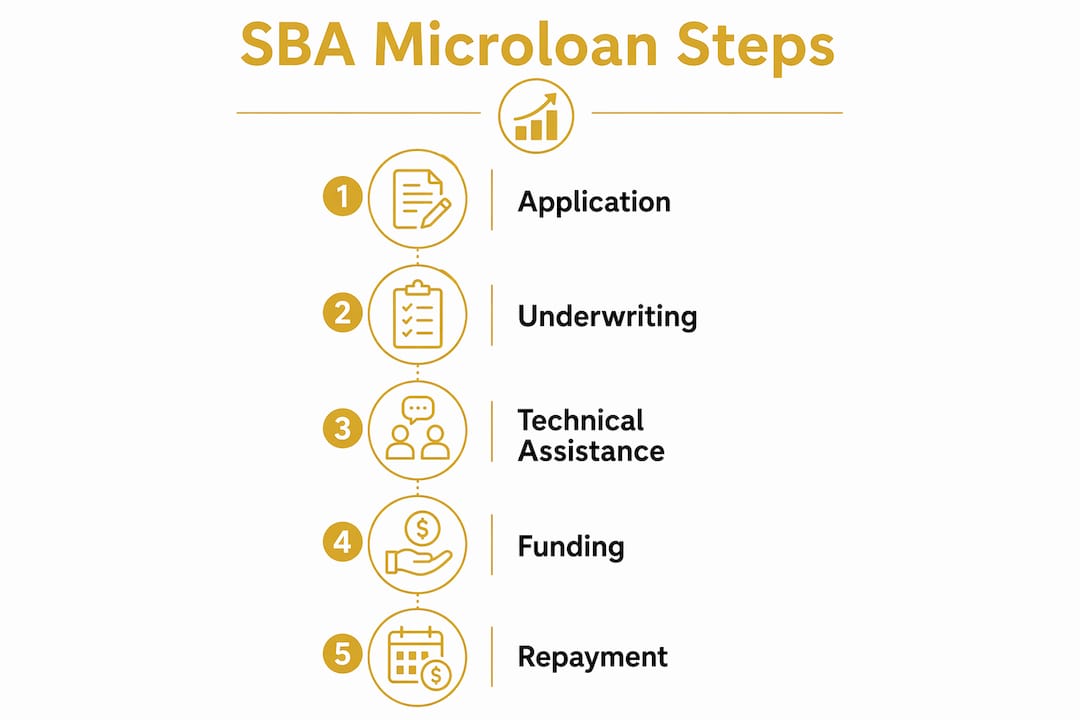
That structure matters for a few reasons. The intermediary handles all underwriting, sets documentation requirements, and determines the actual loan size you receive. SBA sets the ceiling and the rules; the intermediary makes the call. This is why terms, rates, and even eligibility criteria can vary significantly depending on which intermediary you work with and where you’re located.
Key program facts:
Maximum loan amount: $50,000 per borrower
Average loan size: typically below the maximum, varying by fiscal year and intermediary
Loan purpose: working capital, inventory, equipment, startup costs (not real estate or debt refinancing)
Technical assistance: required or strongly encouraged as part of the lending relationship
Who underwrites: the intermediary, not the SBA
Intermediaries also maintain a Microloan Revolving Fund and a Loan Loss Reserve Fund, which affects how much they can lend at any given time and whether they can serve your geographic area. If an intermediary tells you they’re at capacity or can’t serve your ZIP code, that’s why.
Who qualifies for an SBA microloan?
Eligibility is broader than most people expect, which is one of the program’s genuine strengths. The baseline requirements are:
For-profit small business that meets SBA size standards for its industry
Certain nonprofit childcare centers (one of the few nonprofit categories eligible)
Located within the intermediary’s service area — this is a hard geographic constraint
Startups are eligible — you don’t need an operating history to apply
Beyond those baseline rules, each intermediary sets its own underwriting criteria. One CDFI might require six months of bank statements; another might accept a strong business plan and personal financial statement alone. Intermediaries may weigh business plan quality, owner character, and market potential alongside credit score — which makes this program genuinely accessible for entrepreneurs with limited credit history.
How hard is it to get approved? Harder than a credit card, easier than a conventional bank loan. The main factors that determine approval are the quality of your business plan, your cash-flow projections, your personal credit history (even if imperfect), and whether you’ve engaged with the intermediary’s technical assistance program. Applicants who show up prepared and have completed or enrolled in TA tend to fare better.
Common disqualifiers include operating in industries SBA deems ineligible (gambling, lending, certain speculative businesses), prior felony convictions within a specified lookback period, and being outside the intermediary’s geographic service area. Some intermediaries also have minimum loan sizes, so if you need $2,000, not every lender will accommodate that.
One underappreciated fact: because the program is decentralized, a rejection from one intermediary doesn’t close the door permanently. The same business profile that doesn’t fit one lender’s criteria might be a strong match for another’s.
What can you use microloan funds for?
The permitted uses are specific, and two common assumptions trip up applicants every year.
Permitted uses:
Working capital (payroll, rent, operating expenses)
Inventory and supplies
Furniture and fixtures
Machinery and equipment
Startup costs
Not permitted:
Purchasing real estate
Paying off or refinancing existing debt
That second restriction catches people off guard. If you were planning to use a microloan to consolidate credit card debt or pay off a prior business loan, that’s a compliance issue — proceeds cannot be used to pay existing debt or buy real estate. Plan your use of funds around forward-looking business needs only.
On loan sizing: the program cap is $50,000, but most intermediaries keep the majority of their loans well under that, with the average loan reported around $13,000–$16,000. Many focus below the maximum, especially for first-time borrowers. A hypothetical example: a food truck operator needing $18,000 for a commercial refrigeration unit and initial inventory is a natural fit. A startup retailer needing $12,000 for shelving, fixtures, and opening inventory is another. These are the use cases intermediaries see regularly and underwrite with confidence.
Match your requested amount to a specific, itemized use-of-funds plan. Vague requests (“general working capital”) are harder to approve than a clear breakdown showing exactly what the money buys and how the business generates enough cash flow to repay it.
How intermediaries, technical assistance, and underwriting actually work
The intermediary’s role
Intermediary lenders are nonprofit, community-based organizations — many are CDFIs — that receive SBA funding and deploy it as microloans. They’re not just pass-through lenders. Their mission is business development, which is why technical assistance is baked into the program. Some intermediaries require borrowers to complete business training before or after funding; others make it strongly encouraged. Either way, it’s a real part of the relationship.

Why technical assistance is worth taking seriously
Most borrowers treat TA as a bureaucratic hurdle. That’s a mistake. The intermediary’s business advisors often have direct insight into what the underwriting team wants to see. Borrowers who engage genuinely — refining their cash-flow projections, pressure-testing their pricing assumptions, getting feedback on their business plan — tend to submit stronger applications. The TA isn’t separate from the loan process; it feeds directly into it.
What intermediaries look at when underwriting
Business plan quality and market analysis
Cash-flow projections (can the business actually repay?)
Owner experience and character references
Personal credit history (not necessarily a minimum score, but reviewed)
Collateral availability (personal assets, equipment, inventory)
The “credit elsewhere” test for larger loan requests — whether the borrower could reasonably obtain financing from conventional sources
Pro Tip: Engage with the intermediary’s TA program before you submit your formal application. Ask the advisor directly what the underwriting team prioritizes. That conversation often surfaces gaps in your business plan you wouldn’t have caught otherwise.
How to apply for an SBA microloan: step-by-step
Step-by-step process
Find an intermediary — Use the SBA microlender list or the SBA lender locator to identify intermediaries serving your ZIP code. Contact two or three if possible.
Attend an orientation or intake meeting — Most intermediaries require an initial meeting before accepting a formal application. Use this to ask about their loan sizes, TA requirements, and typical timelines.
Prepare your documents (see checklist below).
Complete or enroll in technical assistance — Some intermediaries require this before you can submit a formal application.
Submit your formal application — Including all required documents and a clear use-of-funds memo.
Underwriting review — The intermediary reviews your file, may request additional documents, and makes a credit decision.
Loan closing — Sign loan documents, complete any remaining TA requirements.
Funding — Funds are disbursed, typically by ACH or check.
Required documents checklist
Business plan with market analysis and financial projections
Projected cash-flow statement (12–24 months)
Personal and business bank statements (typically 3–6 months)
Personal tax returns (2–3 years if available)
Business tax returns (2–3 years if the business has been operating)
Government-issued photo ID for all owners
Lease agreement or letter of intent for business location
Equipment quotes or vendor invoices (for equipment purchases)
Ownership and formation documents (articles of incorporation, operating agreement)
Personal financial statement
Credit authorization (soft or hard pull, depending on intermediary)
Use-of-funds memo (a one-page breakdown of exactly how you’ll spend the loan)
Pro Tip: Prepare a one-page use-of-funds memo before your first intermediary meeting. A clear, itemized breakdown — “X for equipment, Y for inventory, Z for first-month operating costs” — signals that you’ve thought through the business, not just the loan amount.
Repayment terms, interest rates, and fees
Who sets your rate
Intermediaries set borrower rates within caps established by federal regulation. Per 13 CFR § 120.707, an intermediary may not charge a spread above its SBA cost of funds that exceeds 7.75% for loans over $10,000, or 8.5% for loans of $10,000 or less. In practice, this produces borrower rates that typically fall in the 8%–13% range, though your actual rate depends on the intermediary and current SBA cost-of-funds rates.

Term | Program Rule |
Maximum loan amount | Set by SBA regulation |
Maximum repayment term | Several years, depending on loan use |
Rate cap (loans > $10,000) | SBA loan rate plus a regulated spread |
Rate cap (loans ≤ $10,000) | SBA loan rate plus a regulated spread |
Typical market rate range | Varies based on intermediary and loan size |
Fees to ask about
Before accepting any offer, request a full breakdown from the intermediary:
APR (not just the stated interest rate)
Origination fee (if any)
Prepayment penalty (most microloans don’t have one, but confirm)
Late payment fees
Total cost of loan example (principal + all interest + all fees over the full term)
Pro Tip: Ask the intermediary for a full amortization schedule and a total-cost calculation before you sign. A loan at 10% with a 2% origination fee costs more than it looks at first glance — seeing the actual dollar amounts over the full term makes the comparison real.
Pros, cons, and when to choose a microloan over alternatives
Microloan pros and cons
Pros | Cons |
Accessible to startups and limited-credit borrowers | Smaller loan amounts (max $50,000) |
Technical assistance included | Slower process than independent lenders |
Community-focused underwriting | Collateral and personal guarantee often required |
Competitive rates within statutory caps | Geographic service-area restrictions |
No minimum operating history required | Intermediary capacity constraints can limit availability |
How microloans compare to common alternatives
Feature | SBA Microloan | Business Line of Credit | Equipment Financing | Short-Term Working Capital |
Typical size | $13,000–$16,000 on average (cap $50,000) | $10,000–$50,000 | Matches equipment cost | $5,000–$50,000 |
Speed to funding | 4–12 weeks | Days to 2 weeks | 1–5 business days | 24 hours |
Underwriting flexibility | High (community focus) | Moderate | Moderate (asset-backed) | High (revenue-based) |
Best for | Startups, limited credit, TA needed | Recurring cash-flow gaps | Specific equipment purchase | Immediate working capital |
Technical assistance | Yes | No | No | No |
When to choose a microloan
You need less than $50,000 and have limited credit history
You’re a startup without operating history
You want structured business training alongside the capital
You have time in your cash-flow plan to accommodate a 4–12 week process
When to consider an alternative
You need funds within days, not weeks
Your loan need exceeds $50,000
You’re buying equipment and want asset-backed financing with faster approval (see equipment financing options)
You need a revolving credit line for ongoing working capital needs
A financing broker can surface all of these options in a single conversation, which is considerably faster than contacting five intermediaries individually.
Where to find SBA microloan lenders near you
The SBA maintains a list of authorized microlenders organized by state. Select your state from the dropdown, and you’ll get the intermediary’s name, contact information, and service area. Download the CSV if you want to scan multiple states at once.
Beyond the SBA list, two other resources are worth using:
Small Business Development Centers (SBDCs): Free advising available at hundreds of locations nationwide. SBDC advisors can help you prepare your business plan and financial projections before you approach an intermediary — and many have working relationships with local CDFIs. Find your nearest SBDC at americassbdc.org.
CDFI Fund directory: The U.S. Treasury’s CDFI Fund maintains a searchable database of certified CDFIs at cdfifund.gov. Not all CDFIs participate in the SBA microloan program, but many do, and the directory helps you identify community lenders in your market.
When you contact an intermediary, come prepared with three questions: What is your typical loan range? What does your TA requirement look like? What is your current average time from application to funding? Those answers will tell you quickly whether the lender is a realistic fit.
What’s the realistic timeline from application to funding?
Expect 4–12 weeks from first contact to funded loan. Here’s how that typically breaks down:
Finding and contacting an intermediary: 1–2 weeks (longer if your area has limited options)
Orientation meeting and TA enrollment: 1–2 weeks
Document preparation and formal application submission: 1–3 weeks (depends on how organized your financials are)
Underwriting review: 2–4 weeks
Loan closing and funding: 1–2 weeks after approval
Common causes of delay and how to reduce them:
Missing documents: Prepare the full checklist before your first meeting. A complete file moves faster.
Incomplete business plan: Use SBDC or TA advisor feedback to finalize projections before submission.
Slow TA scheduling: Book your TA sessions as early as possible — don’t wait for the intermediary to prompt you.
Collateral valuation issues: If you’re pledging equipment or inventory, have documentation of value ready upfront.
If your business needs capital faster than this timeline allows, a short-term working capital product or a business line of credit can bridge the gap while your microloan application processes. A broker can help you run both tracks simultaneously without doubling your workload.
How a financing broker can help with your SBA microloan application
Cotifunding is a business financing brokerage — not a lender, and not an SBA intermediary. That distinction matters: Cotifunding does not underwrite loans, fund disbursements, or guarantee approvals, rates, or terms. Borrowers sign loan agreements directly with the intermediary or funding provider.
What a brokerage does is save you time and improve your options:
Soft-pull prequalification — Cotifunding can assess your profile without a hard credit inquiry, giving you a realistic picture of where you stand before you commit to a specific intermediary.
Intermediary matching — Rather than contacting five CDFIs individually, a broker identifies which intermediaries serve your area and align with your loan size and business type.
Application packaging support — Brokers familiar with microloan requirements can help you organize your documents, sharpen your use-of-funds memo, and flag gaps before submission.
Parallel option comparison — If the microloan timeline doesn’t fit your cash-flow needs, a broker can simultaneously surface faster alternatives (equipment financing, working capital, term loans) so you’re not waiting on one path.
TA preparation guidance — Brokers can advise on how to approach the technical assistance component to strengthen your application, not just complete it.
For readers who want more context on SBA programs broadly, Cotifunding’s SBA resource hub covers related loan types and eligibility considerations.
Key Takeaways
The SBA Microloan program is the most accessible federal small-business loan for startups and microbusinesses with limited credit history, but its 4–12 week timeline and $50,000 ceiling mean it works best when paired with a clear use-of-funds plan and early engagement with technical assistance.
Point | Details |
Who it suits | Startups, microbusinesses, and nonprofit childcare centers needing under $50,000 with limited credit history. |
Typical loan sizes | Average loans run $13,000–$16,000; the program cap is $50,000. |
Technical assistance matters | Engaging with TA early strengthens your application and improves approval odds. |
Documents to prepare | Business plan, cash-flow projections, tax returns, bank statements, ID, and a one-page use-of-funds memo. |
Cotifunding’s role | Cotifunding is a brokerage that can prequalify, match, and compare microloan intermediaries and faster alternatives without a hard credit pull. |
What a financing specialist actually sees in microloan applications
Most microloan applications that stall share the same problem: the business plan and the use-of-funds request don’t tell the same story. An applicant asks for $22,000 but the cash-flow projection only supports repayment on $14,000. Or the use-of-funds memo says “equipment and working capital” with no line-item breakdown. Intermediaries aren’t being difficult when they ask for more documentation — they’re trying to build a case for approval internally, and a vague application makes that harder.
Three things that consistently separate funded applications from stalled ones:
A one-page use-of-funds memo with line items. Not a paragraph — an actual table showing what each dollar buys and when. It takes 30 minutes to build and signals serious preparation.
Cash-flow projections that account for the loan repayment. Many applicants project revenue and expenses but forget to include the monthly loan payment in their outflows. That omission raises an immediate flag.
Comparing amortization scenarios across at least two intermediaries. Rates and terms vary more than most borrowers realize. A broker or SBDC advisor can run side-by-side scenarios so you’re choosing based on total cost, not just the stated rate.
Cotifunding can help you prepare and compare your options
Applying for an SBA microloan without comparing intermediaries is like accepting the first price you’re quoted on anything. Cotifunding connects small businesses to a network of third-party funding providers — including SBA intermediaries and faster independent lenders — through a single, streamlined process that starts with a soft credit pull and no commitment.
The workflow is straightforward: soft-pull prequalification, intermediary or lender matching based on your business profile and funding need, application packaging support, and guidance on TA preparation. You sign directly with the intermediary or funding provider — Cotifunding doesn’t lend or guarantee outcomes. What you get is a faster, more informed path through a process that can otherwise take weeks of cold calls and duplicate paperwork.
Whether you’re a startup in Florida or a microbusiness anywhere in the country, start your prequalification today and see which options fit your situation before committing to a single lender.
This article is general information, not financial or legal advice. Confirm current program rules and your specific eligibility with the SBA or a qualified professional before applying.
Useful sources and official links
SBA Microloan Program overview — Official program page with eligibility rules, permitted uses, and links to the intermediary locator.
SBA list of authorized microlenders — Searchable, state-by-state directory of participating intermediaries; download the full CSV for a complete national list.
SBA microloan program partner page — Program details for intermediaries, including forms, program updates, and lender guidance.
13 CFR § 120.707 (Cornell Law / e-CFR) — The federal regulation governing loan conditions between intermediaries and borrowers, including rate-spread caps.
e-CFR Part 120 Subpart G — Full regulatory text covering technical assistance requirements and program rules for intermediaries.
America’s SBDC — Find a Small Business Development Center near you for free business advising and application preparation support.
CDFI Fund directory (U.S. Treasury) — Searchable database of certified CDFIs, many of which participate in the SBA microloan program.
Recommended
Disclosure: Coti Funding is not a direct lender. We connect businesses with independent third-party lenders and financing providers. Financing products, rates, terms, funding amounts, approval requirements, and funding timelines vary by provider and applicant qualifications and are not guaranteed. Any rates, terms, examples, or scenarios presented in this article are for general informational and educational purposes only and may not reflect actual offers available to a particular business. Submission of information or an application does not guarantee approval or funding. This content does not constitute financial, legal, tax, or investment advice.
Comments