Soft Pull Business Loans: Prequalify Without Hurting Credit


Yes, you can shop for business financing using only a soft credit pull — and for many small business owners, that is exactly the right first move. Products like merchant cash advances, invoice factoring, and revenue-based financing routinely use soft inquiries for prequalification, meaning your FICO score stays untouched while you compare offers. Cotifunding works as a brokerage that connects owners with funding providers using this approach, so you can see real options before any formal underwriting begins. The catch: most lenders, including those who start with a soft pull, move to a hard inquiry before releasing funds.
Here is where to start:
Shop through a broker first. A brokerage like Cotifunding can run soft-pull prequalification across multiple funding providers without you contacting each one separately.
Gather your documents now. Three to six months of bank statements, recent tax returns, and any payment processor reports will speed every step.
Confirm the inquiry type in writing. Before you consent to any credit check, ask the lender or broker whether it is a soft or hard pull and get that answer documented.
Table of Contents
How do soft credit pulls actually work in business lending?
A soft pull is an informational credit check. It lets a lender see a summary of your credit profile — enough to estimate whether you qualify — without triggering a formal inquiry. Soft pulls do not lower scores and are often invisible to other lenders reviewing your report. Hard pulls are different: they appear on your credit file, can temporarily reduce your FICO or VantageScore by a few points, and stay visible to future lenders.
In the lending workflow, soft pulls typically appear at the prequalification stage. A lender uses the soft check to decide whether to extend a preliminary offer. If you accept and move forward, the lender usually runs a hard pull during final underwriting to verify the full picture before funding. That transition is the moment most business owners miss.
Prequalification estimates are non-binding. Final underwriting typically requires more information and may trigger a hard pull — meaning the soft-pull offer you received is not a guarantee of the terms you will actually get.
Multiple hard inquiries within a short window are often grouped as a single inquiry under consumer scoring models, but business credit bureaus like Dun & Bradstreet and Equifax Business handle inquiry grouping differently. Confirm the timing rules with any lender before submitting multiple applications.
Pro Tip: Ask every lender, in writing, whether their prequalification uses a soft or hard pull and at exactly what stage a hard pull would occur. A lender who cannot answer that question clearly is a red flag.
Which loan types commonly let you prequalify with a soft pull?
Not every product works the same way. Some financing types are built around alternative underwriting data, which makes soft-pull prequalification the norm rather than the exception.
Financing Type | How It Works | Credit Impact | Typical Cost Direction | Reports to Business Bureaus? |
Merchant cash advance | Advance against future card sales; repaid via daily/weekly split | Soft pull common for prequal; hard pull possible at funding | Higher factor rates | Rarely |
Revenue-based financing | Advance repaid as a percentage of monthly revenue | Soft pull common; focuses on revenue data | Higher than bank loans | Varies |
Invoice factoring | Sell unpaid invoices to a factor at a discount | Customer creditworthiness matters more than owner’s score | Factoring fee (1%–5% per invoice) | Rarely |
Business line of credit | Revolving credit; draw as needed | Soft prequal common online; hard pull at approval | Moderate to high | Some online lenders do |
Equipment financing | Loan or lease secured by the equipment itself | Collateral reduces credit reliance; soft prequal available | Moderate | Some lenders do |
Short-term online term loan | Lump sum repaid over weeks to months | Soft prequal common; hard pull at underwriting | Higher than traditional | Varies |
A few things worth noting about this list:
Merchant cash advances and revenue-based financing focus heavily on monthly deposits and card processing volume. Personal credit is a secondary factor, which is why soft pulls are common at the prequalification stage for these products.
Invoice factoring is the most credit-agnostic option on the list. The factor cares about whether your customers will pay, not whether you have a perfect credit score.
Many of these products do not report payment history to business credit bureaus, so using them protects your score on the way in but does not build your business credit profile on the way out.
What do lenders look at instead of your credit score?
When a lender relies on a soft check or skips a hard pull entirely, something else has to fill that underwriting gap. For most alternative funders, that something is cash flow data.

Bank statements, payment processor records, and invoices carry as much weight as credit scores for many alternative funders. A lender reviewing three to six months of bank statements can see your average monthly deposits, how consistent your revenue is, whether you carry a negative balance regularly, and how quickly money moves through the account. That picture tells them more about repayment risk than a credit score alone.
For invoice factoring specifically, the underwriting focus shifts almost entirely to your customers. A factor wants to know that the businesses or agencies owing you money are creditworthy and will pay on time. Your personal FICO score becomes almost irrelevant.
Document | Why Lenders Want It | When They Ask |
3 months of bank statements | Verify revenue, cash flow consistency, and average balance | Prequalification and underwriting |
Payment processor statements | Confirm card sales volume for MCA/revenue-based products | Prequalification |
Accounts receivable / invoices | Assess invoice quality and customer creditworthiness for factoring | Prequalification |
Business tax returns (1–2 years) | Verify annual revenue and profitability | Underwriting |
Business formation documents | Confirm legal entity, ownership, and time in business | Underwriting |
Government-issued ID | Identity verification | Underwriting |
Time in business matters too. Most alternative lenders want to see at least six months of operating history, and many prefer twelve. A business with two years of consistent deposits can often qualify for better terms even with a thin credit file.
Pro Tip: Pull your last six months of bank statements before you start any application. Lenders will ask for them at every stage, and having them ready cuts days off the process.
What are the real pros and cons of soft-pull business financing?
The credit-protection benefit is genuine. Shopping with soft inquiries means you can compare five offers without your score dropping a single point. Speed is another real advantage — many soft-pull products fund within 24–72 hours once underwriting is complete. And for owners with thin or damaged credit files, alternative underwriting opens doors that traditional banks keep closed.
The tradeoffs are just as real.
Pros:
No score impact during the shopping phase
Faster decisions than traditional bank loans
Accessible to businesses with limited credit history
Invoice factoring and revenue-based options do not rely heavily on personal credit
Cons:
Higher factor rates and fees than bank or SBA loans
Many products do not report to business credit bureaus, so you build no credit history
Prequalification is not final approval — a hard pull often follows
Shorter repayment terms can create cash-flow pressure
The hidden risk most owners overlook is the personal guarantee. A business loan can affect personal credit if the owner signs a personal guarantee and then defaults. Many small-business financing agreements include personal guarantees as a standard clause. The initial soft pull protects your score during shopping, but a default after signing can trigger reporting to consumer credit bureaus regardless of how the application started.
Consider this hypothetical: A business owner takes a merchant cash advance with a 1.45 factor rate on a $50,000 advance, repaying $72,500 total over eight months. The soft-pull prequalification protected their score during shopping, but the effective APR on that product is substantially higher than a bank term loan. The credit protection benefit is real; so is the cost.
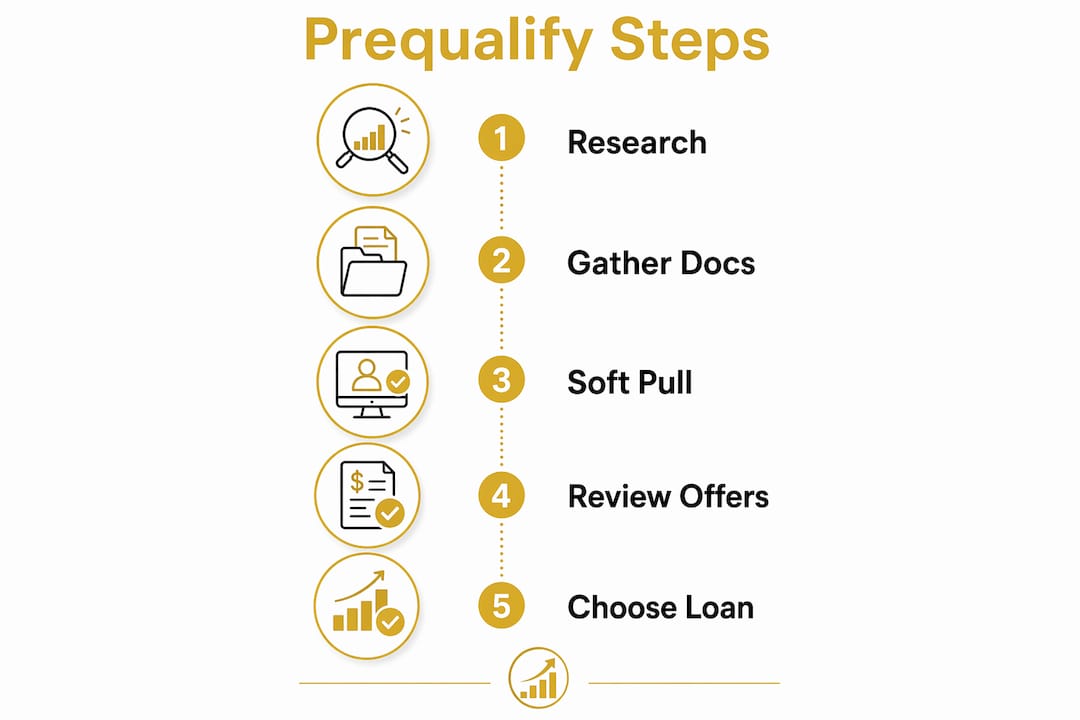
How to prequalify with a soft pull: step by step
The process is straightforward when you know what to expect at each stage.

Step 1: Research your options. Identify which product types fit your situation — revenue-based financing if you have consistent monthly deposits, invoice factoring if you carry receivables, a line of credit if you need flexibility.
Step 2: Gather your documents. Bank statements, processor reports, invoices, tax returns, and formation documents. Having these ready before you apply prevents delays at every stage.
Step 3: Use a broker or prequalification tool. A broker can run soft-pull prequalification across multiple funding providers in a single step, which is far more efficient than contacting lenders individually. This is where Cotifunding’s approach adds real value.
Step 4: Confirm the soft/hard policy. Before submitting anything, ask whether the prequalification uses a soft or hard pull and at what point a hard pull would occur. Get it in writing.
Step 5: Review and compare offers. Prequalification results give you estimated terms. Compare the total cost of capital, not just the rate, and check whether the lender reports to business credit bureaus.
Phase | Typical Timeline | What Happens |
Prequalification | Same day to 24 hours | Soft pull, preliminary offer generated |
Document review | 1–3 business days | Lender verifies bank statements, revenue, identity |
Underwriting | 1–3 business days | Hard pull often occurs here; final terms set |
Funding | 24–72 hours after approval | Funds deposited via ACH or wire |
Red flags that often trigger hard pulls or automatic escalations:
Applying to multiple lenders simultaneously without a broker coordinating the process
Submitting incomplete documents that force a second review cycle
Requesting amounts significantly above what your revenue supports
Lenders who ask for Social Security number and consent upfront without explaining the inquiry type
Pro Tip: Consumer scoring models often group multiple hard inquiries within a 14–45 day window as one. Business bureaus may not. If you expect multiple hard pulls at underwriting, try to compress them into the same two-week window and confirm the grouping rules with each bureau.
How do you choose the right soft-pull funding route?
The right product depends on four variables: how long you have been in business, your monthly revenue, how quickly you need funds, and whether building business credit matters to you right now.
Decision framework:
Under 12 months in business, revenue under $15K/month: Merchant cash advance or revenue-based financing are the most accessible options. Expect higher costs and no credit-building benefit.
12+ months, consistent receivables: Invoice factoring gives you the most credit-agnostic path and can unlock capital tied up in unpaid invoices without a hard pull at prequalification.
Established business, need revolving access: A business line of credit offers flexibility. Some online lenders prequalify with soft pulls, though a hard pull typically follows at approval.
Equipment purchase: Equipment financing uses the asset as collateral, which can reduce the weight placed on personal credit scores.
Long-term, low-cost capital: SBA loans and traditional bank term loans offer the best rates but almost always require hard pulls and more documentation. If cost matters more than speed, these are worth the credit impact.
Questions to ask every lender or broker before proceeding:
Is your prequalification a soft pull or a hard pull?
At exactly what stage does a hard pull occur?
Do you report payment history to business credit bureaus?
Is a personal guarantee required?
What is the total repayment amount, not just the rate?
Trust signals to look for: clear written disclosure of inquiry type, transparent fee schedules, and a lender who answers question four without hesitation. Red flags: vague language about “credit checks,” pressure to sign the same day, and any claim that they “never” run a hard pull without explaining why.
Why a soft pull at application doesn’t guarantee no credit impact
This is the part most articles gloss over, and it is the part that actually matters.
Financial experts emphasize that soft-pull prequalification is valuable for shopping, but signing a personal guarantee can expose an owner’s personal credit regardless of the initial inquiry type. The soft pull protects you during the shopping phase. The personal guarantee exposes you after you sign.
Practitioners note that lenders who truly never perform a hard pull typically offset underwriting uncertainty with higher rates or stricter repayment terms. Treat any “no hard pull ever” claim skeptically — it usually means the lender is pricing that risk into the cost of capital.
Two scenarios play out regularly:
Scenario A: A business owner prequalifies for a short-term loan via soft pull, receives an estimated offer, and proceeds to underwriting. The lender runs a hard pull before funding. The owner’s score dips a few points temporarily. This is normal and expected — the soft pull served its purpose during shopping.
Scenario B: A business owner takes a merchant cash advance that advertises no hard pull. The advance funds without a hard inquiry. Twelve months later, the business struggles and defaults. Because the owner signed a personal guarantee, the default is reported to consumer credit bureaus. The initial soft pull is irrelevant at that point.
The prequalification tool protects your score during rate-shopping. It does not protect you from the downstream consequences of the agreement you sign. Read the personal guarantee clause before you sign anything, and if the terms are complex, consult a business attorney or financial advisor.
This article is general information, not legal or financial advice. Verify current terms and policies with the lender or a qualified professional before making any financing decision.
Key Takeaways
Soft-pull prequalification lets you shop for business financing without score impact, but most lenders still run a hard pull before funding, and personal guarantees can expose your credit after signing.
Point | Details |
Soft pulls protect during shopping | Soft inquiries do not lower FICO or VantageScore and are often invisible to other lenders. |
Hard pull usually follows at underwriting | Most lenders convert to a hard inquiry before releasing funds, even after a soft-pull prequalification. |
Personal guarantees carry real risk | Signing a personal guarantee means a default can hit your personal credit regardless of how the application started. |
No-hard-pull products often cost more | Lenders who never run a hard pull typically price that underwriting uncertainty into higher rates or fees. |
Cotifunding as a brokerage | Cotifunding connects owners with multiple funding providers using soft-pull prequalification, so you compare options without contacting lenders individually. |
When soft-pull prequalification is actually the right call
The conventional wisdom treats soft-pull financing as a compromise — you pay more to protect your credit. That framing misses the real use case.
Soft-pull prequalification is not primarily about protecting a credit score. It is about gathering real market information before you commit. An owner who runs soft-pull prequalification across three or four products in a single afternoon now knows what the market will actually offer them, at what cost, and under what terms. That is intelligence. A hard pull at the end of that process, once you have chosen the right product, is a reasonable trade.
Where I think owners go wrong is treating soft-pull financing as a permanent solution rather than a discovery tool. If you are using a merchant cash advance every six months because it requires no hard pull, you are paying a premium for credit protection you may not actually need. At some point, accepting a hard pull to access a lower-cost line of credit or an SBA loan is the smarter financial move. The comparison between commercial and SBA loan structures is worth understanding before you default to the soft-pull option every time.
Use soft-pull prequalification for early-stage cash-flow checks, fast working capital needs, and invoice financing. Accept the hard pull when you are ready to pursue lower-cost, longer-term capital. And use a broker to manage the process either way — the value is not just in protecting your score, it is in seeing the full market without doing the legwork yourself.
Cotifunding can help you compare soft-pull options without the legwork
Cotifunding is a business financing brokerage, not a direct lender. That distinction matters. When you work with Cotifunding, the team connects you with independent funding providers and presents options side by side, so you are not spending a week calling lenders individually and hoping each one uses a soft pull.

The practical advantage is straightforward: one soft-pull prequalification process, multiple offers, full transparency on which products require a hard pull at underwriting and which do not. Cotifunding’s partners cover merchant cash advances, revenue-based financing, invoice factoring, equipment financing, lines of credit, and SBA loan options — the full range of products discussed in this article. Before you reach out, have your last six months of bank statements, your most recent tax return, and a clear sense of how much capital you need and over what timeframe. That preparation makes the comparison faster and the offers more accurate.
To start, visit Cotifunding’s prequalification page and submit a brief profile. The process uses a soft pull, and you will see what funding providers are willing to offer before any hard inquiry occurs.
Useful sources and further reading
These U.S.-specific resources help you verify inquiry policies, understand reporting rules, and go deeper on specific product types.
NMLS Consumer Access: The official registry for licensed mortgage and financial services companies in the U.S. Use it to verify whether a lender is registered and in good standing before you share financial documents.
NerdWallet: Does a Business Loan Affect Personal Credit?: Clear explanation of personal guarantee risk and how business loan defaults can reach your personal credit report.
Nav: How to Avoid Hard Credit Pulls With Business Lending Options: Practical breakdown of which product types use soft pulls and what alternative underwriting data lenders rely on.
Capital MBS: Soft Pull vs. Hard Pull: Explains the prequalification-to-underwriting transition and why soft-pull offers are non-binding estimates.
Business Funding Knight: Soft vs. Hard Pull for Business Funding: Covers how inquiry grouping works under consumer scoring models and why business bureau rules differ.
WSJ Buy Side: Best Business Loans With No Credit Check: Authoritative overview of no-credit-check and low-credit-impact business loan options available in the U.S.
Before consenting to any credit check, ask the lender for written confirmation of whether it is a soft or hard inquiry. That one step prevents the most common and avoidable surprise in the prequalification process.
Recommended
Disclosure: Coti Funding is not a direct lender. We connect businesses with independent third-party lenders and financing providers. Financing products, rates, terms, funding amounts, approval requirements, and funding timelines vary by provider and applicant qualifications and are not guaranteed. Any rates, terms, examples, or scenarios presented in this article are for general informational and educational purposes only and may not reflect actual offers available to a particular business. Submission of information or an application does not guarantee approval or funding. This content does not constitute financial, legal, tax, or investment advice.
Comments