Spot Factoring for Small Businesses: When to Use It


Spot factoring lets you sell a single outstanding invoice to a funding provider and receive most of its value as cash within one to two business days, with no long-term contract required. The industry also calls this selective factoring or single invoice factoring. It solves one specific problem well: you have a large, creditworthy invoice sitting unpaid, and you need cash now.
You’re likely a good candidate if:
A single invoice represents a significant chunk of your monthly revenue and its payment is 30–60 days out
You have an urgent payroll, supplier, or project expense that can’t wait
You want to avoid signing a long-term factoring contract that commits your entire receivables ledger
You’re a contractor, staffing firm, or manufacturer with lumpy, project-based revenue
Advance rates on spot deals typically run 70%–90% of the invoice face value. The trade-off is cost: per-invoice fees for spot transactions tend to run higher than contract factoring rates because the factor concentrates all its underwriting cost on a single deal.
Key Takeaways
Spot factoring is a high-speed, single-invoice tool that trades a cost premium for flexibility and speed, making it best suited for one-off cash gaps rather than recurring use.
Point | Details |
Advance rate range | Factors typically advance 70%–90% of invoice face value, depending on customer creditworthiness. |
Cost premium | Spot discount rates run 3%–5% per 30 days, materially higher than contract factoring’s 1%–3%. |
Speed to funding | Advances typically arrive within 24–48 hours after approval, making it one of the fastest liquidity options. |
Best use case | One-off large invoice with an urgent cash need; repeated use makes it one of the more expensive funding strategies. |
Cotifunding’s role | Cotifunding brokers access to multiple spot factoring providers, presenting offers side by side with no direct lending or guaranteed approval. |
Table of Contents
How does spot factoring work, step by step?
The transaction follows a predictable sequence, and knowing each stage helps you move faster and avoid surprises.
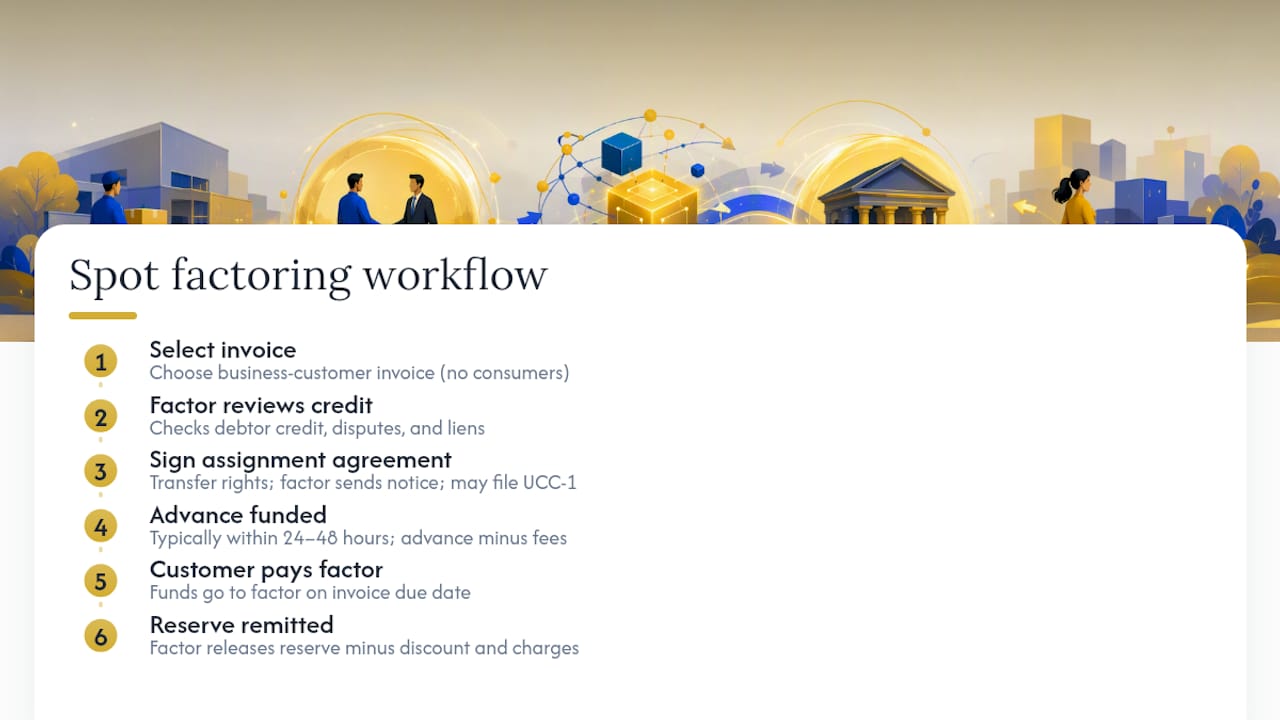
1. You select the invoice. You choose one invoice (or a small batch) you want to factor. The invoice must be for completed work or delivered goods billed to a business customer, not a consumer.
2. The factor reviews your customer’s credit. The factor’s primary concern is whether your customer can pay, not your own credit score. They’ll verify the account debtor’s creditworthiness, confirm the invoice is undisputed, and check for any existing liens on your receivables.
3. You sign an assignment agreement. You legally transfer the right to collect that invoice to the factor. Under standard U.S. practice, the factor will send a notice of assignment to your customer, directing them to pay the factor directly. The factor may also file a UCC-1 financing statement against the purchased receivable to perfect its interest.
4. The advance is funded. Once approved, advances typically arrive within 24–48 hours. You receive the advance percentage of the invoice face value, minus any upfront fees.
5. Your customer pays the factor. On the invoice due date (or whenever your customer pays), the funds go directly to the factor.
6. The reserve is remitted. The factor releases the remaining balance, called the reserve, back to you, minus its discount fee and any applicable charges.
Recourse vs. non-recourse: In a recourse arrangement, if your customer doesn’t pay, you’re on the hook to buy the invoice back. Non-recourse deals shift that credit risk to the factor, but they charge higher fees and are harder to qualify for. Most U.S. spot factoring deals are recourse.
Pro Tip: Prepare your customer’s credit information, a clean signed invoice, and any underlying purchase order or contract before you contact a factor. Factors approve faster when the file is complete on day one.
A concrete example: what the math actually looks like
Say your construction company completes a $50,000 subcontract and issues an invoice with net-60 terms. You need cash for payroll in five days.
Invoice face value: $50,000
Advance rate: 85% → $42,500 funded to you upfront
Reserve held: 15% → $7,500
Discount fee (30-day term, 3.5%): $50,000 × 3.5% = $1,750
Net reserve remitted after fees: $7,500 − $1,750 = $5,750
Total net proceeds: $42,500 + $5,750 = $48,250
Effective cost: $1,750 on $50,000 = 3.5% of invoice value
Now consider what happens if your customer pays late, at day 45 instead of day 30. Many factors charge the discount fee in 30-day increments, so a 45-day payment triggers a second partial period:
Additional fee (15-day overage, prorated at ~1.75%): $50,000 × 1.75% = $875
Revised total cost: $1,750 + $875 = $2,625
Revised net proceeds: $50,000 − $2,625 = $47,375
Late payment erodes your net proceeds fast. Before signing, ask exactly how the factor calculates fees when invoices run past term.
What does spot factoring actually cost?
Fees in spot factoring have several components, and the discount rate is only one of them. Sage’s invoice factoring overview notes that the full cost picture includes origination charges, processing fees, and potential minimums that don’t always appear in the headline rate.
Common fee elements to expect:
Discount rate: The core fee, charged as a percentage of the invoice face value per 30-day period. Spot deals commonly run 3%–5% per 30 days, compared to 1%–3% for contract factoring arrangements.
Origination or processing fee: A flat one-time charge per transaction, often $150–$500, covering underwriting and setup.
Wire or ACH transfer fee: Typically $15–$35 per funding event.
Late-payment penalty or additional discount period: Fees continue to accrue if your customer pays after the initial 30-day window, usually in 10- or 15-day increments.
Minimum invoice threshold: Many spot factors require a minimum invoice size, often $5,000–$10,000, to make the deal worth underwriting.
Advance rates and fee ranges at a glance:
Fee element | Typical range | Notes |
Advance rate | 70%–90% of invoice | Higher for strong account debtors |
Discount rate (spot) | 3%–5% per 30 days | Premium over contract rates |
Discount rate (contract) | 1%–3% per 30 days | Spread across full ledger |
Origination/processing fee | $150–$500 flat | One-time per transaction |
Wire/ACH fee | $15–$35 | Per funding event |
Minimum invoice size | $5,000–$10,000 | Varies by factor |

Fees compound if invoices age past term. Corpay’s factoring guide warns that spot factoring can run 25%–50% more expensive per invoice than a contracted rate when you model cumulative cost across multiple transactions.
Pro Tip: Ask every factor for a complete, itemized fee schedule before signing. Then convert the discount rate to an annualized effective rate: multiply the per-30-day rate by 12. That number helps you compare spot factoring against a business line of credit or other short-term options on equal footing.
Who qualifies for spot factoring in the U.S.?
Your own credit score matters far less than your customer’s. Factors are buying the right to collect from your account debtor, so their underwriting centers on that company’s payment history and financial standing.
Qualification checklist:
Your customer is a creditworthy business (not a consumer), with a verifiable payment track record
The invoice is for completed work or delivered goods, not future services
The invoice is undisputed, with no pending chargebacks, credits, or offsets
Invoice size meets the factor’s minimum threshold (commonly $5,000+)
Your business operates in an accepted industry (most factors work with construction, staffing, manufacturing, wholesale, and transportation; some avoid healthcare or government receivables without specialized programs)
No existing lender has a blanket lien on your receivables that would block assignment
Application steps and typical timeline:
Submit the invoice, customer contact details, and any underlying purchase order or contract
Factor runs a credit check on your customer (usually same day)
You sign the assignment agreement and notice of assignment
Factor verifies the invoice with your customer (called a “verification call”)
Advance funded, often within 24–48 hours of approval
If your business has an existing bank loan or line of credit, check your loan agreement first. Many commercial lenders include a negative pledge or assignment restriction on receivables. You may need written consent or a lender waiver before factoring an invoice.
What are the real advantages and disadvantages?
Advantages:
Speed. Cash in 24–48 hours after approval, with no lengthy underwriting of your business financials
No long-term commitment. Use it once and walk away; you’re not locked into factoring every invoice
Flexibility. You choose which invoice to factor and when, preserving the rest of your receivables for other financing
Credit-driven, not collateral-driven. Approval depends on your customer’s creditworthiness, which helps businesses with thin credit histories
Disadvantages:
Higher per-invoice cost. The 3%–5% per 30-day range is materially more expensive than contract factoring or a line of credit
Customer notice. Your customer learns a third party now owns the invoice and will collect payment, which some business relationships find awkward
Recourse exposure. If your customer doesn’t pay, most spot deals require you to buy the invoice back
Not a repeating strategy. eCapital’s spot factoring explainer is direct about this: spot factoring is a tactical bridge for one-off needs, and using it repeatedly makes it one of the more expensive funding strategies available to a small business
Pro Tip: Use spot factoring to cover a specific, time-bound gap, then put a recurring liquidity solution in place. A business line of credit or contract factoring arrangement will cost less per dollar drawn once your volume justifies it. SCORE’s small business guidance links cash flow gaps directly to business failure — spot factoring buys time, but a plan for recurring liquidity is what prevents the next gap.
How does spot factoring compare to other short-term options?
The core trade-off is simplicity and speed versus cost and commitment.
Feature | Spot factoring | Contract factoring | Business line of credit |
Commitment | None (per invoice) | Full ledger, ongoing | Revolving, ongoing |
Advance rate | 70%–90% | 70%–90% | Up to credit limit |
Cost per draw | 3%–5% per 30 days | 1%–3% per 30 days | Prime + spread (lower) |
Approval speed | 24–48 hours | Days to weeks (setup) | Days to weeks (setup) |
Customer notice required | Yes | Yes | No |
Credit management included | Sometimes | Often | No |
Best for | One-off invoice, urgent gap | High-volume, recurring | Flexible ongoing draws |
When each option fits better:
Spot factoring: One large invoice, urgent timeline, no desire for a contract, or you’re testing factoring before committing to a program
Contract factoring: You factor regularly, want credit management and collections support, and can justify the volume to get lower rates
Line of credit: You need flexible draws over time, your bank relationship is solid, and you want the lowest cost per dollar borrowed
For startups and early-stage businesses weighing these options, invoice factoring for startups covers the selective vs. contract decision in more detail.
When does spot factoring make the most sense?
The clearest use cases share two traits: a single large invoice and a specific, near-term cash need.
Common scenarios:
A general contractor completes a phase of a project and issues a $75,000 invoice, but the GC’s net-45 terms don’t align with subcontractor payroll due in 10 days
A staffing agency places a large temporary workforce for a seasonal client and needs to fund weekly payroll before the client’s 30-day invoice clears
A manufacturer ships a large wholesale order and needs to restock raw materials before the next production run
A business is transitioning to a new credit facility and needs a short bridge while the new line is being set up
Industries where spot factoring is common: construction, staffing, manufacturing, wholesale distribution, and transportation. These sectors share long payment cycles, project-based billing, and high working capital demands between invoice and payment.
A useful heuristic: spot factoring tends to be efficient when the invoice is large enough that the flat fees (origination, wire) represent a small percentage of the total cost, and when the gap between invoice date and payment is 30–60 days.
Construction businesses with equipment and financing needs can also explore rent-to-own and financing options as a complement to receivables-based funding when capital equipment is part of the project equation.
How do you compare spot factoring offers effectively?
Shopping offers without a consistent framework leads to choosing the lowest headline rate while missing fees that matter more. Use this checklist every time.
Total effective cost. Ask for the all-in cost on a sample invoice matching your typical size and payment term. Include origination fees, wire fees, and the discount rate.
Advance percentage. Confirm the exact advance rate for your specific customer, not a generic range.
Recourse terms. Is this recourse or non-recourse? If recourse, what is the buyback period and process?
Complete fee schedule. Request a written itemization of every fee, including what triggers additional charges.
Invoice minimums. What is the minimum invoice size they’ll factor?
Notice and verification process. How do they contact your customer? What exactly do they say?
UCC-1 filing. Will they file a UCC-1? Against which assets? This can affect other financing you’re pursuing.
Funding speed. How many hours from signed agreement to wire?
Late-payment fee structure. How are fees calculated if your customer pays at day 35, 45, or 60?
Questions to ask directly:
“Is this a recourse deal? What happens if my customer doesn’t pay within 90 days?”
“What are every upfront and recurring fee I’ll pay on a $50,000 invoice paid at day 45?”
“Do you file a UCC-1, and against what collateral?”
“Will you contact my customer, and what will the notice say?”
To convert a discount rate to an annualized cost for comparison: multiply the per-30-day rate by 12. That comparison makes the premium of spot factoring concrete. For a deeper look at how factoring rates are structured, invoice factoring rates breaks down the full pricing picture.
How Cotifunding helps you find spot factoring options
Cotifunding is a business financing brokerage. It connects small businesses to independent funding providers, including those offering spot and contract factoring, rather than lending directly. Cotifunding does not underwrite, guarantee approvals, or set lender terms.
What the process looks like:
Pre-qualification with a soft credit pull. You complete a short application; Cotifunding runs a soft inquiry that doesn’t affect your credit score and identifies which providers are likely to approve your deal.
Side-by-side offer comparison. Instead of contacting five factors individually and getting five different fee schedules in different formats, Cotifunding presents offers in a consistent format so you can compare total effective cost, advance rate, and recourse terms directly.
Document preparation guidance. Cotifunding walks you through what each provider needs: the invoice, customer contact details, purchase order or contract, and any existing loan documentation.
Typical funding speed. Pre-qualification often takes less than 24 hours; funded offers typically arrive within one to two business days after a provider approves the file.
Pro Tip: Before you submit, pull your existing loan agreements and check for any assignment restrictions on receivables. Bringing that documentation to Cotifunding upfront prevents a last-minute delay when a provider runs its lien search.
Cotifunding brokers access to funding options and does not guarantee that any specific lender will approve your application or offer particular rates. All final terms are set by the independent funding provider.
My take: when I’d actually choose spot factoring
Spot factoring earns its cost in one situation: you have a single large invoice from a creditworthy customer, a specific cash need in the next 48 hours, and no existing credit facility that can cover it faster and cheaper.
Where I’d push back on it is the habit. The right move after using spot factoring once or twice is to use that breathing room to set up a line of credit or a contract factoring arrangement at lower rates.
The other thing most guides understate: the customer notice is real friction. Some clients take it in stride. Others ask questions. Know your customer relationship before you assign that invoice.
Cotifunding connects you to spot factoring options fast
Cash flow gaps don’t wait for paperwork. Cotifunding gives small businesses a faster path to comparing spot factoring offers without the back-and-forth of contacting multiple providers independently.
The pre-qualification process uses a soft credit pull, takes minutes, and surfaces real offers from independent funding providers, typically within one business day. You see advance rates, discount fees, and recourse terms side by side before you commit to anything.
Have these ready to move quickly:
The invoice you want to factor (signed, undisputed)
Your customer’s contact information and payment history
The underlying purchase order or sales contract
Details of any existing business loans or lines of credit
Cotifunding brokers access to funding options and does not underwrite or guarantee lender decisions. For trade and contractor businesses that also need equipment or project financing, HVAC and contractor business funding is another option worth reviewing alongside receivables financing.
Start your pre-qualification at Cotifunding to see which spot factoring providers match your invoice and customer profile.
Sources
This article is general information, not a substitute for advice from a qualified financial advisor. Consult a qualified financial professional about your own circumstances before acting on anything here.
Recommended
Disclosure: Coti Funding is not a direct lender. We connect businesses with independent third-party lenders and financing providers. Financing products, rates, terms, funding amounts, approval requirements, and funding timelines vary by provider and applicant qualifications and are not guaranteed. Any rates, terms, examples, or scenarios presented in this article are for general informational and educational purposes only and may not reflect actual offers available to a particular business. Submission of information or an application does not guarantee approval or funding. This content does not constitute financial, legal, tax, or investment advice.
Comments