Working Capital for Roofing Companies in Miami

For most Miami roofing companies, the three funding paths that actually solve cash flow problems are a business line of credit, invoice factoring/AR financing, and equipment financing. A line of credit covers material purchases and payroll between jobs. Invoice factoring turns outstanding receivables into same-week cash without waiting on insurance carriers or general contractors. Equipment financing keeps trucks and lifts off your operating budget. The fastest next step: run a soft-credit-pull prequalification through a broker to compare live offers across all three without touching your credit score.
Business line of credit — best when you need flexible, repeatable access to cash for materials, labor, or deposits across multiple active jobs
Invoice factoring / AR financing — best when you’re sitting on unpaid invoices and need cash now, not in 60–90 days
Equipment financing — best when a truck, lift, or shingle machine is the bottleneck, not operating cash
Short-term working capital / revenue-based financing — best for fast bridge funding when you have strong monthly revenue but thin reserves
Pro Tip: Before you call a single lender, run a broker prequalification first. One soft pull surfaces multiple competing offers, so you negotiate from a position of knowledge rather than desperation.
Key takeaways
Miami roofing companies that set up a line of credit or factoring agreement before hurricane season consistently outperform those who apply under pressure, because they negotiate from strength rather than urgency.
Point | Details |
Best funding by use case | Factoring for receivables gaps, line of credit for recurring materials, equipment financing for trucks/tools. |
Funding amounts by size | Solo crews qualify for $30K–$100K; small companies (3–5 crews) for $30K; mid-size firms for $100K. |
Speed vs. cost trade-off | MCA funds same-day but costs most; SBA costs least but takes 30–90 days; factoring and lines sit in the middle. |
Document checklist | Contractor license, COI, 12–24 months bank statements, AR aging report, signed contracts, and tax returns. |
Cotifunding prequalification | Soft-pull prequalification through Cotifunding surfaces multiple offers in 24–72 hours with no credit commitment. |
Table of Contents
Why Miami roofing companies face unique working capital pressure
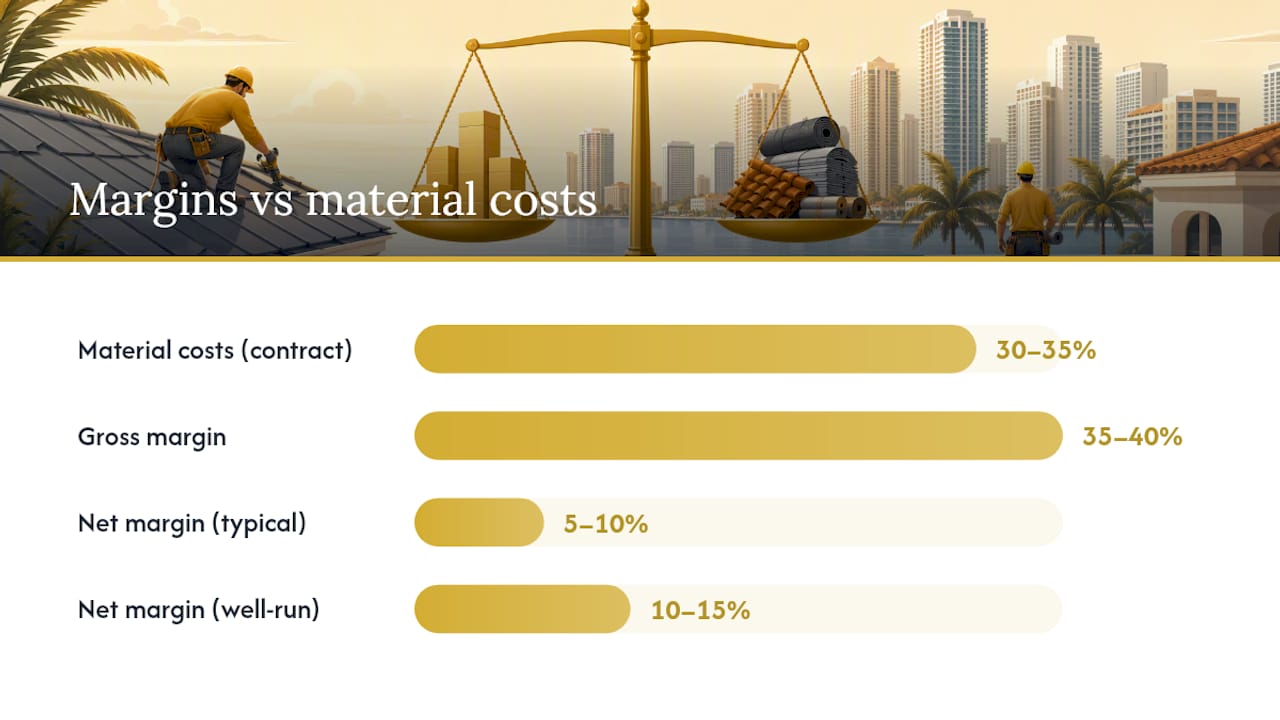
Miami’s roofing market is the largest concentration of roofing contractors in Florida, which means competition is fierce and margins are already tight. Most roofing companies net between 5% and 10%, with well-run operations reaching 10–15% net margin and gross margins around 35–40%. At those margins, a single delayed payment can stall payroll.
The cash pressure comes from several directions at once:
High upfront material costs. Shingles, underlayment, and fasteners must be purchased before a job starts, often representing 30–35% of the contract value.
Large deposit-to-final-pay gaps. A $45,000 job might require $15,000 in materials on day one, with final payment arriving 60–90 days later.
Hurricane season demand spikes. June through November floods the pipeline with storm-damage claims, but insurance carriers routinely take 45–90 days to release funds, leaving contractors holding labor costs.
Florida’s 25% rule. Under Florida building code, damage exceeding roughly 25% of a roof triggers full replacement requirements, turning a repair call into a $20,000–$40,000 project overnight. That’s good for revenue but brutal for cash flow.
Equipment and truck cycles. A single service truck breakdown mid-season can cost $8,000–$15,000 in repairs or a replacement rental, with no warning.
Delayed insurance payouts. Supplement negotiations, adjuster disputes, and multi-party approvals routinely push final payment past 90 days on storm jobs.
Small Florida roofing businesses often earn between $100,000 and $500,000 in annual profit, but that profit is back-loaded. The cash to run the business has to come from somewhere in the meantime.
How much working capital can your Miami roofing company qualify for?
Funding amounts are almost always tied to revenue, receivables, and time in business. Industry revenue benchmarks give a useful starting frame:
Company Size | Annual Revenue Range | Typical Working Capital Range |
Solo / 1–2 person crew | $300K | $30K–$100K |
Small (3–5 crews) | typical revenue range | typical working capital range |
Mid-size (6–15 crews) | typical revenue range | typical working capital range |
These ranges assume standard lender sizing: lines of credit and revenue-based products typically advance 10–20% of annual revenue; invoice factoring advances 70–90% of eligible receivables; equipment financing covers up to 100% of equipment value with the asset as collateral.
Factors that push your offer higher:
Consistent 12–24 months of bank statements showing steady deposits
Signed contracts or letters of intent for upcoming jobs
Receivables under 60 days old (aged AR above 90 days is often excluded)
Clean contractor license and current Certificate of Insurance on file
Equipment with clear titles that can serve as collateral
Owner personal credit score above 620 (some products go lower)
IBISWorld’s Florida roofing data tracks county-level revenue and wage benchmarks that lenders and brokers use to validate your numbers against local market norms.
Funding structures that work for roofing contractors
Each product solves a different problem. Matching the structure to the actual cash gap is what separates a useful loan from an expensive one.
Invoice factoring / AR financing converts unpaid invoices into cash, typically within 24–48 hours. Advance rates run 70–90% of the invoice face value, with the remainder (minus fees) released when the customer pays. No collateral beyond the receivables themselves. Best for storm-season backlogs where you’re invoice-rich but cash-poor.
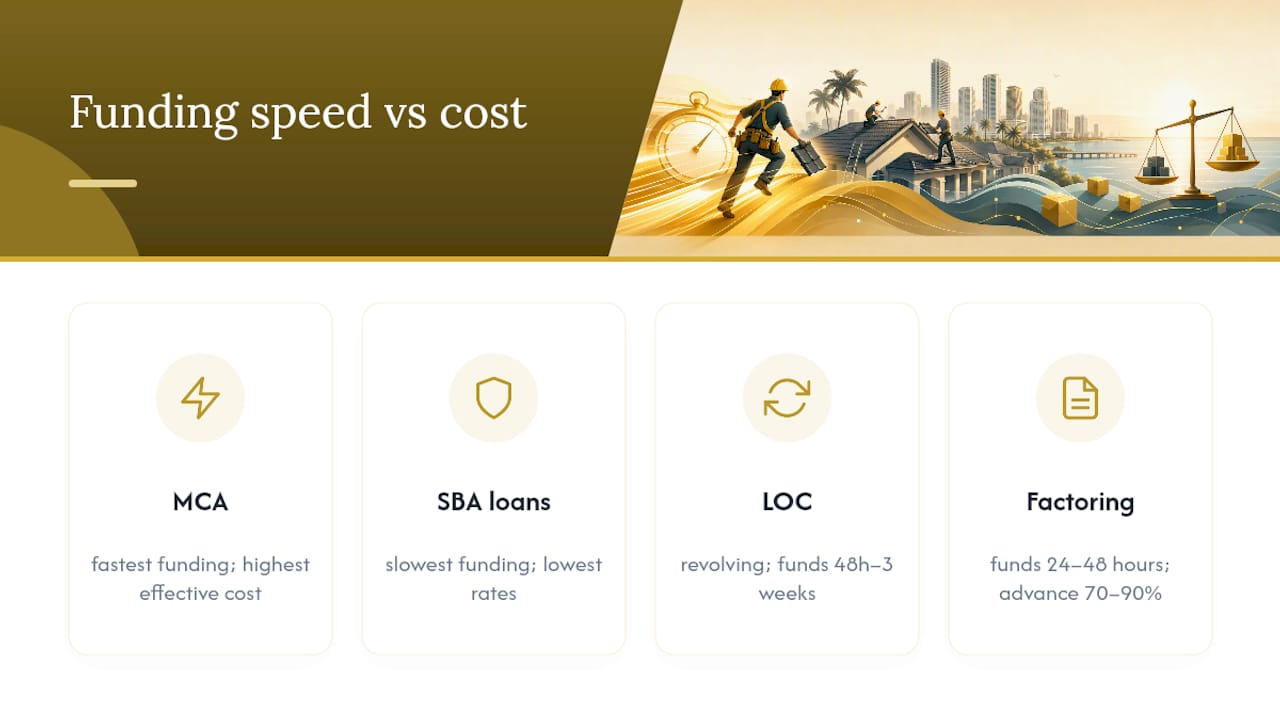
Business line of credit works like a revolving account: draw what you need, repay, draw again. Rates vary widely by lender and credit profile. Time to fund ranges from 48 hours (online lenders) to 2–3 weeks (banks). The right tool for ongoing material purchases and payroll smoothing across multiple jobs.
Equipment financing is secured by the equipment itself, which means lower rates and longer terms (24–72 months). Approvals for construction equipment often come through in 24–72 hours when documentation is clean. Preserves operating cash for labor and materials.
Merchant cash advance (MCA) / revenue-based financing is the fastest option, sometimes funded same-day, but carries the highest effective cost. Repayment is a fixed percentage of daily or weekly revenue, which can strain cash flow during slow weeks. Use it as a last resort for a genuine short-term bridge, not as a recurring funding tool.
SBA 7(a) and CDC/504 loans offer the lowest rates and longest terms, but approval takes 30–90 days and requires two years of tax returns, strong personal credit, and full financial documentation. Worth pursuing for planned capital investments, not urgent cash needs.
Purchase-order financing covers supplier costs on a confirmed job before you invoice. Useful for large commercial contracts where the material bill arrives before any payment does.
Speed vs. cost in plain terms: MCA funds fastest, costs most. SBA funds slowest, costs least. Lines of credit and invoice factoring sit in the middle on both axes and cover the majority of roofing cash flow needs.
Pro Tip: Set up a line of credit or factoring agreement before June. Applying during peak storm season, when your team is overwhelmed and your books look chaotic, is the worst time to negotiate terms.
What lenders look for and the documents you should have ready
Preparation cuts approval time in half. Here’s what to gather before you prequalify:
Active Florida contractor license (state and county)
Certificate of Insurance covering general liability and workers’ compensation
12–24 months of business bank statements
Most recent two years of business tax returns
Accounts receivable aging report (current, 30, 60, 90+ day buckets)
Three to five recent signed contracts or invoices
Proof of any deposits received on active jobs
Equipment titles if applying for equipment financing
Business formation documents (LLC operating agreement or articles of incorporation)
Owner’s government-issued ID and Social Security number for the soft credit pull
Eligibility thresholds that matter most: at least six months in business (12+ months preferred), $10,000–$15,000 in monthly revenue for most working capital products, and receivables no older than 90 days for factoring programs.
Timeline to expect: Soft prequalification takes minutes. Full document review runs 24–48 hours for fast products. Funding arrives in 24–72 hours for lines of credit, factoring, and MCA. Florida contractors have accessed approvals in 24–72 hours when documentation is complete. SBA loans run 30–90 days from application to funding.
A practical cash-flow playbook for Miami roofers
Follow this sequence before you apply for anything:
Calculate your cash runway. Add up committed expenses for the next 60 days (materials on order, payroll, insurance, equipment payments). Subtract confirmed incoming payments. The gap is your target funding amount.
Audit your receivables. Pull every open invoice. Anything under 60 days old is factorable. Anything over 90 days needs a collections call, not a loan.
Set a funding target. A $2M annual revenue firm with two large jobs in progress and $150,000 in outstanding invoices has a clear path: factor $120,000–$135,000 of those receivables immediately, covering materials and payroll while waiting on payment.
Pick the right product. Receivables gap? Factor. Recurring material purchases? Line of credit. Truck down? Equipment financing. Urgent bridge? Short-term working capital line.
Run a broker prequalification. One application, multiple offers, no hard pull on your credit.
Benchmark your cash planning against a three-year rolling revenue average, not last year’s storm-season spike. Roofing revenue swings dramatically year to year, and lenders know it. Material-cost swings can move net margin by comparable points, so locking in supplier agreements for 6–12 months reduces both cost volatility and funding needs simultaneously.
For a deeper look at your overall financial position before you apply, a financial health analysis can help you see what lenders will see when they review your books.
How to choose the right funding option
Map your situation to the right product with these questions:
How fast do you need the money? Same-day to 48 hours: MCA or factoring. One to two weeks: line of credit. One to three months: SBA.
Do you have receivables or contracts? Yes: factoring or PO financing. No: revenue-based line or MCA.
Is equipment the bottleneck? Equipment financing preserves cash and carries lower rates than unsecured products.
How often will you need capital? Recurring need: revolving line. One-time gap: term loan or factoring.
Questions to ask any lender or broker:
What is the effective APR or total cost of capital (not just the factor rate)?
Are there prepayment penalties?
Is this recourse or non-recourse factoring?
What is the advance rate and reserve holdback percentage?
Is the credit pull soft or hard at prequalification?
What fees are disclosed in writing before I sign?
Red flags to walk away from: fee schedules that aren’t in writing, holdback reserves that aren’t disclosed upfront, requests for your personal home as collateral on a working capital product, and any lender who pressures you to sign before you’ve seen the full term sheet.
When you prequalify, lead with: your monthly revenue, how many open invoices you’re carrying, your next two or three confirmed jobs, and how quickly you need funds. That framing gets you matched to the right product faster.
What the Miami roofing finance market actually looks like from the inside
Miami’s roofing market is one of the most active construction segments in the Southeast, and the financing side reflects that complexity. Contractors here aren’t just managing cash flow; they’re managing insurance carrier timelines, permit backlogs, and material costs that shift with every major storm forecast.
What I see consistently is that the owners who navigate this best aren’t necessarily the ones with the best credit. They’re the ones who set up their credit infrastructure before they need it. A pre-established factoring agreement or revolving line sitting at zero balance costs almost nothing to maintain and is worth its weight in gold the week after a Category 2 makes landfall.
Cotifunding works with roofing contractors across Florida, connecting them with funding providers that specialize in construction and trades. The soft-pull prequalification process means you can see real offers without committing, which is exactly the kind of leverage you need when you’re comparing a factoring advance against a line of credit on a tight timeline.
Cotifunding helps Miami roofers compare funding options fast
Miami roofing contractors need capital that moves as fast as the work does. Cotifunding connects you with funding providers across working capital lines, invoice factoring, equipment financing, and SBA loan placement, so you’re comparing real offers rather than guessing which lender to call first.
The prequalification process uses a soft credit pull, takes minutes to complete, and surfaces matched funding options typically within 24–72 hours. No long applications, no commitment to a single lender, and no hard inquiry until you choose an offer. Whether you’re bridging a $50,000 material purchase or funding a $300,000 storm-season push, the brokerage model means you see the full range of what’s available for your revenue profile and credit situation.
Start your prequalification here and get matched to the right funding structure for your Miami roofing business today.
Sources
This article is general information, not a substitute for advice from a qualified financial advisor. Consult a qualified financial professional about your own circumstances before acting on anything here.
Recommended
Disclosure: Coti Funding is not a direct lender. We connect businesses with independent third-party lenders and financing providers. Financing products, rates, terms, funding amounts, approval requirements, and funding timelines vary by provider and applicant qualifications and are not guaranteed. Any rates, terms, examples, or scenarios presented in this article are for general informational and educational purposes only and may not reflect actual offers available to a particular business. Submission of information or an application does not guarantee approval or funding. This content does not constitute financial, legal, tax, or investment advice.
Comments