Working Capital Loan Requirements: What Small Businesses Need


Most U.S. lenders approve working capital financing when a business meets four baseline thresholds: at least six months of operating history, roughly $100,000 in annual revenue, a personal credit score near 680 or above, and a clean set of financial documents. Meet all four and you have a realistic shot at most online lenders. Fall short on one or two and you still have options, but the product type and cost structure will shift.
Here is the quick self-assessment checklist:
Time in business: at least six months minimum for most online and alternative lenders; a full year or more for SBA programs and traditional banks
Annual revenue: ~$100,000 is the common floor most lenders cite; some alternative lenders accept less with stronger cash flow
Personal credit score: roughly 680 or higher for standard products; SBA-backed options can be more flexible for lower scores
Collateral: Many products are unsecured below $50,000; larger loans often trigger a blanket lien on business assets
Documentation: Business bank statements (3–12 months), business and personal tax returns, a Profit & Loss statement, and proof of ownership
Two notable exceptions worth flagging early. The SBA 7(a) Working Capital Pilot program has specific operational-history and reporting requirements that go beyond the standard checklist. PayPal Working Capital operates on entirely different rules, requiring an active PayPal merchant account and a minimum processing volume rather than traditional credit criteria.
If you want to compare multiple products without running a hard credit pull on your own, Cotifunding connects small businesses with funding providers across product types. It is a brokerage, not a direct lender, so it does not underwrite or guarantee approvals.
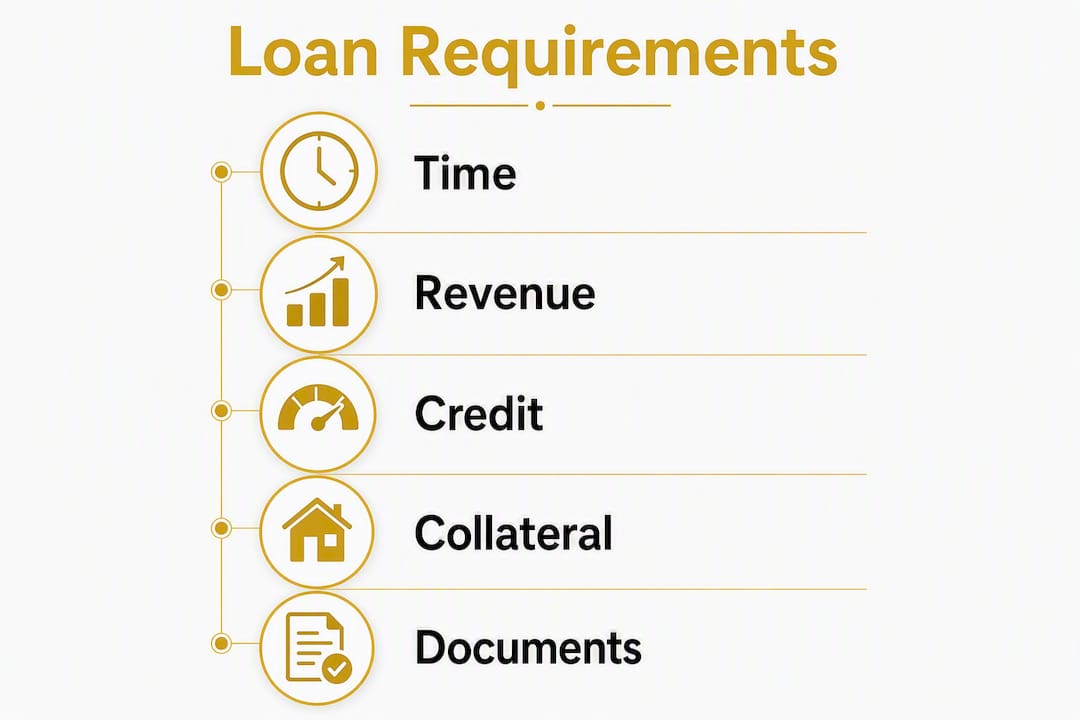
Table of Contents
Which products count as working capital financing?
Working capital financing is a broad category. The term covers any short-to-medium-term product designed to fund day-to-day operations rather than long-term assets. Payroll gaps, inventory purchases before a busy season, a slow accounts-receivable cycle — these are the use cases that define it.
The five main product types are:
Business line of credit: A revolving facility you draw from and repay repeatedly; interest accrues only on the outstanding balance. Suited for ongoing, unpredictable cash needs.
Short-term term loan: A lump sum repaid on a fixed schedule, often daily or weekly, over 3–24 months. Faster to obtain than a bank term loan but typically more expensive.
Merchant cash advance (MCA): A purchase of future receivables, repaid as a percentage of daily card sales. Not technically a loan, which is why it carries a factor rate rather than an APR. Learn more about MCA mechanics and timelines.
Invoice factoring: You sell outstanding invoices to a factoring company at a discount and receive cash immediately. Approval depends more on your customers’ creditworthiness than your own. Details on how factoring works are worth reviewing if you carry significant receivables.
SBA working capital options: The SBA 7(a) loan program includes working capital as an eligible use, and the 7(a) Working Capital Pilot adds an asset-based revolving structure for qualifying businesses.
PayPal Working Capital sits outside these categories. It uses your PayPal processing history to set a borrowing limit and repays automatically from each transaction. No credit check, no tax returns, but you must have an established PayPal merchant account with sufficient volume.
Product | Typical term | Repayment frequency | Collateral tendency |
Line of credit | Revolving | Monthly or as drawn | Often unsecured below $50K |
Short-term term loan | 3–24 months | Daily or weekly | Blanket lien on larger amounts |
Merchant cash advance | 3–24 months | Daily (% of sales) | None; based on receivables |
Invoice factoring | Per invoice cycle | Upon customer payment | Receivables as collateral |
SBA 7(a) working capital | 12 months or more | Monthly | Varies; often required |
A working capital loan can be structured as a lump sum or a revolving line of credit, and the cost and repayment patterns differ materially between those two structures. That distinction matters most when you are matching repayment timing to your actual revenue cycle.
Common lender minimums: time in business, revenue, credit, and collateral
These are the thresholds lenders actually enforce, not the marketing minimums on a landing page.

Time in business
Many lenders require at least six months of operating history, and that is genuinely the floor for most online and alternative lenders. Traditional banks typically want one to two years. SBA programs, including the 7(a) Working Capital Pilot, require a full 12 months of operations. The nuance: six months of documented history is different from six months of incorporated history. Lenders want to see six months of bank statements showing real revenue activity.
Revenue
The $100,000 annual revenue threshold is the most commonly cited floor across lenders. In practice, underwriters look at monthly deposits rather than an annual figure on a tax return, because tax returns lag by months. A business showing $8,500 in average monthly deposits is roughly at that threshold. Banks often prefer one to two years of revenue history, while alternative lenders will accept six months or more with consistent deposit patterns.
Credit score
Most lenders look for a personal credit score around 680 or higher. That is not a hard cutoff everywhere, but below 620 you are largely limited to MCAs, invoice factoring, and revenue-based products where the underwriting relies less on credit history. SBA-backed options tend to be more flexible on credit, though they compensate with stricter documentation and time-in-business requirements.
Business credit (Dun & Bradstreet Paydex, Experian Business) matters too, but most small businesses have thin business credit files. Lenders know this and weight personal credit more heavily for businesses under five years old.
Collateral and liens
Loans under $50,000: often marketed as unsecured, though lenders may still file a UCC-1 blanket lien
Loans above certain thresholds commonly trigger a blanket lien on most business assets, putting equipment, inventory, and receivables at risk
SBA loans above $25,000 typically require collateral when it is available
Invoice factoring and asset-based lines use the specific asset (receivables, inventory) as collateral rather than a blanket lien
Ownership and legal status
Most lenders require at least 20% ownership to sign as a guarantor. All owners above that threshold are usually required to provide a personal guarantee. Non-citizen owners face additional SBA eligibility considerations worth reviewing separately.
Statistic callout: Many lenders require a minimum annual revenue of about $100,000 and at least six months in operation, while SBA programs often expect a longer operational history before approving working capital facilities.
Pro Tip: If your business is under 12 months old, start with invoice factoring or a small revenue-based advance rather than applying for a term loan and collecting a denial. A denial at this stage can affect your credit and closes doors with that lender for months.
How eligibility rules change by product type
The product you apply for determines which requirements matter most. Here is how the underwriting logic shifts across categories.
Line of credit vs. short-term term loan

Both require similar time-in-business and revenue minimums, but lines of credit tend to require stronger credit scores because the facility stays open and the lender is making a longer-term commitment. Short-term term loans are often easier to qualify for because the repayment window is fixed and the lender’s risk exposure is more predictable.
Merchant cash advance
MCAs have the lowest formal barriers. No minimum credit score requirement at many providers, and some will fund businesses as young as three months. The trade-off is cost: factor rates on MCAs typically run higher than APRs on term loans, and daily repayments can strain cash flow if revenue dips. An e-commerce business with consistent daily card volume is a natural fit. A service firm billing net-30 invoices is not.
Invoice factoring
Factoring flips the eligibility model entirely. Your credit score is almost irrelevant. What matters is the creditworthiness of your customers and the quality of your receivables. A two-year-old staffing firm with Fortune 500 clients can factor invoices even if the owner’s personal credit is below 600. The documentation requirement shifts too: you need aging reports, customer contact information, and sometimes notice-of-assignment agreements.
SBA working capital programs
The SBA 7(a) Working Capital Pilot requires at least 12 months of operations and specific financial reporting when used as an asset-based facility. The upside is rate: SBA-backed rates are typically lower than any alternative lender product. The downside is time: approval takes weeks to months, not days.
Asset-based lending (ABL)
Asset-based loans are particularly effective for seasonal or inventory-heavy businesses because borrowing capacity tracks collateral value. A seasonal retailer stocking up for Q4 can draw more as inventory builds, then repay as sales convert. This structure suits businesses with strong assets but lumpy revenue.
Three quick scenarios:
Seasonal retailer: Inventory is the asset. An ABL or asset-based line of credit fits better than a fixed-term loan because the borrowing base expands when inventory is high.
E-commerce business: Daily card volume makes an MCA or revenue-based advance a natural fit. Factoring works if the business sells wholesale to retailers on net terms.
Service firm with B2B clients: Invoice factoring is often the fastest path, especially if the business is under two years old and personal credit is below 680.
Documents you need to apply for working capital
Gather these before you start any application. A complete package moves through underwriting faster and signals that the business is organized.
Standard documents for most products:
Business bank statements: last 3 months minimum; 6–12 months preferred by banks and SBA lenders
Business tax returns: last 1–2 years (Form 1120, 1120-S, or Schedule C depending on entity type)
Personal tax returns: last 1–2 years for all owners above 20%
Profit & Loss statement: year-to-date, prepared or CPA-reviewed
Balance sheet: current
Business license or registration documents
Employer Identification Number (EIN) confirmation
Ownership documentation (operating agreement, articles of incorporation, or similar)
Government-issued ID for all guarantors
Product-specific additions:
MCA and merchant lenders: 3–6 months of card processing statements (Stripe, Square, or processor reports)
Invoice factoring: Accounts receivable aging report, customer list with contact details, sample invoices
Asset-based loans: Inventory reports, equipment appraisals, or detailed receivables schedules
SBA programs: Business plan, personal financial statement (SBA Form 413), and sometimes a debt schedule
Pro Tip: Export your bank statements as PDFs directly from your bank’s portal rather than printing and scanning. Lenders’ underwriting software reads digital PDFs faster, and scanned images sometimes fail automated parsing, which delays decisions by days.
A clean, consistent set of statements also means no unexplained large deposits or withdrawals. If there are unusual transactions, prepare a one-paragraph explanation in advance. Underwriters will ask, and having the answer ready prevents back-and-forth that stalls the file.
How lenders actually evaluate your application
Knowing the minimums is one thing. Understanding what an underwriter does with your documents is another.
Bank-statement lending
Most alternative lenders do not run a formal debt service coverage ratio (DSCR) calculation. Instead, they look at average monthly deposits over the last 3–6 months, subtract any loan payments already showing in the statements, and estimate what a new payment would represent as a percentage of that average. If the new payment would consume more than 15–20% of average monthly deposits, many lenders will reduce the offer or decline.
Formal DSCR
Banks and SBA lenders use a more structured approach. DSCR = Net Operating Income / Total Debt Service. A ratio above 1.25 is the common benchmark for SBA-backed loans, meaning the business generates $1.25 for every $1.00 of debt obligation. A business with $10,000 in monthly net operating income and $7,000 in existing debt service has a DSCR of 1.43, which is comfortably above that threshold.
Current ratio
Lenders commonly look at the current ratio (current assets / current liabilities) as a short-term health metric. A ratio above 1.0 is the standard informal benchmark for favorable terms. A business with $80,000 in current assets and $60,000 in current liabilities has a current ratio of 1.33, which signals it can cover short-term obligations. Below 1.0 raises a flag, especially for revolving facilities.
What kills approvals
Inconsistent deposits are the most common problem. A business averaging $15,000 per month but showing two months at $4,000 will get questioned. High chargeback rates or frequent NSF fees signal cash-flow stress. Lenders also flag businesses where the bank balance drops near zero at the end of each month, even if average deposits look healthy.
Statistic callout: Lending decisions for many alternative working capital products often come quickly, with some lenders offering same-day decisions. That speed, however, typically correlates with higher total borrowing costs and repayment terms under 24 months.
Accurate, recent bank statements and clear revenue documentation often move an approval from “maybe” to “yes”. Lenders weigh repayment ability within the term far more heavily than growth projections.
Practical steps to improve your chances before you apply
If you do not meet the minimums today, here is a realistic, time-bound plan.
Organize your bank statements (0–30 days). Consolidate business revenue into a single primary business account if it is currently spread across two or three accounts. Lenders want to see one clean deposit history. Multiple accounts make revenue look smaller than it is.
Pull your credit reports and dispute errors (30–60 days). Check your personal credit through AnnualCreditReport.com. Errors on credit reports are more common than most people expect. Disputing and correcting an error can move a score by 20–40 points within 30–45 days.
Reduce unnecessary withdrawals (30–60 days). Underwriters notice when a business account shows frequent small cash withdrawals or personal-looking transactions. Move personal expenses to a personal account and keep the business account clean.
Build business credit (60–180 days). Open a business credit card, pay it in full monthly, and register with Dun & Bradstreet to establish a Paydex score. A thin business credit file is not disqualifying, but a positive one helps.
Document recurring revenue (60–90 days). If you have subscription clients, retainer agreements, or recurring contracts, create a one-page revenue summary showing predictable monthly income. This is not a standard document lenders request, but it can tip a borderline decision.
Consider an alternative product first (immediate). If you need capital now and do not yet meet term-loan minimums, invoice factoring or a small revenue-based advance can provide cash while you build the history needed for better products. Startup funding options are worth reviewing if your business is under 12 months old.
Time your SBA application strategically (90–180 days). SBA approval takes longer, but the rate savings over a 3–5 year period can be substantial. If you are six months away from meeting SBA minimums, it may be worth waiting rather than taking an expensive short-term product now. Tactics for qualifying faster can shorten that window.
Pro Tip: Apply to one product at a time and wait for a decision before applying elsewhere. Multiple hard credit inquiries in a short window lower your score and make lenders nervous. Use a brokerage that runs a single soft pull to compare multiple options simultaneously.
Decision timelines and cost trade-offs
Speed and cost move in opposite directions in working capital financing. The faster the money arrives, the more it typically costs.
Decision and funding timelines by lender type:
Lender type | Decision timeline | Funding timeline |
Online alternative lenders / MCA | 1–2 business days | Same day to 2 days |
Marketplace / broker-matched | 1–3 business days | 1–5 business days |
Community banks / credit unions | 1–2 weeks | 1–3 weeks |
SBA 7(a) standard | 2–8 weeks | 1–2 weeks after approval |
APR vs. factor rate
APR (annual percentage rate) accounts for the total cost of borrowing over a year, including fees. Factor rate is a multiplier applied to the original advance amount, common in MCAs. A factor rate of 1.30 on a $50,000 advance means you repay $65,000 total, regardless of how quickly you pay it off. If you repay in four months, the effective APR is far higher than if you repay in twelve. Understanding these loan terms before signing is worth the time.
Faster funding generally correlates with higher total costs and more frequent repayment schedules. Daily repayments on an MCA can feel manageable when sales are strong and suffocating when they dip.
Illustrative cost comparison:
Product | Amount | Cost structure | Estimated total repayment |
Short-term term loan | $50,000 | ~30–50% APR | ~$100,000 over 12 months |
MCA | $50,000 | 1.25 factor rate | $50,000 |
SBA 7(a) line of credit | $50,000 | Prime + 3–5% | Significantly lower over 3–5 years |
Statistic callout: Repayment terms for working capital products are often under 24 months, which means the effective annual cost of a short-term product is almost always higher than the headline rate suggests. Always calculate total repayment, not just the stated rate.
Step-by-step application workflow
The application process, from start to funded:
Run a soft credit pull / pre-qualify. Most online lenders and brokerages offer pre-qualification with no impact on your credit score. This tells you which products and amounts you are likely to qualify for before you commit to a full application.
Prepare your document package. Use the checklist from the documentation section above. Have everything in a single folder, digital or physical, before you start.
Submit the application. Fill out the lender’s intake form accurately. Inconsistencies between what you state and what your bank statements show are the most common cause of delays.
Review the term sheet carefully. Before signing, confirm: total repayment amount, factor rate or APR, repayment frequency, prepayment penalties, and whether a UCC-1 lien will be filed.
Accept and set up repayments. For daily-repayment products, confirm the bank account the lender will debit and verify the daily amount against your average daily balance.
Questions to ask before you sign:
What is the total repayment amount, not just the advance amount?
Is there a prepayment discount, and how is it calculated?
Will a blanket lien be filed, and on which assets?
What happens if I miss a payment or my revenue drops?
Are there any origination fees, maintenance fees, or draw fees?
Red flags to watch for:
No written amortization schedule provided before signing
Daily ACH withdrawals with no clear end date
Blanket liens on all assets for small loan amounts with no explanation
Pressure to sign same-day without time to review terms
Fees buried in addenda rather than the main agreement
When using a broker makes sense vs. going straight to a lender
Going directly to a single lender makes sense when you already know exactly which product you want, you have a strong existing relationship with that lender, and your profile is clean enough that you are confident you will qualify. That describes a minority of small business owners.
For everyone else, a brokerage approach has three concrete advantages. First, a single soft credit pull gets your profile in front of multiple funding providers simultaneously, preserving your credit score while you compare offers. Second, a broker who works across product types can match your profile to the right product category, not just the one product a direct lender sells. Third, it saves time. Contacting five lenders individually, filling out five separate applications, and waiting for five separate decisions takes days. A broker compresses that into a single intake.
The realistic case where a broker adds the most value: a business owner with 14 months of history, $140,000 in annual revenue, and a 650 personal credit score. That profile is too thin for most bank term loans, borderline for some online lenders, and a strong fit for certain revenue-based products. A broker who sees that profile immediately knows which product categories are realistic and which are a waste of time.
Pro Tip: Use a broker when your profile is complex, when you are shopping across product types, or when you have limited time to manage multiple applications. Use a direct lender when you have a pre-existing relationship and already know you qualify.
Cotifunding is a financing brokerage, not a direct lender. It does not underwrite loans or guarantee approvals, rates, or funding timelines. Those are determined by the independent funding providers in its network. What it does is match your profile to the right options and manage the comparison process so you are not doing it alone.
Key Takeaways
Meeting working capital loan requirements comes down to four factors: operating history, revenue consistency, personal credit, and clean documentation — and the product type you target determines which of those four carries the most weight.
Point | Details |
Baseline thresholds | Most lenders require at least six months in business, roughly $100,000 in annual revenue, and a personal credit score near 680. |
Product type changes the rules | MCAs and factoring have lower credit barriers; SBA programs require 12 months of history and formal financial reporting. |
Documentation drives speed | Bank statements, tax returns, P&L, and ownership docs prepared in advance prevent the delays that stall most applications. |
Cost and speed trade off | Alternative lenders fund in 1–2 days but carry higher total costs; SBA rates are lower but approval takes weeks to months. |
Cotifunding as a starting point | Cotifunding connects small businesses with multiple funding providers via a single soft credit pull, making it easier to compare options without damaging your credit score. |
What most business owners get wrong about working capital eligibility
The conventional wisdom says “fix your credit score first.” That is not wrong, but it misses the more immediate lever most business owners have available: their bank statements.
An underwriter reviewing a working capital application spends more time on the last three months of bank statements than on any other document. A 710 credit score with two months of near-zero balances and frequent NSF fees will lose to a 640 score with consistent $12,000 monthly deposits and no overdrafts. The statements tell the story of how the business actually operates. The credit score tells the story of how the owner handles personal debt. Both matter, but for short-term working capital, the operational story usually wins.
The second thing most owners get wrong is applying for the wrong product. A service business with 60-day receivables applying for a daily-repayment MCA is setting itself up for cash-flow stress even if it gets approved. The repayment comes out every day; the revenue comes in every 60 days. That mismatch is predictable and avoidable. Invoice factoring or a net-terms financing product would solve the same problem without creating a new one.
Florida-based businesses, in particular, often have seasonal revenue patterns that make standard underwriting look worse than the underlying business actually is. A hospitality or tourism business showing two slow months in a 12-month bank statement history is not a bad credit risk. It is a seasonal business. Lenders who specialize in working capital for seasonal industries understand this. Lenders who do not will decline based on the slow months.
The practical takeaway: before you apply anywhere, look at your own bank statements the way an underwriter would. Identify the two or three things that would make you nervous if you were the lender, and address those first.
Cotifunding helps you find working capital without the guesswork of going it alone
Applying to five lenders separately, managing five document requests, and waiting on five decisions is not a strategy. It is a time drain, and every hard credit pull along the way chips away at the score you are trying to protect.

Cotifunding works differently. As a business financing brokerage, it runs a single soft credit pull, reviews your profile across multiple product categories, and matches you with funding providers suited to your actual situation, whether that is a business line of credit, an SBA loan, invoice factoring, or a short-term advance. The intake process is online and takes minutes, not days. Funding can arrive in as little as 24 hours depending on the product and provider.
This is not a guarantee of approval or a specific rate. Cotifunding is a broker; approvals, rates, and funding timelines are set by the independent funding providers in its network. What Cotifunding provides is the comparison layer that most business owners skip because they do not have time to build it themselves.
If you are ready to see which working capital options fit your business, get pre-qualified through Cotifunding with no impact to your credit score. For HVAC contractors and trades businesses specifically, Cotifunding’s contractor financing page outlines the product options most relevant to your revenue cycle.
Cotifunding is a business financing brokerage. It does not directly lend, underwrite, or guarantee approvals, rates, or funding timelines. All financing is provided by independent funding partners.
Useful sources
The claims and thresholds in this article draw from the following authoritative sources:
7(a) loans — Small Business Administration: SBA’s primary business loan program overview, including working capital as an eligible use
7(a) Working Capital Pilot program — U.S. Small Business Administration: Specific operational and reporting requirements for the SBA WCP
Business loan requirements — Bankrate: Industry baseline thresholds for revenue, time in business, credit score, and decision timelines
What Is a Working Capital Loan and How Does It Work? — CNBC Select: Blanket lien thresholds and collateral expectations
Current ratio — Xero small business guide: Current ratio as a lender benchmark for short-term financial health
Note: Lender-specific pages and program pages reflect the policies of those institutions. Always verify current requirements directly with the lender or a qualified financial advisor before applying. This article is general information, not financial or legal advice.
Recommended
Disclosure: Coti Funding is not a direct lender. We connect businesses with independent third-party lenders and financing providers. Financing products, rates, terms, funding amounts, approval requirements, and funding timelines vary by provider and applicant qualifications and are not guaranteed. Any rates, terms, examples, or scenarios presented in this article are for general informational and educational purposes only and may not reflect actual offers available to a particular business. Submission of information or an application does not guarantee approval or funding. This content does not constitute financial, legal, tax, or investment advice.
Comments